

by Voxintech-admin@2022 Voxintech-admin@2022 No Comments

Compact 38 mm Encoder with 360 PPR: VXT-E38S06-0360-NPN

Key takeaways

  • 360 PPR means one pulse per degree, which makes angle and length maths simple.
  • VXT-E38S06-0360-NPN is a compact 38 mm encoder with a 6 mm shaft and A/B outputs.
  • A 360 mm circumference measuring wheel gives exactly 1 mm per pulse.
  • For a Z index pulse or higher PPR, move to the 40 mm VXT-E40S06 series.
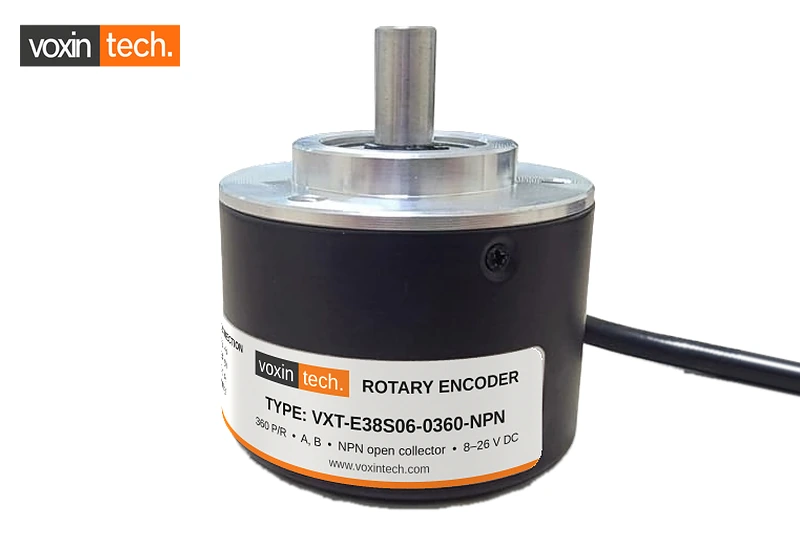
VXT-E38S06-0360-NPN Voxintech incremental rotary encoder
VXT-E38S06-0360-NPN Voxintech Rotary Encoder

Not every machine needs a large, high-resolution encoder. Many counting, length and angle jobs need something compact, easy to wire and simple to scale. The VXT-E38S06-0360-NPN is built for exactly that: a 38 mm housing, a 6 mm shaft and 360 pulses per revolution, which means one pulse for every degree of rotation.

Key specifications

Specification Value
Housing ø38 mm
Shaft ø6 mm g6 solid shaft with flat
Resolution 360 PPR (1 pulse per degree)
Output NPN open collector
Channels A and B (90° quadrature)
Supply 8–26 V DC
Response frequency up to 300 kHz
Mechanical speed 6000 rpm
Mounting ø20 mm spigot, 3 × M3 on ø30 mm pitch circle
Cable 2 m shielded, radial exit
Protection IP54, −20 to +85 °C

Why 360 PPR is so practical

With 360 PPR, the maths is simple:

  • Angle: each pulse is exactly 1°. A cam position of 90° is 90 pulses.
  • Length with a measuring wheel: with a 360 mm circumference wheel, each pulse is 1 mm. With a 180 mm wheel, each pulse is 0.5 mm.
  • Speed: at 1 revolution per second, the encoder gives 360 Hz. At the 6000 rpm mechanical limit it gives 36 kHz, well inside the input range of most PLC high-speed counters.

Because the numbers are round, commissioning is faster and there is less risk of scaling errors in the PLC program.

Where a compact 38 mm encoder fits

  • Length counting: cloth, paper, foil, wire, hose and cable measured with a wheel.
  • Printing and paper converting: sheet counting and simple registration.
  • Textile machines: fabric inspection and rolling machines.
  • Rotary tables and cams: angle indexing in degrees.
  • Retrofit jobs where space behind the shaft is tight.
  • Speed monitoring on small motors and rollers.

NPN output with A and B channels

The VXT-E38S06-0360-NPN provides two quadrature channels, A and B, with NPN open collector outputs. Connect them to PLC high-speed counter inputs configured for NPN sensors. With A and B, the controller detects direction as well as distance, which is important for reversing material or manual hand-wheel style inputs.

Wiring:

Wire colour Signal
Red +V (8–26 V DC)
Black 0 V
Green A
White B
Shield Frame ground

If your receiver needs a voltage signal rather than a sinking input, add a pull-up resistor from each output to +V.

Compared with 40 mm encoders

The 38 mm VXT-E38S06 shares the same 6 mm shaft and ø30 mm mounting pitch circle as our 40 mm VXT-E40S06 series, with a slightly smaller body. If your design uses 40 mm encoders such as the Omron E6B2-C or Autonics E40S6 in 360 PPR, the VXT-E38S06-0360-NPN is worth considering where space is limited. Always confirm the spigot diameter and hole positions against your bracket.

If you need a Z (index) pulse or a different PPR, look at the 40 mm VXT-E40S06 series, which offers 500 and 1024 PPR with A, B and Z channels.

When 360 PPR is enough, and when to go higher

360 PPR is the right choice when simple maths and reliable counting matter more than very fine resolution. It suits:

  • Length counting to 1 mm or 0.5 mm with a suitably sized measuring wheel.
  • Angle positioning to 1°, or 0.25° per count when the PLC uses 4x quadrature decoding on A and B.
  • Older or basic counters with low maximum input frequency. At 1500 rpm the encoder outputs only 9 kHz.
  • Long cable runs with NPN outputs, where a lower pulse rate gives cleaner signals.

Move up to a higher resolution when you need finer registration or slow-speed position control. The VXT-E40S06-1024-NPN (1024 PPR) or the VXT-E50S08-2500-T (2500 PPR) are the usual next steps, and both add a Z index pulse for homing.

A typical length-counting setup

A common setup on cloth inspection, cable coiling and paper rewinding machines looks like this:

  • A measuring wheel with a rubber or knurled surface rides on the material.
  • The wheel is fitted directly to the encoder shaft, or through a flexible coupling, on a spring-loaded swing arm.
  • The VXT-E38S06-0360-NPN outputs A and B pulses to a PLC high-speed counter or a preset counter.
  • The PLC multiplies the count by the length per pulse and stops the machine or triggers a cutter at the set length.

Because the encoder housing is only 38 mm in diameter, the swing arm stays light and compact, which helps the wheel follow the material without bouncing.

Installation tips

  • Use a flexible coupling; keep shaft loads within 30 N radial and 20 N axial.
  • For measuring wheels, use a spring-loaded arm to keep steady contact pressure.
  • Earth the shield at the controller end and keep the cable away from inverter outputs.

Frequently Asked Questions

What does 360 PPR mean?

360 pulses per revolution. Each pulse represents 1° of shaft rotation, which makes angle and length calculations simple.

Does the VXT-E38S06-0360-NPN have a Z index pulse?

No. It provides A and B quadrature channels. For a Z index pulse, choose a model from the VXT-E40S06 series.

Can I use it with a 24 V PLC?

Yes. It accepts 8 to 26 V DC and connects to high-speed counter inputs configured for NPN sensors.

How do I calculate length with a 360 PPR encoder?

Length per pulse = wheel circumference ÷ 360. For example, a 360 mm circumference wheel gives 1 mm per pulse.

Order the VXT-E38S06-0360-NPN

Contact us for the datasheet, pricing and availability. We supply VXT encoders across India with a 1-year warranty and help with wiring and PLC scaling.

Omron and Autonics are trademarks of their respective owners. They are mentioned for comparison only; VXT is not affiliated with these companies.
by Voxintech-admin@2022 Voxintech-admin@2022 No Comments

58 mm Line Driver Encoders for Servo, CNC and Motion Control

Key takeaways

  • Line driver (RS-422) encoders send each signal with its inverted copy for high noise immunity.
  • VXT-E58S06-1024-L and VXT-E58S10-5000-L suit servo drives, motion controllers and CNC.
  • VXT-E58S10-5000-L gives 20,000 counts per revolution with 4x decoding, up to 3600 rpm.
  • Line driver encoders need a differential input and a 5 V supply, not a standard 24 V PLC input.
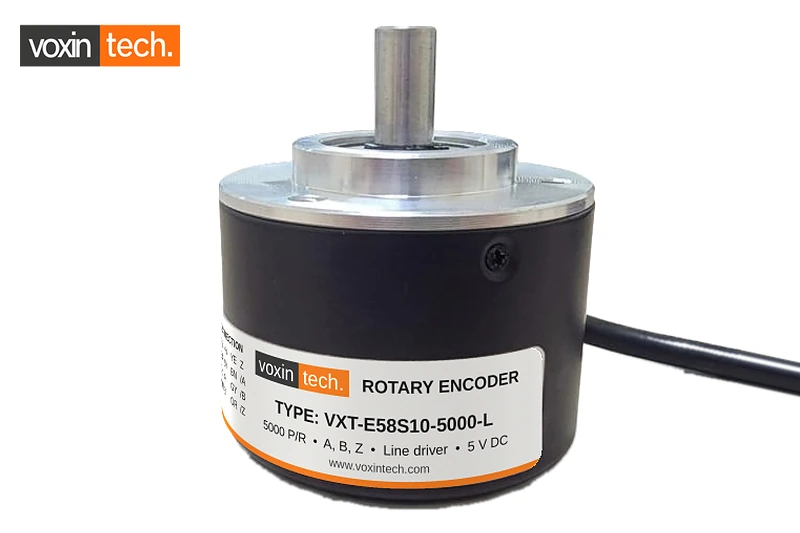
VXT-E58S10-5000-L Voxintech incremental rotary encoder
VXT-E58S10-5000-L Voxintech Rotary Encoder

Motion control is where encoder signal quality matters most. Servo drives, motion controllers and CNC systems count every edge, often at high frequency and over cable runs that pass right beside power wiring. A line driver encoder with RS-422 differential outputs is the standard answer, and the 58 mm housing is the standard size for industrial motion feedback. The VXT-E58 series brings both together.

The VXT-E58 line driver range

Model Housing Shaft Resolution Output Supply
VXT-E58S06-1024-L ø58 mm ø6 mm 1024 PPR Line driver (RS-422) 5 V DC ±5 %
VXT-E58S10-5000-L ø58 mm ø10 mm 5000 PPR Line driver (RS-422) 5 V DC ±5 %

Both models output A, /A, B, /B, Z and /Z, have a ø36 mm spigot with three M4 mounting holes at 120° on a ø48 mm pitch circle, a 2 m shielded radial cable, IP54 protection and an operating range of −20 to +85 °C. Response frequency is up to 300 kHz.

Why line driver (differential) output?

A line driver sends each channel twice: the normal signal and its inverted copy. The receiver looks at the difference between the two wires. Electrical noise picked up along the cable affects both wires equally, so it cancels out at the receiver. The benefits:

  • High noise immunity near VFDs, servo drives and welding equipment.
  • Longer cable runs than single-ended NPN or PNP outputs.
  • Cable fault detection: many drives can detect a broken wire because the differential pair goes out of balance.
  • Direct compatibility with servo drive and motion controller encoder inputs, which typically expect RS-422 signals at 5 V.

VXT-E58S06-1024-L: 58 mm housing, 6 mm shaft

This model combines the stability of a 58 mm body with a 6 mm shaft. It suits machines where the encoder couples to a small roller or gearbox output but the mounting plate is designed for a 58 mm flange. 1024 PPR gives 4096 counts per revolution when the controller uses quadrature (4x) decoding, which is plenty for most positioning tasks.

VXT-E58S10-5000-L: high resolution with a 10 mm shaft

With 5000 PPR, this encoder gives 20,000 counts per revolution in 4x quadrature mode. The 10 mm shaft and higher shaft load rating (40 N radial, 30 N axial) suit heavier couplings and industrial gearboxes. Typical uses include CNC rotary axes, servo-driven index tables, precision cut-to-length and high-accuracy positioning.

Speed note: at 5000 PPR, the 300 kHz response frequency allows up to 3600 rpm (300,000 × 60 ÷ 5000). For faster shafts, choose a lower PPR or gear down the encoder.

An alternative to Autonics E58 and other 58 mm encoders

The 58 mm size is used by many encoder makers, including the Autonics E58 series (for example E58SC10 clamping-flange models with "6-L-5" line driver codes), as well as 58 mm ranges from Hengstler and Kübler. Omron's 40 mm E6B2-CWZ1X is another common line driver model.

If you use Consider
Autonics E58SC10-1024-6-L-5 (58 mm, 10 mm shaft, line driver) VXT-E58S10-5000-L if you need higher resolution, or contact us for 1024 PPR with a 10 mm shaft
58 mm line driver encoder, 6 mm shaft, 1024 PPR VXT-E58S06-1024-L
Omron E6B2-CWZ1X (40 mm, line driver) VXT-E40S06-1024-L (40 mm)

Check before replacing:

  • Flange type: 58 mm encoders come with synchro (servo) flanges and clamping flanges. VXT-E58 uses a ø36 mm spigot with M4 holes on a ø48 mm pitch circle.
  • Shaft diameter: 6 mm or 10 mm.
  • PPR: match it, or change the electronic gear ratio or scaling in your drive.
  • Supply: 5 V DC; most servo drives provide this from the encoder connector.

Wiring a VXT line driver encoder

Wire colour Signal
Red +5 V
Black 0 V
Green A
Brown /A
White B
Grey /B
Yellow Z
Orange /Z
Shield Frame ground

Connect each pair (A and /A, B and /B, Z and /Z) to the matching differential input of the drive or controller. Use twisted-pair cable for extensions and terminate long lines according to the receiver's instructions. Earth the shield at the controller end.

Typical applications

  • Servo motor feedback and closed-loop positioning.
  • CNC machines: spindle orientation, rotary tables and manual pulse generator replacement.
  • Robotics and pick-and-place.
  • Precision cut-to-length and flying shear.
  • Printing registration on high-speed lines.
  • Test rigs and laboratory equipment.

Frequently Asked Questions

What is a line driver encoder?

A line driver encoder outputs each signal together with its inverted copy (A and /A, B and /B, Z and /Z) to RS-422 levels. The receiver reads the difference, which rejects noise and allows longer cables.

Can I connect a line driver encoder to a normal PLC input?

Not directly. A line driver needs a differential (RS-422) receiver input, such as those on servo drives, motion controllers or PLC high-speed counter modules with line driver inputs. For a standard 24 V PLC input, choose an NPN, PNP or totem pole encoder instead.

What is the maximum speed of the VXT-E58S10-5000-L?

3600 rpm, set by the 300 kHz response frequency at 5000 PPR. The mechanical limit of the housing is 6000 rpm.

What supply voltage do VXT line driver encoders need?

5 V DC ±5 %. Most servo drives and motion controllers supply this through the encoder connector.

Order VXT 58 mm line driver encoders

Send us your drive or controller model, the shaft size and the PPR you need. Contact us for datasheets, pricing and availability across India.

Autonics, Omron, Hengstler and Kübler are trademarks of their respective owners. They are mentioned for comparison and cross-reference only; VXT is not affiliated with these companies.
by Voxintech-admin@2022 Voxintech-admin@2022 No Comments

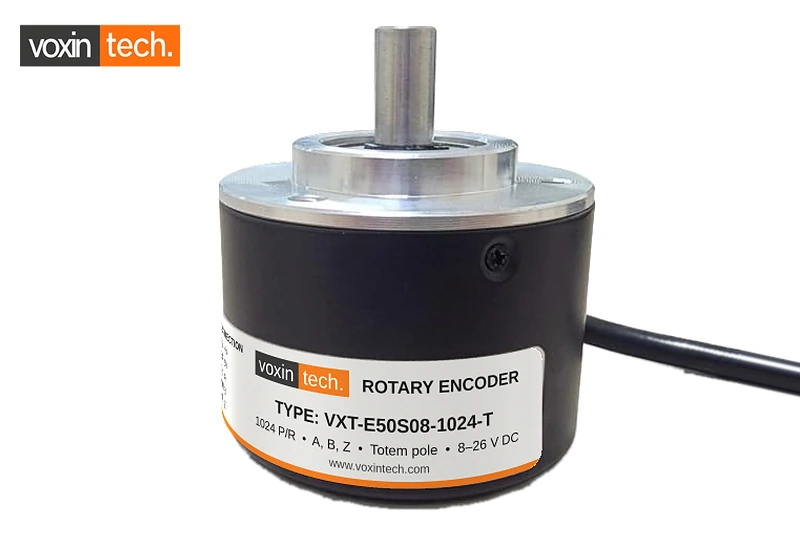
50 mm Encoder with 8 mm Shaft: The VXT-E50S08 Totem Pole Series

Key takeaways

  • A totem pole (push-pull) output works with both NPN-type and PNP-type PLC inputs.
  • VXT-E50S08 is available in 1000, 1024 and 2500 PPR with an 8 mm shaft.
  • Choose 1000 PPR for decimal maths, 1024 to match existing programs, 2500 for registration.
  • A matching option for Autonics E50S8 totem pole models such as E50S8-1024-3-T-24.
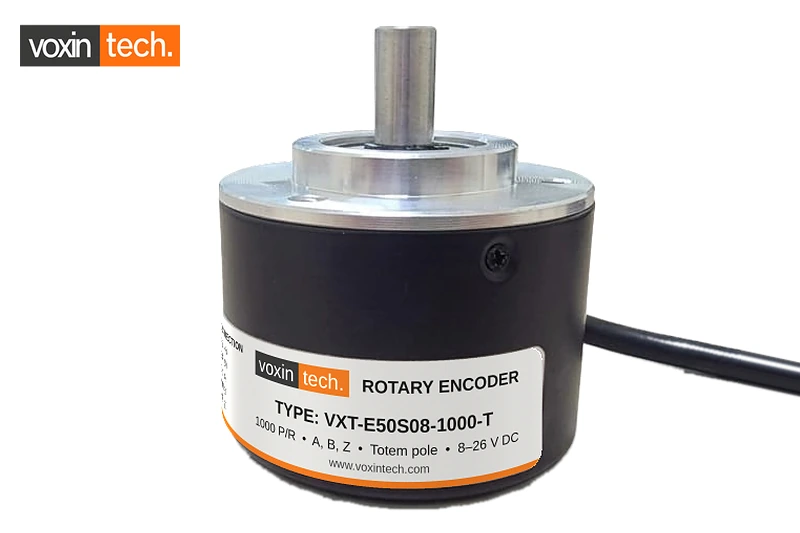
VXT-E50S08-1000-T Voxintech incremental rotary encoder
VXT-E50S08-1000-T Voxintech Rotary Encoder

When a machine needs a sturdier shaft, a larger bearing span and an output that works with almost any controller, the 50 mm encoder with an 8 mm shaft is the standard choice. The VXT-E50S08 series pairs this robust size with a totem pole (push-pull) output, which connects to both NPN-type and PNP-type PLC inputs. That makes it one of the most versatile encoders you can stock.

The VXT-E50S08 range

Model Resolution Output Supply Channels
VXT-E50S08-1000-T 1000 PPR Totem pole (push-pull) 8–26 V DC A, B, Z
VXT-E50S08-1024-T 1024 PPR Totem pole (push-pull) 8–26 V DC A, B, Z
VXT-E50S08-2500-T 2500 PPR Totem pole (push-pull) 8–26 V DC A, B, Z

Common specifications: ø50 mm housing, ø8 mm g6 solid shaft with a flat, ø30 mm spigot, three M4 mounting holes on a ø40 mm pitch circle, 2 m shielded radial cable, response frequency up to 300 kHz, 6000 rpm mechanical speed, IP54, −20 to +85 °C.

Why a totem pole output?

A totem pole output has two transistors: one drives the signal high and one drives it low. The result is a clean, actively driven square wave in both directions. In practical terms:

  • It works with NPN-type and PNP-type inputs, so one encoder model covers machines built for different controllers.
  • Edges are faster and cleaner than with an open collector and a weak pull-up, which helps at higher pulse rates.
  • No external pull-up resistor is needed in most installations.

For OEMs supplying machines to customers with different PLC brands, standardising on a totem pole encoder reduces the number of spares to stock.

Choosing between 1000, 1024 and 2500 PPR

  • VXT-E50S08-1000-T: 1000 PPR makes decimal calculations easy. With a 100 mm circumference measuring wheel, every pulse is 0.1 mm.
  • VXT-E50S08-1024-T: 1024 PPR is a binary-friendly value used by many drives, motion modules and existing machine programs. Choose it when replacing an existing 1024 PPR encoder so no scaling changes are needed.
  • VXT-E50S08-2500-T: 2500 PPR gives finer resolution for print registration, cut-to-length accuracy and slow-speed position control. At the 300 kHz response limit it supports up to 7200 rpm electrically, so the 6000 rpm mechanical limit still applies.

An alternative to Autonics E50S8 and Omron 50 mm encoders

The Autonics E50S8 series is one of the most widely used 50 mm, 8 mm shaft encoders in India, and its totem pole versions carry a "T" in the model code, for example E50S8-1000-3-T-24. Omron offers 50 mm encoders in the E6C2-C and E6C3-C families. If you are looking for an equivalent:

If you use Consider
Autonics E50S8-1000-3-T-24 VXT-E50S08-1000-T
Autonics E50S8-1024-3-T-24 VXT-E50S08-1024-T
Autonics E50S8-2500-3-T-24 VXT-E50S08-2500-T
Omron 50 mm encoder, 8 mm shaft VXT-E50S08 model with matching PPR (check the output type)

Before replacing, compare the mounting hole pattern, spigot diameter and cable exit direction with your existing installation. Published data for the Autonics E50S series lists a maximum of 5000 rpm; VXT-E50S08 is rated to 6000 rpm mechanically. Both support response frequencies up to 300 kHz.

Where the VXT-E50S08 fits best

  • Printing and converting: web speed, print registration and sheet counting on flexo, offset and rotogravure lines.
  • Cut-to-length lines: steel coil, paper, film and corrugated board, using a measuring wheel on the material.
  • Conveyors and material handling: belt speed, tracking and synchronisation.
  • Textile machinery: fabric length on stenters, inspection machines and folding machines.
  • Packaging machines: form-fill-seal, carton erectors and labellers.
  • Wire and cable: length counting on take-up and coiling machines.

Installation tips

  • Use a flexible coupling and keep shaft loads within 30 N radial and 20 N axial.
  • For measuring-wheel applications, mount the encoder on a spring-loaded arm so the wheel keeps constant contact without overloading the shaft.
  • Route the encoder cable separately from motor and inverter cables, and earth the shield at the controller end.

Frequently Asked Questions

What is a totem pole encoder?

A totem pole (push-pull) encoder drives its output actively both high and low. It can be connected to PLC inputs configured for NPN sensors or for PNP sensors, which makes it more flexible than an open collector encoder.

Can I use VXT-E50S08-1024-T with a Delta, Mitsubishi or Siemens PLC?

Yes, as long as the PLC high-speed counter input accepts 24 V signals at your pulse rate. The totem pole output works with both NPN and PNP input configurations.

Is VXT-E50S08 a replacement for Autonics E50S8?

It is in the same 50 mm, 8 mm shaft class with an equivalent totem pole output. Check the mounting holes and cable direction, or share your Autonics model number and we will confirm the closest match.

What is the maximum speed of the VXT-E50S08-2500-T?

The mechanical limit is 6000 rpm. At 2500 PPR and the 300 kHz response limit, the electrical limit is 7200 rpm, so 6000 rpm is the operating limit.

Order the VXT-E50S08 series

Contact us with the PPR and quantity you need, or the model you want to replace. We supply VXT encoders across India with datasheets, wiring support and a 1-year warranty.

Autonics and Omron are trademarks of their respective owners. They are mentioned for comparison and cross-reference only; VXT is not affiliated with these companies.
by Voxintech-admin@2022 Voxintech-admin@2022 No Comments

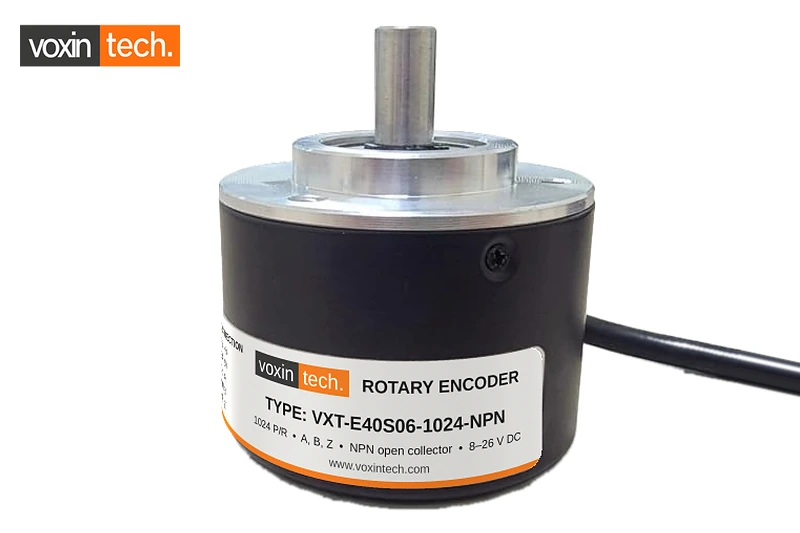
40 mm Rotary Encoder with 6 mm Shaft: The VXT-E40S06 Series

Key takeaways

  • The 40 mm housing with 6 mm shaft is India's most common encoder size.
  • VXT-E40S06 comes in NPN (500 and 1024 PPR), PNP and line driver versions.
  • It is in the same class as Omron E6B2-C and Autonics E40S6; check mounting and PPR before swapping.
  • Up to 300 kHz response and IP54 protection across the series.
VXT-E40S06-1024-NPN Voxintech incremental rotary encoder
VXT-E40S06-1024-NPN Voxintech Rotary Encoder

The 40 mm housing with a 6 mm solid shaft is the most popular encoder size in Indian automation. It fits compact machines, mounts on standard brackets and couples easily to rollers and motor shafts. The VXT-E40S06 series covers this size in four ready-to-ship versions, so you can match the output to your controller instead of adapting the controller to the encoder.

The VXT-E40S06 range at a glance

Model Resolution Output Supply Channels
VXT-E40S06-0500-NPN 500 PPR NPN open collector 8–26 V DC A, B, Z
VXT-E40S06-1024-NPN 1024 PPR NPN open collector 8–26 V DC A, B, Z
VXT-E40S06-1024-PNP 1024 PPR PNP open collector 8–26 V DC A, B, Z
VXT-E40S06-1024-L 1024 PPR Line driver (RS-422) 5 V DC A, /A, B, /B, Z, /Z

All four share the same mechanics: ø40 mm housing, ø6 mm g6 solid shaft with a flat, ø20 mm spigot, three M3 mounting holes on a ø30 mm pitch circle, and a 2 m shielded radial cable. Response frequency is up to 300 kHz and the mechanical speed limit is 6000 rpm. Protection is IP54 with an operating range of −20 to +85 °C.

Which VXT-E40S06 model should you choose?

VXT-E40S06-1024-NPN: the everyday workhorse

If your PLC high-speed counter inputs are configured for NPN sensors, which is the most common setup in Indian panels, this is the model to start with. 1024 PPR gives fine enough resolution for conveyor tracking, roll length measurement and packaging machine timing, while staying well within the input frequency of most PLC counters at normal machine speeds.

VXT-E40S06-0500-NPN: simple speed and counting jobs

At 500 PPR, the pulse rate is half that of a 1024 PPR encoder at the same speed. That makes it a good fit for older PLCs or counters with lower input frequency limits, and for speed monitoring where very fine resolution is not needed.

VXT-E40S06-1024-PNP: for PNP-input controllers

Many European-style panels and some OEM machines use inputs configured for PNP sensors. The PNP open collector output sources current to the input, so it connects directly without an interface relay or converter.

VXT-E40S06-1024-L: for drives, motion controllers and long cables

The line driver version outputs differential A, /A, B, /B, Z and /Z signals at 5 V DC to RS-422 levels. Differential signalling rejects electrical noise from VFDs and servo drives and supports longer cable runs. Choose it for servo drive feedback, motion controller inputs and CNC retrofits.

An alternative to Omron E6B2-C and Autonics E40S6

The 40 mm, 6 mm shaft class is also served by well-known models such as the Omron E6B2-C series and the Autonics E40S6 series. Machine builders often ask us for an equivalent when lead times are long or budgets are tight. The table below shows which VXT-E40S06 model matches each common output type.

If you use Output type Consider
Omron E6B2-CWZ6C NPN open collector VXT-E40S06-1024-NPN or VXT-E40S06-0500-NPN
Omron E6B2-CWZ5B PNP open collector VXT-E40S06-1024-PNP
Omron E6B2-CWZ1X Line driver VXT-E40S06-1024-L
Autonics E40S6-…-N-24 NPN open collector VXT-E40S06-1024-NPN
Autonics E40S6-…-6-L-5 Line driver VXT-E40S06-1024-L

A few points to check before replacing:

  • Mounting: compare the flange hole pattern and spigot with your existing bracket.
  • Resolution: match the PPR, or update the scaling in your PLC program.
  • Supply: VXT open collector models accept 8 to 26 V DC, which covers standard 12 V and 24 V panels.
  • Response frequency: VXT-E40S06 encoders support up to 300 kHz. Published data for the Omron E6B2-CWZ6C lists 100 kHz, so a VXT encoder will not be the limiting factor in an equivalent application.
  • Protection: VXT-E40S06 is rated IP54; the Omron E6B2-C series is listed at IP50.

Typical applications

  • Packaging machines: film feed length, cutter timing, flow-wrap registration.
  • Conveyors: belt speed monitoring, product tracking.
  • Textile machines: yarn and fabric length measurement.
  • Printing and labelling: web speed and label position.
  • Material handling and AGV wheels: distance travelled.
  • Small motor feedback with PLC high-speed counters.

Installation tips

  • Always use a flexible coupling between the encoder shaft and the machine shaft. A rigid coupling transfers misalignment into the encoder bearings.
  • Keep within the rated shaft load of 30 N radial and 20 N axial.
  • For NPN models, connect to an input configured for NPN sensors, or add a pull-up resistor for voltage-type receivers.
  • Earth the cable shield at the controller end only.

Frequently Asked Questions

What is the shaft size of the VXT-E40S06 encoder?

All VXT-E40S06 models have a ø6 mm g6 solid shaft with a flat, in a ø40 mm housing.

Can VXT-E40S06-1024-NPN be used with a 24 V PLC?

Yes. It accepts 8 to 26 V DC and its NPN open collector outputs connect to PLC high-speed counter inputs configured for NPN sensors.

Is the VXT-E40S06 a direct replacement for Omron E6B2-CWZ6C?

It is in the same 40 mm, 6 mm shaft class with an equivalent NPN open collector output. Check the mounting hole pattern and PPR against your machine before swapping, or send us your model number and we will confirm.

What cable length does the VXT-E40S06 have?

It comes with a 2 m shielded radial cable with open-ended leads.

Order the VXT-E40S06 series

Tell us the PPR, output type and quantity you need, or share the model you are replacing. Contact us for datasheets, pricing and availability across India.

Omron and Autonics are trademarks of their respective owners. They are mentioned for comparison and cross-reference only; VXT is not affiliated with these companies.
by Voxintech-admin@2022 Voxintech-admin@2022 No Comments

Incremental Rotary Encoder Buying Guide for Indian Machine Builders

Key takeaways

  • Pick an encoder in five steps: housing and shaft size, PPR, output type, supply voltage, environment.
  • The output type must match your PLC or drive input; it is the most common ordering mistake.
  • VXT covers 38, 40, 50 and 58 mm sizes, 360 to 5000 PPR, and NPN, PNP, totem pole and line driver outputs.
  • All VXT encoders respond up to 300 kHz; at 5000 PPR this limits speed to 3600 rpm.
VXT-E50S08-1024-T Voxintech incremental rotary encoder
VXT-E50S08-1024-T Voxintech Rotary Encoder

An incremental rotary encoder turns shaft rotation into pulses that your PLC, counter or drive can read. It is one of the most common feedback devices on Indian shop floors: on packaging machines, printing presses, conveyors, cut-to-length lines, textile machines and CNC equipment. Choosing the wrong one usually shows up later as missed counts, noisy signals or a shaft that will not fit the coupling.

This guide walks through the five decisions that matter and maps each one to the VXT encoder range, so you can pick the right model the first time.

What an incremental encoder actually does

Inside the encoder, a coded disc rotates between a light source and a sensor. Every line on the disc produces one pulse. The encoder gives you two square-wave channels, A and B, offset by 90 degrees, so your controller can tell both how far the shaft has moved and in which direction. Most VXT models also provide a Z (index) pulse once per revolution, which is useful for homing and reference positioning.

Because it counts pulses rather than storing an absolute position, an incremental encoder is simple, fast and cost-effective. It is the right choice for speed measurement, length measurement, registration and most motion tasks where the machine can home on power-up.

Decision 1: Housing and shaft size

Start with the mechanical fit. The housing diameter and shaft size decide the mounting bracket and coupling you need.

VXT series Housing Shaft Typical use
VXT-E38S06 ø38 mm ø6 mm Compact machines, length counting
VXT-E40S06 ø40 mm ø6 mm General automation, packaging, PLC counting
VXT-E50S08 ø50 mm ø8 mm Conveyors, printing, cut-to-length
VXT-E58S06 / E58S10 ø58 mm ø6 or ø10 mm Motion control, CNC, high resolution

If you are replacing an existing encoder, measure the housing diameter, shaft diameter and the mounting hole pattern on the flange before ordering. The 40 mm and 50 mm sizes are the most common in India, and they cover the same applications as the popular Autonics E40S6 and E50S8 and Omron E6B2-C and E6C2-C families.

Decision 2: Resolution (PPR)

PPR is pulses per revolution. Higher PPR means finer position resolution, but also a higher pulse frequency at speed, which your input must be able to read. The VXT range covers the common values:

  • 360 PPR (VXT-E38S06-0360-NPN): one pulse per degree, easy for length and angle calculations.
  • 500 PPR (VXT-E40S06-0500-NPN): a good default for speed monitoring and simple counting.
  • 1000 and 1024 PPR (VXT-E40S06-1024 series, VXT-E50S08-1000-T, VXT-E50S08-1024-T, VXT-E58S06-1024-L): the most widely used resolution band for packaging, conveyors and servo-assisted axes.
  • 2500 PPR (VXT-E50S08-2500-T): finer registration on printing and converting lines.
  • 5000 PPR (VXT-E58S10-5000-L): high-resolution positioning with a differential line driver.

All VXT encoders support response frequencies up to 300 kHz. At 5000 PPR that limits operating speed to 3600 rpm; at 2500 PPR and below, the 6000 rpm mechanical limit applies. Our separate guide on choosing PPR explains the calculation.

Decision 3: Output type

This is where most wrong orders happen. The output must match the input of your PLC or counter.

  • NPN open collector (VXT-E40S06-0500-NPN, VXT-E40S06-1024-NPN, VXT-E38S06-0360-NPN): the most common choice for Indian PLCs with inputs configured for NPN sensors. Supply 8 to 26 V DC.
  • PNP open collector (VXT-E40S06-1024-PNP): for PLC inputs configured for PNP sensors, common on European-style panels.
  • Totem pole / push-pull (VXT-E50S08 series): works with both NPN and PNP type inputs, ideal when you are not sure what the controller expects or you serve mixed customers.
  • Line driver / RS-422 (VXT-E40S06-1024-L, VXT-E58S06-1024-L, VXT-E58S10-5000-L): differential A, /A, B, /B, Z, /Z outputs at 5 V DC for servo drives, motion controllers, CNC and long cable runs in noisy panels.

Decision 4: Supply voltage

Most Indian control panels run on 24 V DC. VXT NPN, PNP and totem pole models accept 8 to 26 V DC, so they work directly on a 12 V or 24 V supply. Line driver models run on 5 V DC (±5 %), which is usually supplied by the drive or motion controller itself.

Decision 5: Environment and cable

VXT encoders are rated IP54, operate from −20 to +85 °C and come with a 2 m shielded radial cable. Earth the shield at the controller end and route the encoder cable away from VFD and motor cables. For wash-down or heavy dust areas, add a protective cover or choose a sealed mounting position.

Quick selection table

Your requirement Recommended VXT model
General PLC counting, NPN inputs VXT-E40S06-1024-NPN
Low-cost speed monitoring VXT-E40S06-0500-NPN
PLC with PNP inputs VXT-E40S06-1024-PNP
Universal output, 50 mm housing VXT-E50S08-1000-T or VXT-E50S08-1024-T
Print registration, finer resolution VXT-E50S08-2500-T
Servo or motion controller, 40 mm VXT-E40S06-1024-L
Motion control, 58 mm, 6 mm shaft VXT-E58S06-1024-L
High-resolution positioning VXT-E58S10-5000-L
Compact length measurement, 1 pulse per degree VXT-E38S06-0360-NPN

Why machine builders choose VXT encoders

  • Response frequency up to 300 kHz across the range.
  • Wide 8 to 26 V DC supply on NPN, PNP and totem pole models.
  • Standard 38, 40, 50 and 58 mm sizes that suit common brackets and couplings.
  • Clear datasheets with wiring colours, dimensions and signal timing for every model.
  • Supply across India with technical support for selection and wiring.
  • 1-year warranty.

Frequently Asked Questions

What is the difference between an incremental and an absolute encoder?

An incremental encoder outputs pulses as the shaft turns, and the controller counts them. An absolute encoder outputs a unique code for every position, so it knows its position immediately at power-up. For speed, length and most counting jobs, an incremental encoder is simpler and more economical.

Which encoder output should I choose for a 24 V PLC?

Check how the PLC high-speed counter input is configured. For inputs set for NPN sensors, choose an NPN open collector model such as VXT-E40S06-1024-NPN. For PNP inputs, choose VXT-E40S06-1024-PNP. If you are unsure, a totem pole model such as VXT-E50S08-1024-T works with both.

Can a VXT encoder replace an Autonics or Omron encoder?

In many cases, yes, provided the housing size, shaft diameter, mounting holes, output type and PPR match your application. Share your existing model number with us and we will suggest the closest VXT model and point out any mounting differences.

What PPR is most common?

1000 and 1024 PPR are the most widely used resolutions for packaging machines, conveyors and general automation in India.

Get the right encoder for your machine

Tell us your housing size, shaft diameter, PPR, output type and supply voltage, or simply send the model number you use today. Contact us for VXT encoder datasheets, pricing and availability anywhere in India.

by Voxintech-admin@2022 Voxintech-admin@2022 No Comments

M12 Sensor Junction Box & Sensor Distribution Box: Complete Wiring Guide

A modern machine can carry twenty, fifty or more sensors, and every one of them needs a clean, reliable path back to the PLC. Running an individual cable from each sensor to the control panel is slow to install, expensive in cable and cable tray, and painful to fault-find. An M12 sensor junction box — also called a sensor distribution box or splitter box — solves all three problems at once. This guide explains what these boxes do, how junction boxes and distribution boxes differ, and how to choose the right port count for your machine.

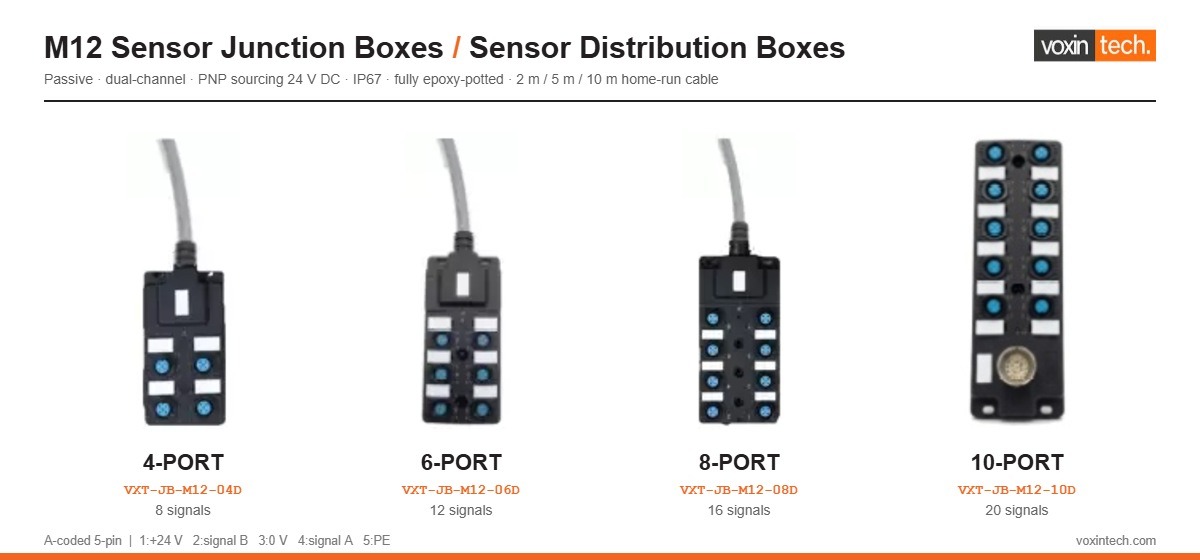
M12 sensor junction box and sensor distribution box range from Voxintech in 4, 6, 8 and 10 port versions
Voxintech VXT-JB-M12 series — 4, 6, 8 and 10-port M12 sensor junction boxes and sensor distribution boxes.

What is an M12 sensor junction box?

An M12 sensor junction box is a rugged, passive connectivity hub that uses standardised M12 circular connectors to link several field devices — proximity sensors, photoelectric sensors, actuators and switches — to a single multi-core home-run cable running back to the PLC or remote I/O module.

Instead of routing dozens of individual wires through cable trays, the box is mounted close to the sensor cluster. Each sensor plugs in with a short M12 cordset, and one home-run cable does the long trip to the cabinet. The result is less cable, less labour and a far tidier machine.

Key features to look for

  • M12 quick-connect ports — tool-free sensor and actuator connection, no wire stripping
  • IP67-rated sealed housing — protection against dust, coolant, oil and washdown
  • Epoxy-resin potted body — no screw terminals to loosen under vibration
  • LED indicators per port — power and signal status visible at the machine
  • 5-pin A-coded sockets — the industry-standard pinout, accepts any brand of M12 cordset
  • PNP (sourcing) 24 V DC operation — matched to standard automation I/O
  • Wide temperature and vibration rating — suitable for real factory conditions

Benefits of using an M12 junction box

  1. Faster installation — plug-and-play M12 connectors remove manual stripping and terminal screwing, typically cutting sensor wiring time by more than half.
  2. Reduced downtime — LED indicators show at a glance which sensor has dropped out, so maintenance finds the fault at the machine instead of tracing wires in the panel.
  3. Improved reliability — sealed, potted construction resists vibration, moisture and contamination far better than a terminal strip in a small enclosure.
  4. Scalability — sensors can be added or swapped without rewiring the panel.
  5. Lower total cost of ownership — less labour, fewer wiring errors, less cable and lower maintenance cost over the life of the machine.

Common applications

  • Packaging and material handling lines
  • Automotive assembly and robot cells
  • Food and beverage processing (washdown areas)
  • CNC machine tools
  • Conveyor and sorting systems

Sensor distribution boxes: 4, 6, 8 and 10-port options

A sensor distribution box performs the same job on a larger scale: it acts as a centralised distribution point that carries power out to the field devices and signals back on one trunk cable. Port count is the main selection decision.

The Voxintech VXT-JB-M12 series is available in 4, 6, 8 and 10-port versions, each with a moulded home-run cable in 2 m, 5 m or 10 m lengths. Every port is a dual-channel M12x1 female socket, so an 8-port box carries up to 16 signals and a 10-port box up to 20 signals on a single cable. Each port also accepts an ordinary 3-wire single-signal sensor on one channel, which means one box covers both single-channel and dual-channel requirements at the same port count.

Typical distribution box specification

  • Ports: M12x1 female, A-coded, 5-pin, nickel-plated brass threads
  • Pinout: 1 = +24 V, 2 = signal B, 3 = 0 V, 4 = signal A, 5 = PE
  • Supply: 24 V DC nominal (10–30 V DC), PNP sourcing outputs
  • Current: approx. 2 A per channel, 4 A per port, 8 A per box
  • Diagnostics: 1 green power LED plus 1 yellow signal LED per channel
  • Construction: fully epoxy-potted body, gold-plated contacts, IP67 with all ports mated or capped

Benefits of a multi-port distribution box

  1. Centralised wiring architecture — one trunk cable replaces dozens of home-run cables to the PLC.
  2. Simplified maintenance — a faulty sensor is isolated and replaced without disturbing the rest of the system.
  3. Space savings — less panel clutter and far less congestion in cable trays and drag chains.
  4. Cost-efficient scaling — add sensors incrementally instead of redesigning the wiring harness.
  5. Faster commissioning — the machine builder wires to a known pinout, so the same cordsets work everywhere.

M12 junction box vs sensor distribution box: which do you need?

Feature M12 junction box Sensor distribution box
Best for Small to medium sensor groups Medium to large sensor networks
Typical port count 4–6 ports 8–10 ports
Signals carried Up to 12 (dual channel) Up to 20 (dual channel)
Ideal use case Machine-level wiring Cell or line-level distribution
Diagnostics LED per channel LED per channel
Example VXT-JB-M12-04D-05M VXT-JB-M12-10D-05M

In practice the two terms describe the same family of product. Both share the goal of simplifying cabling, reducing downtime and improving serviceability — the right choice comes down to sensor count, machine layout and how much spare capacity you want to leave for future additions. A useful rule of thumb: choose a box with at least one or two spare ports beyond today’s requirement.

Why IP67 and epoxy potting matter

Industrial environments expose wiring to dust, coolant, oil, vibration and washdown cycles. An IP67-rated M12 distribution box meets the IEC 60529 IP rating for total dust ingress protection and temporary immersion, provided every unused port is fitted with a protective cap.

Potting matters just as much as the IP rating. A box with internal screw terminals has connections that can work loose under continuous vibration, and any moisture that does get in has somewhere to sit. A fully epoxy-potted body with gold-plated contacts has no serviceable joints inside to fail, which is why potted boxes are the standard choice for welding cells, presses and high-vibration conveyor equipment.

Installation best practices

  • Mount the box as close to the sensor cluster as possible to keep cordsets short.
  • Cap every unused port — an open port destroys the IP67 rating of the whole box.
  • Use labelled or colour-coded M12 cordsets so port numbers map clearly to PLC addresses.
  • Check the supply capacity: total sensor load must stay within the per-port and per-box current limits.
  • Route the home-run cable away from VFD and motor cables to reduce electrical noise.
  • Inspect connector seals periodically in washdown and high-vibration areas.
  • Confirm sensor switching type — PNP boxes require PNP (sourcing) sensors.

Voxintech M12 junction box and distribution box range

Voxintech manufactures and supplies M12 sensor junction boxes in India and Europe across four port counts and three cable lengths:

VXT-JB-M12-10D 10-port sensor distribution box with M12 ports and status LEDs
VXT-JB-M12-10D — a 10-port sensor distribution box carrying up to 20 signals on one cable.

Frequently asked questions

What is the difference between a junction box and a distribution box?

In sensor wiring the two terms are used interchangeably. Where a distinction is made, a junction box usually groups a smaller number of sensors onto one cable run, while a distribution box handles a higher port count for centralised, cell-level wiring.

Are M12 junction boxes waterproof?

Industrial-grade M12 junction boxes are rated IP67, meaning they are protected against dust and temporary immersion — suitable for washdown areas. The rating only holds if every unused port is fitted with a sealing cap.

Can I use NPN sensors with a PNP distribution box?

No. A PNP (sourcing) box must be used with PNP sensors and PNP-configured PLC inputs. Mixing switching types will not work and can damage inputs, so always confirm the sensor type before wiring.

How many sensors can a 10-port distribution box support?

A 10-port dual-channel box supports up to 10 dual-signal devices — 20 signals in total — or up to 10 standard 3-wire single-signal sensors, all on one home-run cable.

Do these boxes need a power supply of their own?

No. Power arrives through the home-run cable from the panel and is distributed to every port, so no separate supply is needed at the machine.

Do junction boxes require a PLC to function?

No. These are passive wiring aids — they do not process logic. They simply route power out to the field devices and signals back to whatever controller you are using.

Conclusion

Whether you are wiring a single machine or a full production line, M12 sensor junction boxes and sensor distribution boxes are essential building blocks for efficient, reliable automation. They cut installation time, simplify troubleshooting and protect the sensor network from the realities of the factory floor. Choosing the right box comes down to port count, cable length and the switching type of your sensors.

Ready to simplify your sensor wiring? Explore the full Voxintech M12 junction box and sensor distribution box range to find the right fit for your application, or contact our team for help selecting a port count.

by Voxintech-admin@2022 Voxintech-admin@2022 No Comments

M12 Sensor Distribution Box Buying Guide (India): Ports, Prices and What to Check

Choosing an M12 sensor distribution box is straightforward once you work through five questions in order: how many sensors, one signal or two per port, PNP or NPN, how long a cable, and how tough the environment. Get those right and the part number falls out. This guide walks through each, with a note on what these boxes cost in the Indian market so you can sanity-check a quote.

Step 1: Count your sensors and size the ports

Start by counting the sensors in the cluster the box will serve, then leave headroom. A station with six sensors today may grow to eight, and it is cheaper to fit an 8-port box now than to add a second box later.

  • Up to 4 sensors: a 4-port box, ideal for a compact machine or a single station.
  • 5 to 6 sensors: a 6-port box.
  • 7 to 8 sensors: an 8-port box, the most common size on packaging and assembly lines.
  • 9 to 10 sensors, or a long run: a 10-port box, which puts twenty signals on one cable and often replaces two smaller boxes.

Step 2: One signal or two per port?

This is the single most common specification error. A single-channel port carries one signal; a dual-channel port carries two. Double-acting pneumatic cylinders use two magnetic reed switches, one for each end position, so on a machine full of cylinders a dual-channel box lets each cylinder occupy one port instead of two. A dual-channel box also accepts a single-signal sensor on one channel, so choosing dual channel is the safe default when you are unsure. See our dedicated single-versus-dual-channel guide for the full explanation.

Step 3: PNP or NPN?

The box must match your sensors' output logic. PNP (sourcing) is the modern European standard and the most common choice on new machines; NPN (sinking) is still found on older equipment, particularly Japanese-built machines. The sensor, the box and the PLC input card should all agree. Our PNP-versus-NPN guide explains how to check and how to avoid a costly mismatch.

Step 4: Choose the home-run cable length

  • 2 m: for a box mounted close to the panel or on a compact machine, and the sharpest price.
  • 5 m: the general-purpose length that covers most mid-span mounting positions.
  • 10 m: for a box at the far end of a long conveyor or on a machine sited away from its cabinet.

Order the length you need; excess cable coiled in the tray is wasted money and clutter.

Step 5: Match the build to the environment

For anything beyond a clean, dry panel, insist on a fully potted box rated to IP67. Epoxy potting leaves no cavity for condensation and no screw terminals to shake loose, which is why potted boxes survive on machines that vibrate continuously or get washed down. Look also for gold-plated contacts and nickel-plated brass threads. Our construction guide covers why this matters.

What these boxes cost in India

As a rough guide for an 8-port dual-channel box with a 5 m cable: unbranded imports sit at the bottom of the market with little support or datasheet continuity; established Korean brands occupy the trusted mid-market; and German premium brands sit well above, often with long lead times on non-stock variants. A branded Indian-supplied alternative aims to give you a real datasheet, a stable part number and local stock at a price close to the mid-market. Always get two quotes and check the total landed price, not just the headline unit rate.

Frequently Asked Questions

How many ports do I need?

Count the sensors the box will serve and add headroom. Four to six sensors suit a 4- or 6-port box; seven to eight suit an 8-port; nine or ten, or a long run, suit a 10-port.

Should I default to single or dual channel?

If in doubt, choose dual channel. It handles double-acting cylinders that need two sensors, and it still accepts single-signal sensors on one channel, so it covers both cases.

Why do prices vary so much for a similar-looking box?

The gap is construction quality, brand, datasheet support and stock. Fully potted boxes with brass threads and proper certification cost more than unbranded ones, but they fail far less often in service, which is where the real cost of a cheap box shows up.

Need help choosing? Voxintech stocks M12 sensor distribution boxes from 4 to 10 ports in Noida, Delhi NCR, with datasheets, GST invoicing and ex-stock dispatch. Send us your sensor count and we will size the right box for your machine.

Related Voxintech products

Browse Voxintech M12 sensor junction boxes – 4, 6, 8 and 10-port dual-channel distribution boxes with 2 m, 5 m and 10 m home-run cables, in stock in Noida, Delhi NCR.

Read next

by Voxintech-admin@2022 Voxintech-admin@2022 No Comments

How to Reduce Sensor Wiring in Your Control Panel

If your control panels are a wall of cable glands and your wiring labour keeps climbing, the sensors are usually the culprit. A modern machine carries dozens of them, and wired individually each one is a cable, a gland and a set of terminals. Sensor distribution boxes are the standard fix, and the saving is easy to quantify.

The problem: one cable per sensor

Traditionally every sensor runs its own cable back to the panel. Twenty sensors mean twenty cables in the trunking, twenty glands drilled and sealed in the enclosure wall, and up to sixty cores to land on terminals inside. That is expensive in cable, in enclosure space, and above all in labour, and it makes fault-finding slow because every sensor is buried in the same bundle.

The fix: consolidate at the machine

A sensor distribution box mounted near a cluster of sensors reverses this. Each sensor plugs into the box with a short cordset, and a single multi-core home-run cable carries every signal back to the panel. Twenty sensors served by three boxes become three home-run cables and three glands instead of twenty of each.

The saving, in numbers

Take one 8-port dual-channel box handling sixteen signals. Wired the old way that is up to sixteen cables and sixteen glands. With the box it is one home-run cable and one gland: fifteen fewer cable runs and fifteen fewer glands from a single box. Across a mid-size packaging machine with several such clusters, that is routinely a full day of wiring labour saved and a noticeably smaller cable tray.

  • Fewer glands to drill, fit and seal in the enclosure.
  • Less cable purchased and less trunking to hold it.
  • Fewer cores to terminate, so faster panel build and fewer wiring errors.
  • Smaller enclosure, because far fewer entries are needed.

The bonus: faster fault-finding

Distribution boxes carry status LEDs, one per signal. A technician standing at the machine can see which sensor is switched without a meter and without walking back to the panel. On a line running multiple shifts, that is the difference between a two-minute fault-find and a twenty-minute one, and over a year it dwarfs the cost of the boxes.

Design tips for the biggest saving

  • Group sensors by location and put a box at the centre of each cluster to keep cordsets short.
  • Use dual-channel boxes so double-acting cylinders occupy one port each.
  • Size up: an 8-port box that is half full today leaves room to add sensors without a new home-run.
  • For long conveyors, consider a 10-port box to keep twenty signals on a single cable.
  • Standardise on one box family and pinout across your machines to simplify stock and spares.

Frequently Asked Questions

How much wiring can a distribution box save?

A single 8-port box handling sixteen signals replaces up to sixteen individual cable runs and glands with one home-run and one gland, saving cable, enclosure space and a large share of the wiring labour.

Do distribution boxes make maintenance easier?

Yes. On-box status LEDs show sensor state at the machine, and a faulty sensor is unplugged and swapped in seconds without rewiring, which cuts downtime.

Where should I mount the box?

At the centre of a cluster of sensors so the cordsets stay short, and where its LEDs are visible to a technician at the machine.

Need help choosing? Voxintech stocks M12 sensor distribution boxes from 4 to 10 ports in Noida, Delhi NCR, with datasheets, GST invoicing and ex-stock dispatch. Send us your sensor count and we will size the right box for your machine.

Related Voxintech products

Browse Voxintech M12 sensor junction boxes – 4, 6, 8 and 10-port dual-channel distribution boxes with 2 m, 5 m and 10 m home-run cables, in stock in Noida, Delhi NCR.

Read next

by Voxintech-admin@2022 Voxintech-admin@2022 No Comments

M12 Junction Box Wiring and Pinout Explained (5-Pin A-Coded)

Most M12 sensor distribution boxes follow one near-universal wiring standard: the 5-pin A-coded pinout. Learn it once and you can wire, cross-reference and troubleshoot boxes from any manufacturer, because they nearly all share it. This guide lays out the pinout, explains each pin, and shows how a dual-channel port maps a double-acting cylinder.

The standard 5-pin A-coded pinout

On a dual-channel 5-pin distribution box, each M12 port uses the same assignment:

Pin Function Typical cordset colour
1 +24 V DC (power to sensor) Brown
2 Signal B (2nd signal, dual channel) White
3 0 V (common return) Blue
4 Signal A (primary signal) Black
5 PE / FE (earth) Grey

Pins 2 and 4 carry the two independent switching signals (channels B and A). On a single-channel box only one signal pin is used per port; the pinout is otherwise identical, which is part of why the standard is so convenient.

What each pin does

  • Pin 1 (+24 V DC): supplies power out to the sensor. Usually brown in a standard cordset.
  • Pin 2 (Signal B): the second switching signal on a dual-channel port. Usually white.
  • Pin 3 (0 V): the common return. Usually blue.
  • Pin 4 (Signal A): the primary switching signal, and the only signal used on a single-signal sensor. Usually black.
  • Pin 5 (PE / FE): protective or functional earth. Usually grey; not present on 4-pin cordsets.

Because a 4-pin sensor cordset simply omits pin 5, it still mates with a 5-pin A-coded socket. That means a 5-pin dual-channel box also accepts 4-pin single-signal sensors.

The home-run side

All the port signals are combined into the home-run trunk, which reaches the panel either as a fixed moulded cable or through an M23 quick-disconnect connector. The trunk has one core per signal plus the shared power and earth cores, so an 8-port dual-channel box carries sixteen signal cores plus power and earth. At the panel, each core lands on its own PLC input terminal.

Worked example: wiring a double-acting cylinder

A double-acting cylinder has two reed switches: one senses the extended position, one the retracted. With a Y-splitter or a twin cordset, both switches connect to a single dual-channel port. The extended-position switch maps to Signal A (pin 4) and the retracted-position switch to Signal B (pin 2). Both travel down the home-run to two adjacent PLC inputs. One port, one plug, two signals, no wiring on terminals.

Common wiring mistakes to avoid

  • Ignoring output logic: a PNP box wired with NPN sensors passes signals but the LEDs will not indicate correctly.
  • Leaving unused ports open: fit protective caps or the box loses its IP67 rating at that socket.
  • Assuming single channel: plugging a two-signal cylinder into a single-channel box loses the second signal.
  • Over-tightening M12 connectors: hand-tight plus a light nip is enough; the seal is in the thread and the O-ring.

Frequently Asked Questions

What is the standard M12 5-pin pinout for a sensor box?

Pin 1 is +24 V, pin 2 is signal B, pin 3 is 0 V, pin 4 is signal A, and pin 5 is protective earth. This A-coded assignment is shared across almost all manufacturers.

Can a 4-pin sensor plug into a 5-pin box?

Yes. A 4-pin A-coded cordset mates with a 5-pin A-coded socket; it simply does not use pin 5. So a 5-pin dual-channel box accepts 4-pin single-signal sensors.

Why must I cap unused ports?

An open M12 socket breaks the box's IP67 seal at that point, letting in dust and moisture. A protective cap restores the rating on ports you are not using.

Need help choosing? Voxintech stocks M12 sensor distribution boxes from 4 to 10 ports in Noida, Delhi NCR, with datasheets, GST invoicing and ex-stock dispatch. Send us your sensor count and we will size the right box for your machine.

Related Voxintech products

Browse Voxintech M12 sensor junction boxes – 4, 6, 8 and 10-port dual-channel distribution boxes with 2 m, 5 m and 10 m home-run cables, in stock in Noida, Delhi NCR.

Read next

by Voxintech-admin@2022 Voxintech-admin@2022 No Comments

What Is an M12 Sensor Junction Box? The Complete Guide

An M12 sensor junction box, also called a sensor distribution box or splitter box, is a passive device that collects the signals from several sensors and carries them back to the control panel on a single cable. Instead of running one cable from every sensor all the way to the cabinet, each sensor plugs into a nearby box with a short cordset, and one multi-core home-run cable does the long trip. It is one of the simplest ways to cut wiring cost, tidy a machine, and speed up fault-finding.

What a junction box actually does

A machine can easily carry twenty or thirty proximity, photoelectric and reed switches. Wired individually, that is twenty or thirty cables threading through trunking to the panel, each needing its own gland and its own set of terminals. A distribution box consolidates that. Sensors plug into M12 ports on the box using standard cordsets; the box combines every signal onto one home-run cable with a single connector or a single gland at the panel end.

The box is passive: it contains no logic and no power supply of its own. It carries 24 V DC out to the sensors and brings their switching signals back. Because there is nothing active inside, it is extremely reliable and needs no configuration.

The anatomy of a distribution box

Whatever the brand, the parts are the same:

  • Ports: 4, 6, 8 or 10 female M12 sockets, usually A-coded, where the sensors plug in.
  • Home-run cable or connector: the single multi-core trunk back to the panel, either a fixed moulded cable or an M23 quick-disconnect.
  • Status LEDs: a power LED plus one LED per signal, so a technician can read sensor state at the machine.
  • Housing: a sealed, often fully epoxy-potted body rated to IP67 so it survives dust, coolant and wash-down.

Why use one instead of wiring sensors directly

  • Less cable and fewer glands: one home-run replaces many individual runs, so trunking is smaller and cheaper.
  • Faster wiring: plugging in cordsets is quicker and less error-prone than landing dozens of cores on terminals.
  • Quicker diagnostics: LEDs at the box show which sensor is switched without a meter or a trip to the panel.
  • Cleaner maintenance: a faulty sensor is unplugged and swapped in seconds, with no rewiring.

The main types you will see

By port count

4-port boxes suit compact machines and single stations; 6- and 8-port boxes are the workhorses of packaging and assembly lines; 10-port boxes handle high-density stations and long conveyors where twenty signals share one cable.

By channel (signals per port)

Single-channel boxes carry one signal per port. Dual-channel boxes carry two, which suits double-acting pneumatic cylinders that use two magnetic sensors. A dual-channel box can also take a single-signal sensor on one channel, so it covers both cases.

By output logic

Boxes are configured for PNP (sourcing) or NPN (sinking) sensors. This mainly affects how the status LEDs are wired, but sensor, box and PLC input should all agree.

By home-run type

A fixed moulded cable is simplest and cheapest. An M23 quick-disconnect lets the trunk cable be unplugged, which some machine builders prefer for servicing.

Key specifications to check before you buy

  • Number of ports and signals per port (single or dual channel).
  • Output logic: PNP or NPN.
  • Home-run cable length and connector type.
  • IP rating and housing construction (potted vs terminal-strip).
  • Pinout: the near-universal 5-pin A-coded standard accepts cordsets from any brand.

Frequently Asked Questions

Is a junction box the same as a distribution box or a splitter box?

Yes. In sensor and automation wiring these terms are used interchangeably for the same device: a passive box that consolidates several sensor signals onto one home-run cable.

Does a junction box need power or programming?

No. It is passive. It simply passes 24 V DC out to the sensors and their signals back to the panel. There is nothing to configure and nothing that can be corrupted.

Can I mix sensor brands on one box?

Yes, as long as the connectors and output logic match. The 5-pin A-coded M12 standard is shared across manufacturers, so cordsets from different brands plug into the same box.

Need help choosing? Voxintech stocks M12 sensor distribution boxes from 4 to 10 ports in Noida, Delhi NCR, with datasheets, GST invoicing and ex-stock dispatch. Send us your sensor count and we will size the right box for your machine.

Related Voxintech products

Browse Voxintech M12 sensor junction boxes – 4, 6, 8 and 10-port dual-channel distribution boxes with 2 m, 5 m and 10 m home-run cables, in stock in Noida, Delhi NCR.

Read next