

by Voxintech-admin@2022 Voxintech-admin@2022 No Comments

Rotary Encoder Supplier Across India: VXT Encoders for Every Industrial Hub

Key takeaways

  • VXT encoders are supplied across India, from Delhi NCR and Gujarat to Tamil Nadu and West Bengal.
  • The range covers 10 models from 360 to 5000 PPR in 38, 40, 50 and 58 mm sizes.
  • Each industry cluster has a typical choice, from textile length counting to CNC positioning.
  • Send us your current model number for a matching VXT recommendation.
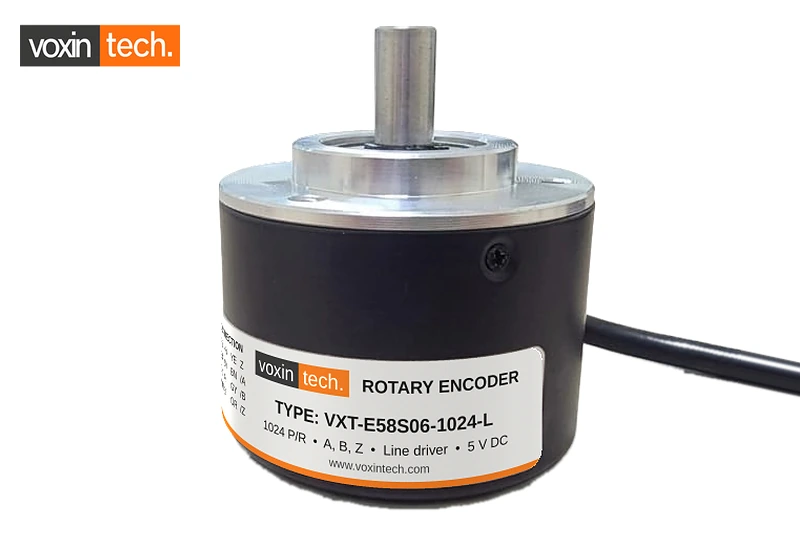
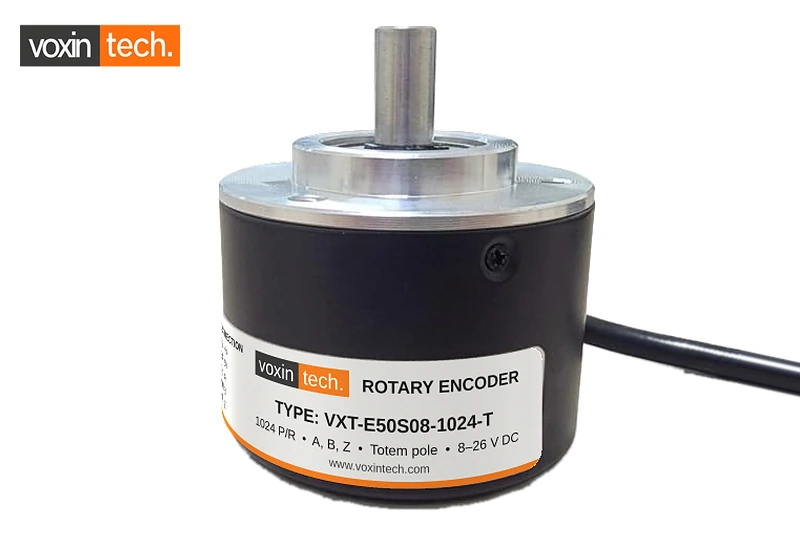
VXT-E58S06-1024-L Voxintech incremental rotary encoder
VXT-E58S06-1024-L Voxintech Rotary Encoder

India's manufacturing is spread across hundreds of industrial clusters, from packaging units in Gujarat to auto component plants in Tamil Nadu and textile mills in Punjab. Each one relies on rotary encoders for speed, length and position feedback. We supply the VXT incremental encoder range across India, with selection help, wiring support and a 1-year warranty, wherever your machine runs.

The VXT encoder range we supply

Model Size / shaft PPR Output Best for
VXT-E38S06-0360-NPN 38 mm / 6 mm 360 NPN open collector Compact length and angle measurement
VXT-E40S06-0500-NPN 40 mm / 6 mm 500 NPN open collector Speed monitoring, simple counting
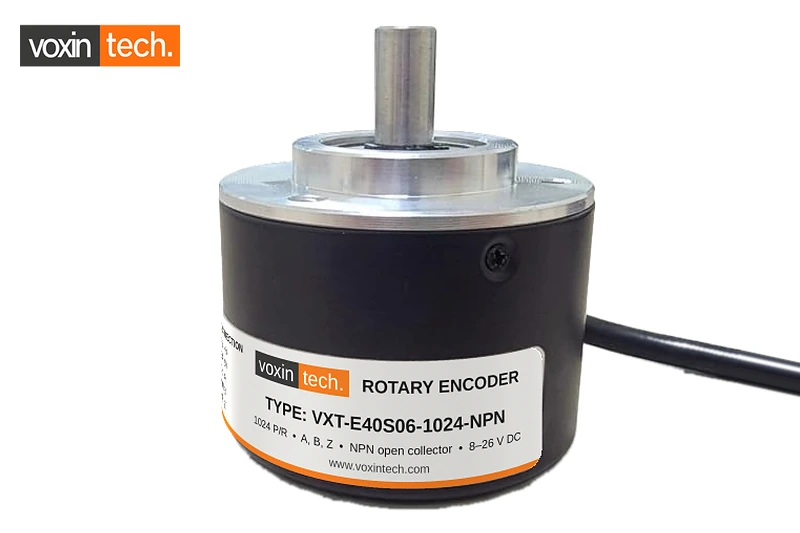
VXT-E40S06-1024-NPN 40 mm / 6 mm 1024 NPN open collector General PLC counting
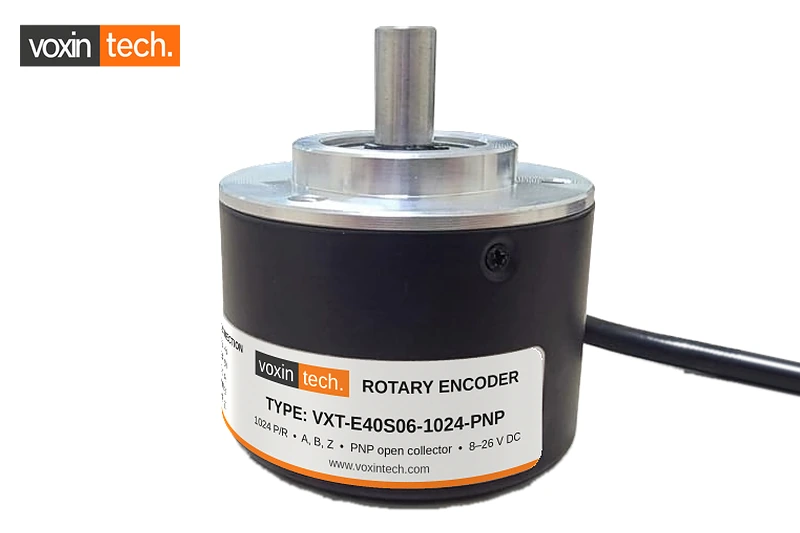
VXT-E40S06-1024-PNP 40 mm / 6 mm 1024 PNP open collector PNP-input controllers
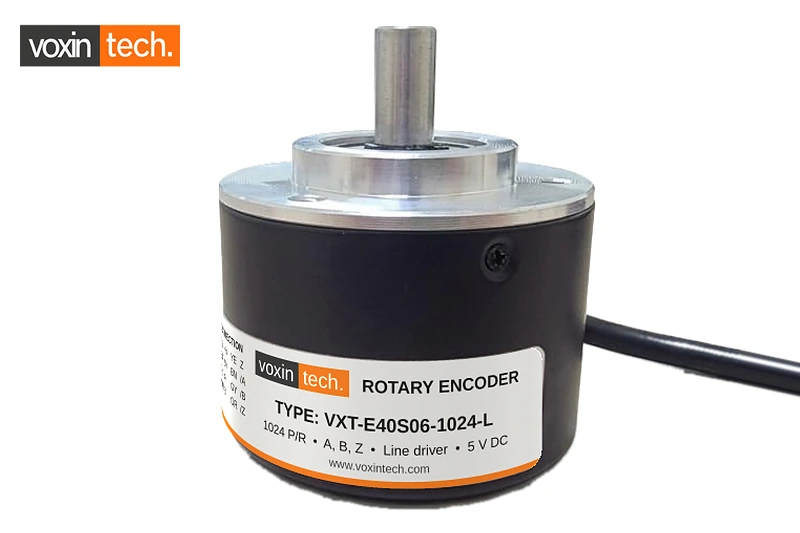
VXT-E40S06-1024-L 40 mm / 6 mm 1024 Line driver Servo and motion inputs
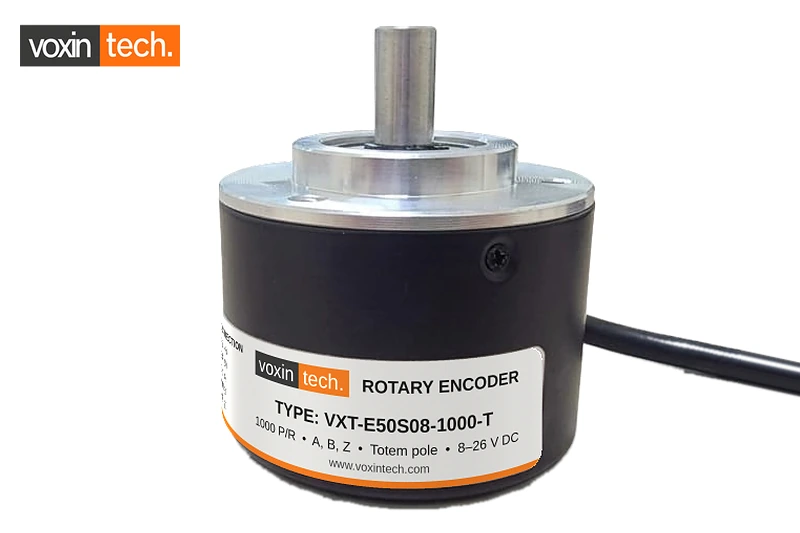
VXT-E50S08-1000-T 50 mm / 8 mm 1000 Totem pole Conveyors, cut-to-length
VXT-E50S08-1024-T 50 mm / 8 mm 1024 Totem pole Universal PLC input
VXT-E50S08-2500-T 50 mm / 8 mm 2500 Totem pole Print registration
VXT-E58S06-1024-L 58 mm / 6 mm 1024 Line driver Motion control
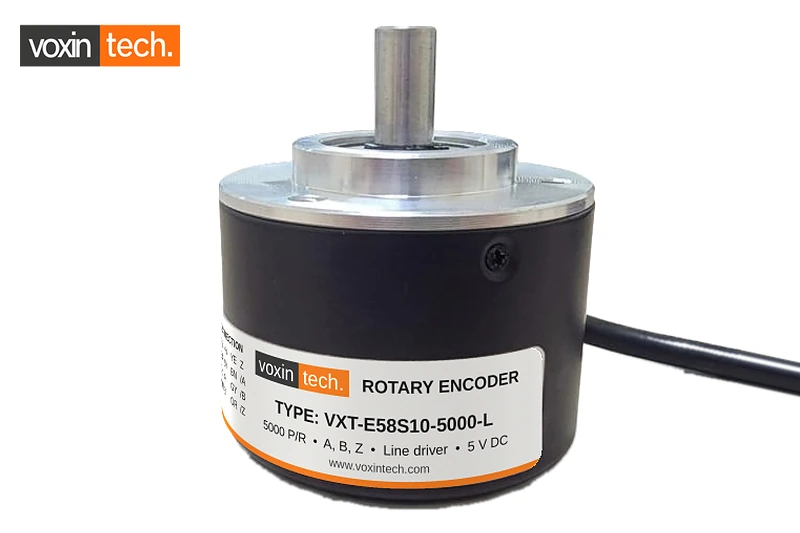
VXT-E58S10-5000-L 58 mm / 10 mm 5000 Line driver High-resolution positioning

All models support up to 300 kHz response frequency, carry IP54 protection and include a 2 m shielded cable.

North India

Delhi NCR is one of India's densest automation markets. We supply encoders to panel builders and machine OEMs in Delhi (Okhla, Narela, Bawana, Mundka, Wazirpur), Noida, Greater Noida, Ghaziabad, Gurugram, Manesar, Faridabad and Sonipat.

In Haryana, Punjab and Himachal Pradesh, our encoders go into textile, bicycle, auto component and pharmaceutical machinery in Ludhiana, Jalandhar, Amritsar, Mohali, Chandigarh, Panchkula, Panipat, Karnal, Ambala, Yamunanagar, Rohtak, Bahadurgarh, Baddi and Parwanoo.

Across Uttar Pradesh and Uttarakhand we serve Kanpur, Lucknow, Agra, Aligarh, Meerut, Moradabad, Bareilly, Varanasi, Prayagraj, Gorakhpur, Haridwar, Rudrapur, Dehradun and Kashipur.

In Rajasthan and Jammu & Kashmir: Jaipur, Bhiwadi, Neemrana, Alwar, Jodhpur, Udaipur, Kota, Bhilwara, Ajmer, Jammu and Kathua.

West India

Gujarat is a powerhouse for packaging, plastics, pharmaceuticals, ceramics and machine tools. We supply Ahmedabad (Naroda, Vatva, Changodar, Sanand), Surat, Vadodara, Rajkot, Jamnagar, Morbi, Bhavnagar, Anand, Gandhinagar, Mehsana, Ankleshwar, Bharuch, Vapi, Valsad and Gandhidham, along with Daman and Silvassa.

Maharashtra has some of the country's largest automotive, engineering and printing clusters: Mumbai, Thane, Navi Mumbai, Bhiwandi, Vasai-Virar, Palghar, Pune (Chakan, Bhosari, Pimpri-Chinchwad, Ranjangaon, Talegaon), Nashik, Aurangabad (Waluj, Shendra), Nagpur (Butibori, Hingna), Kolhapur, Satara, Sangli, Ahmednagar, Jalgaon and Solapur.

In Goa: Verna, Margao and Panaji.

Central India

Madhya Pradesh and Chhattisgarh: Indore, Pithampur, Dewas, Bhopal, Mandideep, Gwalior, Jabalpur, Ujjain, Raipur, Bhilai, Durg and Bilaspur, serving steel, auto component, food processing and pharmaceutical plants.

South India

Tamil Nadu is a leading region for automotive, textiles and engineering: Chennai (Ambattur, Guindy, Sriperumbudur, Oragadam), Coimbatore, Tiruppur, Hosur, Madurai, Salem, Erode, Karur, Tiruchirappalli, Sivakasi and Tuticorin.

Karnataka: Bengaluru (Peenya, Bommasandra, Whitefield, Jigani, Doddaballapur), Mysuru, Hubballi-Dharwad, Belagavi, Mangaluru, Tumakuru and Davanagere.

Telangana and Andhra Pradesh: Hyderabad, Secunderabad, Medak, Patancheru, Visakhapatnam, Vijayawada, Guntur, Nellore, Tirupati, Sri City and Anantapur.

Kerala: Kochi, Thiruvananthapuram, Kozhikode, Thrissur and Palakkad.

East and North-East India

West Bengal, Odisha, Jharkhand and Bihar: Kolkata, Howrah, Durgapur, Asansol, Haldia, Kharagpur, Siliguri, Bhubaneswar, Cuttack, Rourkela, Jharsuguda, Angul, Jamshedpur, Ranchi, Bokaro, Dhanbad and Patna, serving steel, paper, cement and heavy engineering.

North-East: Guwahati and the wider region.

Which encoder do different industries buy?

Industry Common cities Typical VXT choice
Packaging machinery Ahmedabad, Vapi, Mumbai, Delhi NCR, Pune, Baddi VXT-E40S06-1024-NPN, VXT-E50S08-1024-T
Printing and converting Delhi, Sivakasi, Mumbai, Ahmedabad, Kolkata VXT-E50S08-2500-T, VXT-E38S06-0360-NPN
Textile machinery Surat, Tiruppur, Coimbatore, Ludhiana, Panipat, Bhilwara VXT-E38S06-0360-NPN, VXT-E50S08-1000-T
Automotive and auto components Pune, Chennai, Manesar, Gurugram, Aurangabad, Pithampur, Hosur VXT-E40S06-1024-PNP, VXT-E58S06-1024-L
CNC and machine tools Rajkot, Bengaluru, Coimbatore, Ludhiana, Pune VXT-E58S10-5000-L, VXT-E40S06-1024-L
Steel, wire and cut-to-length Jamshedpur, Raipur, Bhilai, Rourkela, Ludhiana VXT-E50S08-1000-T, VXT-E50S08-1024-T
Pharma and food processing Baddi, Hyderabad, Ahmedabad, Vadodara, Sikkim, Indore VXT-E40S06-1024-NPN, VXT-E40S06-1024-PNP

Looking for an Autonics or Omron alternative near you?

Many customers in these cities come to us when they need a replacement for an Autonics or Omron encoder. Our cross-reference guide shows which VXT model matches common types such as Omron E6B2-CWZ6C and Autonics E50S8-1024-3-T-24. Send us the model you use and we will suggest the closest VXT encoder.

How ordering works

  • Share the model you need, or the model you want to replace.
  • We confirm the right VXT encoder, datasheet and wiring.
  • We dispatch to your city and stay available for installation and after-sales support.

Frequently Asked Questions

Do you supply rotary encoders outside Delhi NCR?

Yes. We supply VXT encoders to customers across India, including all major industrial cities and clusters listed above.

Can I get technical help choosing an encoder?

Yes. Tell us your application, controller and the encoder you use today, and we will recommend the right VXT model.

Do VXT encoders come with a warranty?

Yes, VXT encoders come with a 1-year warranty.

Can I buy a single encoder for a replacement?

Yes. We supply single units for maintenance as well as volume quantities for machine builders.

Contact us

Wherever your plant is, contact us for VXT encoder datasheets, pricing and availability.

Autonics and Omron are trademarks of their respective owners. They are mentioned for reference only; VXT is not affiliated with these companies.
by Voxintech-admin@2022 Voxintech-admin@2022 No Comments

How to Wire a Rotary Encoder to a PLC: A Practical Guide

Key takeaways

  • VXT wire colours: red +V, black 0 V, green A, white B, yellow Z; line drivers add brown /A, grey /B, orange /Z.
  • Configure PLC inputs for NPN or PNP sensors to match the encoder output.
  • Never connect a 5 V line driver encoder to a 24 V PLC input.
  • Earth the shield at one end only and keep encoder cables away from VFD and motor cables.
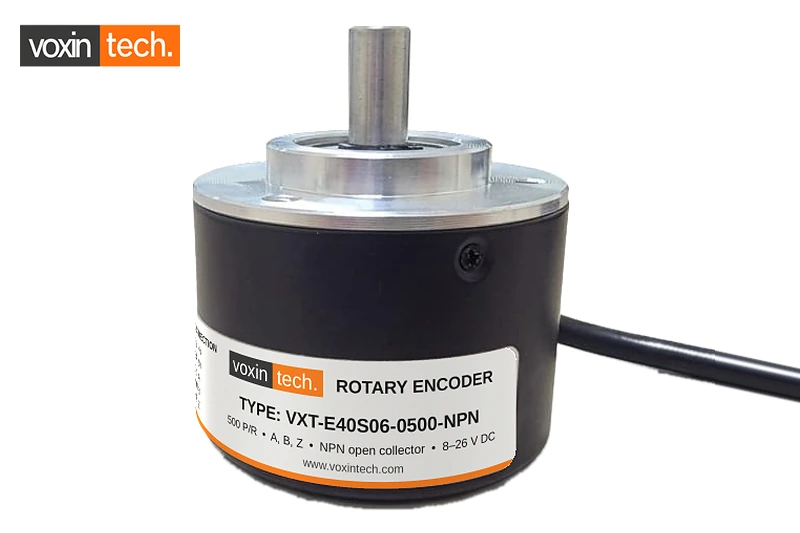
VXT-E40S06-0500-NPN Voxintech incremental rotary encoder
VXT-E40S06-0500-NPN Voxintech Rotary Encoder

Most encoder problems on commissioning day are wiring problems. The encoder is working, but the PLC counts nothing, counts in the wrong direction, or drifts at high speed. This guide covers the wiring for each VXT encoder output type, the standard wire colours, and the checks that fix most counting issues.

VXT encoder wire colours

All VXT encoders use the same colour code, which makes panel drawings and spares simpler.

Wire colour Signal Used on
Red +V supply All models
Black 0 V All models
Green A All models
White B All models
Yellow Z (index) Models with Z channel
Brown /A Line driver models
Grey /B Line driver models
Orange /Z Line driver models
Shield (bare) Frame ground All models

Supply: 8 to 26 V DC for NPN, PNP and totem pole models; 5 V DC for line driver models. Always check the label before powering up.

Wiring an NPN open collector encoder

Models: VXT-E40S06-0500-NPN, VXT-E40S06-1024-NPN, VXT-E38S06-0360-NPN.

  • Red to +24 V, black to 0 V of the same supply that powers the PLC inputs.
  • Green (A), white (B) and yellow (Z, if present) to the PLC high-speed counter inputs.
  • Configure the inputs for NPN sensors. On many compact PLCs this means connecting the input common terminal (often marked S/S, COM or 1M) to +24 V. Check your PLC manual.
  • If the receiving device needs a voltage signal rather than a sinking input, add a pull-up resistor (typically 1 to 4.7 kΩ) from each output to +V.

Wiring a PNP open collector encoder

Model: VXT-E40S06-1024-PNP.

  • Red to +24 V, black to 0 V.
  • A, B and Z to the high-speed counter inputs.
  • Configure the inputs for PNP sensors. On many PLCs, this means connecting the input common to 0 V.
  • For a voltage-type receiver, add a pull-down resistor from each output to 0 V.

Wiring a totem pole encoder

Models: VXT-E50S08-1000-T, VXT-E50S08-1024-T, VXT-E50S08-2500-T.

Wire supply and signals the same way as above. The totem pole output drives the line both high and low, so it works whether the PLC inputs are configured for NPN or PNP sensors. No external resistor is needed in most installations.

Wiring a line driver encoder

Models: VXT-E40S06-1024-L, VXT-E58S06-1024-L, VXT-E58S10-5000-L.

  • Red to +5 V and black to 0 V, usually supplied by the drive or the line driver input module.
  • Connect each pair to a differential input: green (A) and brown (/A), white (B) and grey (/B), yellow (Z) and orange (/Z).
  • Use twisted-pair cable for any extension, keeping each signal with its inverted partner.
  • Do not connect a line driver encoder to a standard 24 V PLC input. It needs an RS-422 receiver, such as a line driver input card or a servo drive encoder input.

Connecting to popular PLCs

Compact PLCs widely used in India, such as Delta DVP, Mitsubishi FX and iQ-F, Siemens S7-1200, Omron CP series and others, include built-in high-speed counter inputs. The steps are similar on all of them:

  • Find which inputs support high-speed counting and which counter mode (single phase, up/down, or A/B phase) they offer.
  • Wire A and B to the inputs assigned to the A/B phase counter. Use Z only if you need a reference or reset.
  • Select the A/B phase (quadrature) mode and the multiplication (1x, 2x or 4x) in the PLC configuration.
  • Check the maximum input frequency for those inputs and compare it with your encoder frequency: rpm × PPR ÷ 60.

Shielding and noise: the most common cause of drifting counts

  • Earth the encoder cable shield at one end only, at the controller or panel earth bar.
  • Keep encoder cables at least 300 mm away from motor, VFD and servo power cables. Cross them at 90° if they must meet.
  • Do not run encoder signals in the same multi-core cable as AC control or power wiring.
  • For long runs or noisy panels, use a line driver encoder.
  • Fit ferrites or output filters on VFDs if counts jump when the drive starts.

Troubleshooting checklist

Symptom Likely cause Fix
No counts at all Wrong input type (NPN vs PNP), no supply, or input common wired wrongly Check supply on red/black; check the input common; swap to the correct output type
Counts in the wrong direction A and B swapped, or direction setting Swap the A and B wires, or invert direction in the PLC
Counts drift or jump Noise, shield not earthed, cable near VFD Earth the shield at one end; reroute the cable; consider a line driver encoder
Misses counts at high speed Frequency above input limit Lower PPR, use a faster input, or use 1x decoding
Count is 4x too high PLC set to 4x quadrature Adjust scaling or select 1x mode
Encoder hot or damaged 24 V applied to a 5 V line driver Check the label; line driver models need 5 V DC

Frequently Asked Questions

What are the wire colours of a VXT encoder?

Red +V, black 0 V, green A, white B, yellow Z, and on line driver models brown /A, grey /B and orange /Z. The bare shield goes to frame ground.

Do I need a pull-up resistor for an NPN encoder?

Not when the PLC input is configured for NPN sensors. You need one only when the receiver expects a voltage signal.

Why is my encoder counting backwards?

Channels A and B are swapped relative to the direction your program expects. Swap the two wires or change the direction setting in the PLC.

Can I extend the encoder cable?

Yes, using shielded twisted-pair cable. For long runs or noisy environments, choose a line driver encoder such as VXT-E40S06-1024-L.

Need wiring help?

Send us your PLC model and the VXT encoder you are using, and we will help you with the connection. Contact us for datasheets, pricing and availability across India.

Delta, Mitsubishi, Siemens, Omron and Autonics are trademarks of their respective owners. They are mentioned for reference only; VXT is not affiliated with these companies.
by Voxintech-admin@2022 Voxintech-admin@2022 No Comments

How to Choose Encoder PPR: Formula, Speed Limits and Worked Examples

Key takeaways

  • Distance per pulse = distance per revolution ÷ PPR.
  • Quadrature (4x) decoding gives four counts for every encoder pulse.
  • Output frequency = rpm × PPR ÷ 60; keep it below both the encoder and PLC input limits.
  • Choose the lowest PPR that meets your resolution; 1000 or 1024 PPR covers most machines.
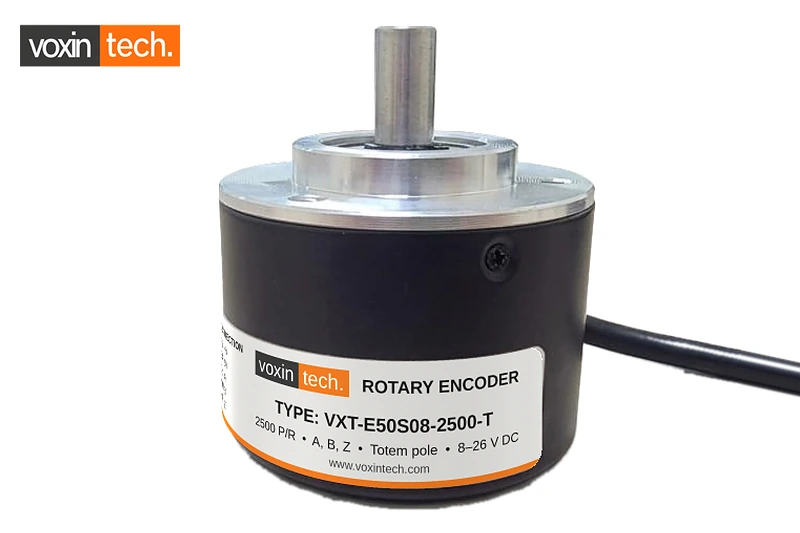
VXT-E50S08-2500-T Voxintech incremental rotary encoder
VXT-E50S08-2500-T Voxintech Rotary Encoder

PPR, or pulses per revolution, is the resolution of an incremental encoder. Pick it too low and your machine cannot position or measure accurately. Pick it too high and the pulse frequency at full speed may exceed what your PLC input or the encoder itself can handle. This guide gives you the formulas and worked examples to choose correctly, using the VXT range of 360, 500, 1000, 1024, 2500 and 5000 PPR.

The three numbers you need

  • Required resolution: the smallest movement you need to detect.
  • Maximum shaft speed in rpm.
  • Maximum input frequency of your PLC high-speed counter, counter module or drive.

Formula 1: Resolution per pulse

Linear distance per pulse = distance per revolution ÷ PPR

For a measuring wheel, the distance per revolution is the wheel circumference (π × diameter). For a ball screw, it is the screw lead.

Example: a 200 mm circumference measuring wheel with a VXT-E50S08-1000-T (1000 PPR) gives 200 ÷ 1000 = 0.2 mm per pulse.

Formula 2: Quadrature multiplies your resolution

An incremental encoder has two channels, A and B, 90° apart. A controller using quadrature decoding counts every rising and falling edge of both channels, which gives 4 counts per pulse:

  • 1024 PPR → 4096 counts per revolution.
  • 2500 PPR → 10,000 counts per revolution.
  • 5000 PPR → 20,000 counts per revolution.

Many PLC high-speed counters and all servo drives support 4x decoding. Check whether your counter is set to 1x, 2x or 4x mode, because it changes the scaling.

Formula 3: Pulse frequency at speed

Output frequency (Hz) = rpm × PPR ÷ 60

This frequency must stay below two limits:

  • the encoder's maximum response frequency (300 kHz for all VXT models), and
  • the maximum input frequency of your PLC or counter (often much lower; check the manual).

Maximum speed (rpm) = maximum frequency × 60 ÷ PPR

Maximum speed of each VXT encoder

VXT model PPR Electrical limit at 300 kHz Mechanical limit Operating limit
VXT-E38S06-0360-NPN 360 50,000 rpm 6000 rpm 6000 rpm
VXT-E40S06-0500-NPN 500 36,000 rpm 6000 rpm 6000 rpm
VXT-E50S08-1000-T 1000 18,000 rpm 6000 rpm 6000 rpm
VXT-E40S06-1024 series, VXT-E50S08-1024-T, VXT-E58S06-1024-L 1024 17,578 rpm 6000 rpm 6000 rpm
VXT-E50S08-2500-T 2500 7200 rpm 6000 rpm 6000 rpm
VXT-E58S10-5000-L 5000 3600 rpm 6000 rpm 3600 rpm

Your PLC input may set a lower limit. For example, if a counter input accepts up to 100 kHz, a 1024 PPR encoder is limited to about 5859 rpm on that input, and a 2500 PPR encoder to 2400 rpm.

Worked examples

Conveyor speed monitoring

A conveyor roller turns at up to 300 rpm and you only need speed. Resolution is not critical, so VXT-E40S06-0500-NPN (500 PPR) gives 2500 Hz at full speed, which any PLC counter can read.

Fabric or film length measurement

A 360 mm circumference measuring wheel on a VXT-E38S06-0360-NPN gives exactly 1 mm per pulse. At 120 m/min the wheel turns at about 333 rpm, producing 2000 Hz.

Packaging machine film feed

A feed roller with a 100 mm circumference needs 0.1 mm resolution. 100 ÷ 0.1 = 1000 PPR, so a VXT-E50S08-1000-T or VXT-E40S06-1024-NPN fits. With 4x decoding you get 0.025 mm per count, giving extra margin.

Print registration

A printing cylinder at up to 2000 rpm needs fine registration. A VXT-E50S08-2500-T gives 10,000 counts per revolution with 4x decoding and 83 kHz at 2000 rpm, within the input range of most high-speed counter modules.

Servo-driven rotary table

A rotary table driven at up to 600 rpm needs high angular resolution. A VXT-E58S10-5000-L gives 20,000 counts per revolution (0.018° per count) with 4x decoding and outputs 50 kHz at 600 rpm, using RS-422 signals for noise immunity.

Rules of thumb

  • Choose the lowest PPR that meets your resolution with some margin. It reduces frequency and makes the system more robust.
  • 1000 or 1024 PPR covers most packaging, conveyor and general automation work.
  • Use 360 PPR when you want one pulse per degree or simple length maths.
  • Use 2500 or 5000 PPR for registration and precision positioning, and check the speed limit.
  • When replacing an existing encoder, keep the same PPR unless you are ready to change the program scaling.

Frequently Asked Questions

What is the difference between PPR and CPR?

PPR is pulses per revolution on one channel. CPR (counts per revolution) is usually PPR × 4 when the controller uses quadrature decoding on channels A and B.

Is 1024 PPR better than 1000 PPR?

Neither is more accurate in practice. 1000 PPR makes decimal calculations easy; 1024 PPR is common in drives and existing programs. Match whatever your machine program expects.

Why does my encoder miss counts at high speed?

The pulse frequency is probably above the PLC input limit or the cable is too long for the output type. Lower the PPR, use a faster counter input, or switch to a line driver encoder.

What is the maximum speed of a 5000 PPR encoder?

For VXT-E58S10-5000-L, 3600 rpm, set by the 300 kHz response frequency.

Not sure which PPR fits your machine?

Tell us your speed, required resolution and controller model, and we will recommend the right VXT encoder. Contact us for datasheets, pricing and availability across India.

by Voxintech-admin@2022 Voxintech-admin@2022 No Comments

Omron and Autonics Encoder Alternatives: VXT Cross-Reference Guide

Key takeaways

  • Decode your existing model number first: Omron suffixes and Autonics codes show the output type.
  • Match output type, then size, shaft, PPR and supply voltage.
  • Common matches: Omron E6B2-CWZ6C to VXT-E40S06 NPN; Autonics E50S8 T-type to VXT-E50S08.
  • Always compare the flange hole pattern before replacing on a running machine.
VXT-E40S06-1024-L Voxintech incremental rotary encoder
VXT-E40S06-1024-L Voxintech Rotary Encoder

When an encoder fails on a running machine, the first question is usually "what can replace it today?" Omron and Autonics encoders are among the most widely installed in India, so they are also the models we are asked to match most often. This guide shows how to read their model numbers, what to check before replacing, and which VXT encoder fits each common type.

Step 1: Decode the model number you have

Omron E6B2-C (40 mm)

The output type is in the suffix:

  • E6B2-CWZ6C: NPN open collector (published supply 5 to 24 V DC).
  • E6B2-CWZ5B: PNP open collector (12 to 24 V DC).
  • E6B2-CWZ3E: voltage output (NPN with pull-up).
  • E6B2-CWZ1X: line driver (RS-422 compatible, 5 V DC).

The resolution is printed after the model, for example "1000P/R", together with the cable length, for example "2M".

Omron 50 mm encoders

Omron's E6C2-C is a slim 50 mm encoder (for example E6C2-CWZ6C, NPN open collector), and the E6C3-C is a heavier-duty 50 mm series with an 8 mm shaft.

Autonics E40S, E50S and E58

Autonics model codes follow a clear pattern, for example E50S8-1024-3-T-24:

  • E50S8: series and size (50 mm housing, 8 mm shaft). E40S6 means 40 mm with a 6 mm shaft; E58SC10 means a 58 mm clamping-flange type with a 10 mm shaft.
  • 1024: pulses per revolution.
  • 3: output phases A, B, Z. 6 means A, /A, B, /B, Z, /Z (line driver).
  • T: output type. T = totem pole, N = NPN open collector, V = voltage output, L = line driver.
  • 24: supply 12 to 24 V DC. 5 means 5 V DC.

Step 2: The cross-reference table

Existing model (type) Output Matching VXT model
Omron E6B2-CWZ6C 500P/R NPN open collector VXT-E40S06-0500-NPN
Omron E6B2-CWZ6C 1024P/R NPN open collector VXT-E40S06-1024-NPN
Omron E6B2-CWZ6C 360P/R (where space is tight) NPN open collector VXT-E38S06-0360-NPN (38 mm, A/B only)
Omron E6B2-CWZ5B 1000P/R PNP open collector VXT-E40S06-1024-PNP (update PLC scaling from 1000 to 1024)
Omron E6B2-CWZ1X 1024P/R Line driver VXT-E40S06-1024-L
Autonics E40S6-1024-3-N-24 NPN open collector VXT-E40S06-1024-NPN
Autonics E40S6-500-3-N-24 NPN open collector VXT-E40S06-0500-NPN
Autonics E40S6-1024-6-L-5 Line driver VXT-E40S06-1024-L
Autonics E50S8-1000-3-T-24 Totem pole VXT-E50S08-1000-T
Autonics E50S8-1024-3-T-24 Totem pole VXT-E50S08-1024-T
Autonics E50S8-2500-3-T-24 Totem pole VXT-E50S08-2500-T
58 mm line driver, 6 mm shaft, 1024 PPR Line driver VXT-E58S06-1024-L
58 mm line driver, 10 mm shaft, high resolution Line driver VXT-E58S10-5000-L

Where your existing encoder uses a voltage output (Omron "3E" or Autonics "V"), a VXT totem pole model is usually the best substitute for 12 V and 24 V inputs, because it drives the line both high and low. Confirm with us if your receiver is a 5 V logic input.

Step 3: Check these five things before you swap

  • Mounting: compare the spigot diameter and the flange hole pattern. VXT-E40S06 and VXT-E38S06 use a ø20 mm spigot with 3 × M3 on a ø30 mm pitch circle. VXT-E50S08 uses a ø30 mm spigot with 3 × M4 on ø40 mm. VXT-E58 uses a ø36 mm spigot with 3 × M4 on ø48 mm.
  • Shaft diameter: 6, 8 or 10 mm. Your coupling bore must match.
  • Output type: NPN, PNP, totem pole or line driver must suit the input. This matters more than the brand.
  • PPR: match it, or update the scaling in the PLC or the electronic gear in the drive.
  • Supply voltage: 8 to 26 V DC for VXT NPN, PNP and totem pole models; 5 V DC for line driver models.

Other brands we are asked to match

Customers also bring us encoders from Hengstler, Kübler, Sick, Baumer, Koyo and Pepperl+Fuchs. The same five checks apply. Send us a photo of the label and the flange, and we will suggest the closest VXT model.

Why switch to VXT?

  • Equivalent outputs for the most common Omron and Autonics types.
  • Up to 300 kHz response frequency across the range.
  • Wide 8 to 26 V DC supply on open collector and totem pole models.
  • IP54 protection with a 2 m shielded cable.
  • Clear datasheets with wire colours, dimensions and timing.
  • Supply across India with selection and wiring support, and a 1-year warranty.

Frequently Asked Questions

What is the VXT equivalent of Omron E6B2-CWZ6C?

For 1024 PPR, the VXT-E40S06-1024-NPN; for 500 PPR, the VXT-E40S06-0500-NPN. Both are 40 mm encoders with a 6 mm shaft and NPN open collector output. Check the mounting hole pattern against your bracket.

What is the VXT equivalent of Autonics E50S8-1024-3-T-24?

The VXT-E50S08-1024-T: 50 mm housing, 8 mm shaft, 1024 PPR, totem pole output with A, B and Z channels.

Can I replace a line driver encoder with an NPN encoder?

Only if the receiver accepts single-ended NPN signals. Servo drives and RS-422 inputs need a line driver encoder such as VXT-E40S06-1024-L or VXT-E58S10-5000-L.

What if my PPR is not listed?

Contact us with your required PPR, size and output. We will advise the closest available VXT model or the scaling change needed.

Get a matching VXT encoder

Send us the model number or a label photo of your current encoder. Contact us for a cross-reference, datasheet, pricing and availability anywhere in India.

Omron, Autonics, Hengstler, Kübler, Sick, Baumer, Koyo and Pepperl+Fuchs are trademarks of their respective owners. They are mentioned for cross-reference only; VXT is not affiliated with, endorsed by or sponsored by these companies. Always verify dimensions and specifications against your application before replacing.

by Voxintech-admin@2022 Voxintech-admin@2022 No Comments

NPN vs PNP vs Totem Pole vs Line Driver: Which Encoder Output Do You Need?

Key takeaways

  • NPN outputs sink current; use them with PLC inputs configured for NPN sensors.
  • PNP outputs source current; use them with inputs configured for PNP sensors.
  • Totem pole outputs work with both; line drivers need an RS-422 differential receiver.
  • When unsure on a 24 V PLC, a totem pole encoder such as VXT-E50S08-1024-T is the safest choice.
VXT-E40S06-1024-PNP Voxintech incremental rotary encoder
VXT-E40S06-1024-PNP Voxintech Rotary Encoder

Two encoders can look identical, share the same size and PPR, and still refuse to work with your PLC. The difference is the output circuit. Getting it right is the single most important step when ordering an incremental encoder. This guide explains the four common output types in plain terms and shows the matching VXT encoder for each.

The short answer

Your controller input Choose this output VXT example
PLC input configured for NPN sensors (most common in India) NPN open collector VXT-E40S06-1024-NPN
PLC input configured for PNP sensors PNP open collector VXT-E40S06-1024-PNP
Not sure, or mixed customer base Totem pole (push-pull) VXT-E50S08-1024-T
Servo drive, motion controller, CNC, long cable Line driver (RS-422) VXT-E40S06-1024-L, VXT-E58S10-5000-L

NPN open collector

An NPN output switches the signal line to 0 V when active. It sinks current. The input on the other side must provide the current, either through its own internal circuit (inputs configured for NPN sensors) or through a pull-up resistor to +V.

  • Pros: the most widely used encoder output in Indian panels; works on any supply from 8 to 26 V DC on VXT models; simple and robust.
  • Watch out for: without a pull-up, you will not see a voltage on a multimeter, which confuses many first-time installers. Rise time depends on the pull-up resistor and cable length, so keep cables reasonably short at high pulse rates.
  • VXT models: VXT-E40S06-0500-NPN, VXT-E40S06-1024-NPN, VXT-E38S06-0360-NPN.

PNP open collector

A PNP output switches the signal line to +V when active. It sources current into the input. It suits PLC inputs configured for PNP sensors, which are common in European-designed machines and some OEM panels.

  • Pros: direct connection to PNP-type inputs; signal is "high" when active, which is intuitive to test.
  • Watch out for: a voltage-type receiver may need a pull-down resistor to 0 V.
  • VXT model: VXT-E40S06-1024-PNP.

Totem pole (push-pull)

A totem pole output has two transistors stacked between +V and 0 V. It actively drives the line high and actively drives it low. That gives sharp edges in both directions and means the output works with both NPN-type and PNP-type inputs.

  • Pros: universal compatibility with 12 V and 24 V PLC inputs; cleaner edges than open collector at higher frequencies; no external resistor in most cases.
  • Watch out for: never connect two totem pole outputs together, and do not connect the output directly to +V or 0 V.
  • VXT models: VXT-E50S08-1000-T, VXT-E50S08-1024-T, VXT-E50S08-2500-T.

In model codes from other makers you may see a similar output under different names. For example, Autonics uses the letter "T" for totem pole in codes such as E50S8-1024-3-T-24, "N" for NPN open collector and "L" for line driver.

Line driver (RS-422 differential)

A line driver outputs each channel twice: the signal and its inverted copy (A and /A, B and /B, Z and /Z). The receiver measures the difference between the pair, so noise picked up on the cable cancels out.

  • Pros: the best noise immunity; supports long cables; standard input on servo drives, motion controllers and CNC; allows broken-wire detection on many drives.
  • Watch out for: needs a differential (RS-422) receiver. It cannot be wired straight into a standard 24 V PLC input. VXT line driver models run on 5 V DC.
  • VXT models: VXT-E40S06-1024-L (40 mm), VXT-E58S06-1024-L (58 mm, 6 mm shaft), VXT-E58S10-5000-L (58 mm, 10 mm shaft, 5000 PPR).

Omron uses the suffix "1X" for line driver models in the E6B2-C series (E6B2-CWZ1X), while its NPN open collector version is E6B2-CWZ6C and its PNP version is E6B2-CWZ5B. If you are replacing one of these, match the output type first, then the size and PPR.

How to check what your PLC needs

  • Look at the high-speed counter section of the PLC manual. It will state whether the inputs are sink or source type, the input voltage, and the maximum input frequency.
  • Check how the input common (COM or S/S terminal) is wired. On many PLCs, wiring the common to +24 V configures the inputs for NPN sensors, and wiring it to 0 V configures them for PNP sensors.
  • For servo drives, check the encoder input specification. "Line driver" or "RS-422" means you need a differential encoder.
  • If in doubt, choose a totem pole encoder for 24 V PLC inputs.

Common mistakes we see

  • Ordering a line driver encoder for a 24 V PLC input. It will not count reliably and can be damaged by 24 V.
  • Connecting an NPN encoder to an input configured for PNP sensors. The input never turns on.
  • Powering a 5 V line driver encoder from 24 V. Always check the supply rating on the label.
  • Leaving the cable shield unconnected, or earthing it at both ends near a VFD.

Frequently Asked Questions

Is NPN or PNP better for an encoder?

Neither is better; they suit different inputs. NPN is more common in Indian panels and with Japanese and Taiwanese PLC brands. PNP is common in European-designed machines. Match the encoder to the input.

Can a totem pole encoder replace an NPN encoder?

In most 12 V and 24 V PLC applications, yes. A totem pole output drives the line both high and low, so it works with inputs configured for NPN or PNP sensors.

Why does my line driver encoder not work with my PLC?

Most standard PLC inputs are single-ended 24 V inputs. A line driver encoder outputs 5 V differential signals and needs an RS-422 receiver, such as a line driver input module or servo drive input.

Which VXT encoder should I stock as a universal spare?

For 24 V PLC applications, the VXT-E50S08-1024-T totem pole encoder covers both NPN-type and PNP-type inputs.

Need help choosing?

Send us your PLC or drive model and we will confirm the right VXT encoder output. Contact us for datasheets, pricing and availability across India.

Omron and Autonics are trademarks of their respective owners. They are mentioned for reference only; VXT is not affiliated with these companies.
by Voxintech-admin@2022 Voxintech-admin@2022 No Comments

Compact 38 mm Encoder with 360 PPR: VXT-E38S06-0360-NPN

Key takeaways

  • 360 PPR means one pulse per degree, which makes angle and length maths simple.
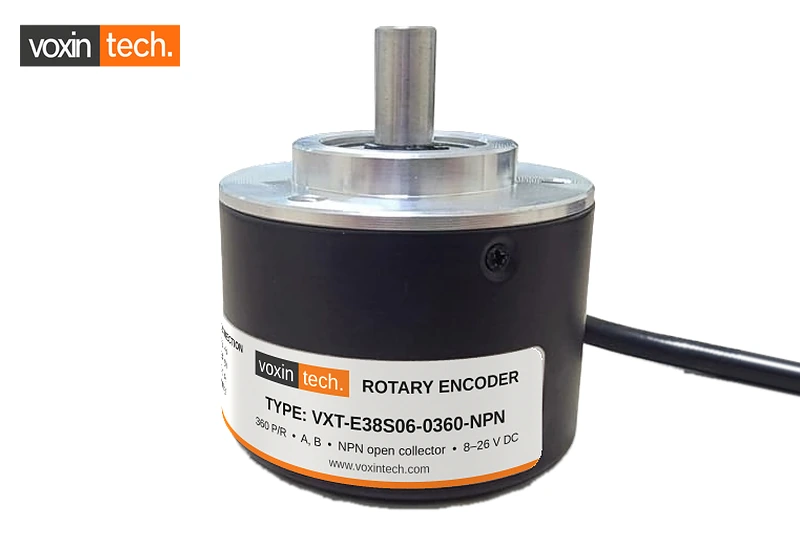
  • VXT-E38S06-0360-NPN is a compact 38 mm encoder with a 6 mm shaft and A/B outputs.
  • A 360 mm circumference measuring wheel gives exactly 1 mm per pulse.
  • For a Z index pulse or higher PPR, move to the 40 mm VXT-E40S06 series.
VXT-E38S06-0360-NPN Voxintech incremental rotary encoder
VXT-E38S06-0360-NPN Voxintech Rotary Encoder

Not every machine needs a large, high-resolution encoder. Many counting, length and angle jobs need something compact, easy to wire and simple to scale. The VXT-E38S06-0360-NPN is built for exactly that: a 38 mm housing, a 6 mm shaft and 360 pulses per revolution, which means one pulse for every degree of rotation.

Key specifications

Specification Value
Housing ø38 mm
Shaft ø6 mm g6 solid shaft with flat
Resolution 360 PPR (1 pulse per degree)
Output NPN open collector
Channels A and B (90° quadrature)
Supply 8–26 V DC
Response frequency up to 300 kHz
Mechanical speed 6000 rpm
Mounting ø20 mm spigot, 3 × M3 on ø30 mm pitch circle
Cable 2 m shielded, radial exit
Protection IP54, −20 to +85 °C

Why 360 PPR is so practical

With 360 PPR, the maths is simple:

  • Angle: each pulse is exactly 1°. A cam position of 90° is 90 pulses.
  • Length with a measuring wheel: with a 360 mm circumference wheel, each pulse is 1 mm. With a 180 mm wheel, each pulse is 0.5 mm.
  • Speed: at 1 revolution per second, the encoder gives 360 Hz. At the 6000 rpm mechanical limit it gives 36 kHz, well inside the input range of most PLC high-speed counters.

Because the numbers are round, commissioning is faster and there is less risk of scaling errors in the PLC program.

Where a compact 38 mm encoder fits

  • Length counting: cloth, paper, foil, wire, hose and cable measured with a wheel.
  • Printing and paper converting: sheet counting and simple registration.
  • Textile machines: fabric inspection and rolling machines.
  • Rotary tables and cams: angle indexing in degrees.
  • Retrofit jobs where space behind the shaft is tight.
  • Speed monitoring on small motors and rollers.

NPN output with A and B channels

The VXT-E38S06-0360-NPN provides two quadrature channels, A and B, with NPN open collector outputs. Connect them to PLC high-speed counter inputs configured for NPN sensors. With A and B, the controller detects direction as well as distance, which is important for reversing material or manual hand-wheel style inputs.

Wiring:

Wire colour Signal
Red +V (8–26 V DC)
Black 0 V
Green A
White B
Shield Frame ground

If your receiver needs a voltage signal rather than a sinking input, add a pull-up resistor from each output to +V.

Compared with 40 mm encoders

The 38 mm VXT-E38S06 shares the same 6 mm shaft and ø30 mm mounting pitch circle as our 40 mm VXT-E40S06 series, with a slightly smaller body. If your design uses 40 mm encoders such as the Omron E6B2-C or Autonics E40S6 in 360 PPR, the VXT-E38S06-0360-NPN is worth considering where space is limited. Always confirm the spigot diameter and hole positions against your bracket.

If you need a Z (index) pulse or a different PPR, look at the 40 mm VXT-E40S06 series, which offers 500 and 1024 PPR with A, B and Z channels.

When 360 PPR is enough, and when to go higher

360 PPR is the right choice when simple maths and reliable counting matter more than very fine resolution. It suits:

  • Length counting to 1 mm or 0.5 mm with a suitably sized measuring wheel.
  • Angle positioning to 1°, or 0.25° per count when the PLC uses 4x quadrature decoding on A and B.
  • Older or basic counters with low maximum input frequency. At 1500 rpm the encoder outputs only 9 kHz.
  • Long cable runs with NPN outputs, where a lower pulse rate gives cleaner signals.

Move up to a higher resolution when you need finer registration or slow-speed position control. The VXT-E40S06-1024-NPN (1024 PPR) or the VXT-E50S08-2500-T (2500 PPR) are the usual next steps, and both add a Z index pulse for homing.

A typical length-counting setup

A common setup on cloth inspection, cable coiling and paper rewinding machines looks like this:

  • A measuring wheel with a rubber or knurled surface rides on the material.
  • The wheel is fitted directly to the encoder shaft, or through a flexible coupling, on a spring-loaded swing arm.
  • The VXT-E38S06-0360-NPN outputs A and B pulses to a PLC high-speed counter or a preset counter.
  • The PLC multiplies the count by the length per pulse and stops the machine or triggers a cutter at the set length.

Because the encoder housing is only 38 mm in diameter, the swing arm stays light and compact, which helps the wheel follow the material without bouncing.

Installation tips

  • Use a flexible coupling; keep shaft loads within 30 N radial and 20 N axial.
  • For measuring wheels, use a spring-loaded arm to keep steady contact pressure.
  • Earth the shield at the controller end and keep the cable away from inverter outputs.

Frequently Asked Questions

What does 360 PPR mean?

360 pulses per revolution. Each pulse represents 1° of shaft rotation, which makes angle and length calculations simple.

Does the VXT-E38S06-0360-NPN have a Z index pulse?

No. It provides A and B quadrature channels. For a Z index pulse, choose a model from the VXT-E40S06 series.

Can I use it with a 24 V PLC?

Yes. It accepts 8 to 26 V DC and connects to high-speed counter inputs configured for NPN sensors.

How do I calculate length with a 360 PPR encoder?

Length per pulse = wheel circumference ÷ 360. For example, a 360 mm circumference wheel gives 1 mm per pulse.

Order the VXT-E38S06-0360-NPN

Contact us for the datasheet, pricing and availability. We supply VXT encoders across India with a 1-year warranty and help with wiring and PLC scaling.

Omron and Autonics are trademarks of their respective owners. They are mentioned for comparison only; VXT is not affiliated with these companies.
by Voxintech-admin@2022 Voxintech-admin@2022 No Comments

58 mm Line Driver Encoders for Servo, CNC and Motion Control

Key takeaways

  • Line driver (RS-422) encoders send each signal with its inverted copy for high noise immunity.
  • VXT-E58S06-1024-L and VXT-E58S10-5000-L suit servo drives, motion controllers and CNC.
  • VXT-E58S10-5000-L gives 20,000 counts per revolution with 4x decoding, up to 3600 rpm.
  • Line driver encoders need a differential input and a 5 V supply, not a standard 24 V PLC input.
VXT-E58S10-5000-L Voxintech incremental rotary encoder
VXT-E58S10-5000-L Voxintech Rotary Encoder

Motion control is where encoder signal quality matters most. Servo drives, motion controllers and CNC systems count every edge, often at high frequency and over cable runs that pass right beside power wiring. A line driver encoder with RS-422 differential outputs is the standard answer, and the 58 mm housing is the standard size for industrial motion feedback. The VXT-E58 series brings both together.

The VXT-E58 line driver range

Model Housing Shaft Resolution Output Supply
VXT-E58S06-1024-L ø58 mm ø6 mm 1024 PPR Line driver (RS-422) 5 V DC ±5 %
VXT-E58S10-5000-L ø58 mm ø10 mm 5000 PPR Line driver (RS-422) 5 V DC ±5 %

Both models output A, /A, B, /B, Z and /Z, have a ø36 mm spigot with three M4 mounting holes at 120° on a ø48 mm pitch circle, a 2 m shielded radial cable, IP54 protection and an operating range of −20 to +85 °C. Response frequency is up to 300 kHz.

Why line driver (differential) output?

A line driver sends each channel twice: the normal signal and its inverted copy. The receiver looks at the difference between the two wires. Electrical noise picked up along the cable affects both wires equally, so it cancels out at the receiver. The benefits:

  • High noise immunity near VFDs, servo drives and welding equipment.
  • Longer cable runs than single-ended NPN or PNP outputs.
  • Cable fault detection: many drives can detect a broken wire because the differential pair goes out of balance.
  • Direct compatibility with servo drive and motion controller encoder inputs, which typically expect RS-422 signals at 5 V.

VXT-E58S06-1024-L: 58 mm housing, 6 mm shaft

This model combines the stability of a 58 mm body with a 6 mm shaft. It suits machines where the encoder couples to a small roller or gearbox output but the mounting plate is designed for a 58 mm flange. 1024 PPR gives 4096 counts per revolution when the controller uses quadrature (4x) decoding, which is plenty for most positioning tasks.

VXT-E58S10-5000-L: high resolution with a 10 mm shaft

With 5000 PPR, this encoder gives 20,000 counts per revolution in 4x quadrature mode. The 10 mm shaft and higher shaft load rating (40 N radial, 30 N axial) suit heavier couplings and industrial gearboxes. Typical uses include CNC rotary axes, servo-driven index tables, precision cut-to-length and high-accuracy positioning.

Speed note: at 5000 PPR, the 300 kHz response frequency allows up to 3600 rpm (300,000 × 60 ÷ 5000). For faster shafts, choose a lower PPR or gear down the encoder.

An alternative to Autonics E58 and other 58 mm encoders

The 58 mm size is used by many encoder makers, including the Autonics E58 series (for example E58SC10 clamping-flange models with "6-L-5" line driver codes), as well as 58 mm ranges from Hengstler and Kübler. Omron's 40 mm E6B2-CWZ1X is another common line driver model.

If you use Consider
Autonics E58SC10-1024-6-L-5 (58 mm, 10 mm shaft, line driver) VXT-E58S10-5000-L if you need higher resolution, or contact us for 1024 PPR with a 10 mm shaft
58 mm line driver encoder, 6 mm shaft, 1024 PPR VXT-E58S06-1024-L
Omron E6B2-CWZ1X (40 mm, line driver) VXT-E40S06-1024-L (40 mm)

Check before replacing:

  • Flange type: 58 mm encoders come with synchro (servo) flanges and clamping flanges. VXT-E58 uses a ø36 mm spigot with M4 holes on a ø48 mm pitch circle.
  • Shaft diameter: 6 mm or 10 mm.
  • PPR: match it, or change the electronic gear ratio or scaling in your drive.
  • Supply: 5 V DC; most servo drives provide this from the encoder connector.

Wiring a VXT line driver encoder

Wire colour Signal
Red +5 V
Black 0 V
Green A
Brown /A
White B
Grey /B
Yellow Z
Orange /Z
Shield Frame ground

Connect each pair (A and /A, B and /B, Z and /Z) to the matching differential input of the drive or controller. Use twisted-pair cable for extensions and terminate long lines according to the receiver's instructions. Earth the shield at the controller end.

Typical applications

  • Servo motor feedback and closed-loop positioning.
  • CNC machines: spindle orientation, rotary tables and manual pulse generator replacement.
  • Robotics and pick-and-place.
  • Precision cut-to-length and flying shear.
  • Printing registration on high-speed lines.
  • Test rigs and laboratory equipment.

Frequently Asked Questions

What is a line driver encoder?

A line driver encoder outputs each signal together with its inverted copy (A and /A, B and /B, Z and /Z) to RS-422 levels. The receiver reads the difference, which rejects noise and allows longer cables.

Can I connect a line driver encoder to a normal PLC input?

Not directly. A line driver needs a differential (RS-422) receiver input, such as those on servo drives, motion controllers or PLC high-speed counter modules with line driver inputs. For a standard 24 V PLC input, choose an NPN, PNP or totem pole encoder instead.

What is the maximum speed of the VXT-E58S10-5000-L?

3600 rpm, set by the 300 kHz response frequency at 5000 PPR. The mechanical limit of the housing is 6000 rpm.

What supply voltage do VXT line driver encoders need?

5 V DC ±5 %. Most servo drives and motion controllers supply this through the encoder connector.

Order VXT 58 mm line driver encoders

Send us your drive or controller model, the shaft size and the PPR you need. Contact us for datasheets, pricing and availability across India.

Autonics, Omron, Hengstler and Kübler are trademarks of their respective owners. They are mentioned for comparison and cross-reference only; VXT is not affiliated with these companies.
by Voxintech-admin@2022 Voxintech-admin@2022 No Comments

50 mm Encoder with 8 mm Shaft: The VXT-E50S08 Totem Pole Series

Key takeaways

  • A totem pole (push-pull) output works with both NPN-type and PNP-type PLC inputs.
  • VXT-E50S08 is available in 1000, 1024 and 2500 PPR with an 8 mm shaft.
  • Choose 1000 PPR for decimal maths, 1024 to match existing programs, 2500 for registration.
  • A matching option for Autonics E50S8 totem pole models such as E50S8-1024-3-T-24.
VXT-E50S08-1000-T Voxintech incremental rotary encoder
VXT-E50S08-1000-T Voxintech Rotary Encoder

When a machine needs a sturdier shaft, a larger bearing span and an output that works with almost any controller, the 50 mm encoder with an 8 mm shaft is the standard choice. The VXT-E50S08 series pairs this robust size with a totem pole (push-pull) output, which connects to both NPN-type and PNP-type PLC inputs. That makes it one of the most versatile encoders you can stock.

The VXT-E50S08 range

Model Resolution Output Supply Channels
VXT-E50S08-1000-T 1000 PPR Totem pole (push-pull) 8–26 V DC A, B, Z
VXT-E50S08-1024-T 1024 PPR Totem pole (push-pull) 8–26 V DC A, B, Z
VXT-E50S08-2500-T 2500 PPR Totem pole (push-pull) 8–26 V DC A, B, Z

Common specifications: ø50 mm housing, ø8 mm g6 solid shaft with a flat, ø30 mm spigot, three M4 mounting holes on a ø40 mm pitch circle, 2 m shielded radial cable, response frequency up to 300 kHz, 6000 rpm mechanical speed, IP54, −20 to +85 °C.

Why a totem pole output?

A totem pole output has two transistors: one drives the signal high and one drives it low. The result is a clean, actively driven square wave in both directions. In practical terms:

  • It works with NPN-type and PNP-type inputs, so one encoder model covers machines built for different controllers.
  • Edges are faster and cleaner than with an open collector and a weak pull-up, which helps at higher pulse rates.
  • No external pull-up resistor is needed in most installations.

For OEMs supplying machines to customers with different PLC brands, standardising on a totem pole encoder reduces the number of spares to stock.

Choosing between 1000, 1024 and 2500 PPR

  • VXT-E50S08-1000-T: 1000 PPR makes decimal calculations easy. With a 100 mm circumference measuring wheel, every pulse is 0.1 mm.
  • VXT-E50S08-1024-T: 1024 PPR is a binary-friendly value used by many drives, motion modules and existing machine programs. Choose it when replacing an existing 1024 PPR encoder so no scaling changes are needed.
  • VXT-E50S08-2500-T: 2500 PPR gives finer resolution for print registration, cut-to-length accuracy and slow-speed position control. At the 300 kHz response limit it supports up to 7200 rpm electrically, so the 6000 rpm mechanical limit still applies.

An alternative to Autonics E50S8 and Omron 50 mm encoders

The Autonics E50S8 series is one of the most widely used 50 mm, 8 mm shaft encoders in India, and its totem pole versions carry a "T" in the model code, for example E50S8-1000-3-T-24. Omron offers 50 mm encoders in the E6C2-C and E6C3-C families. If you are looking for an equivalent:

If you use Consider
Autonics E50S8-1000-3-T-24 VXT-E50S08-1000-T
Autonics E50S8-1024-3-T-24 VXT-E50S08-1024-T
Autonics E50S8-2500-3-T-24 VXT-E50S08-2500-T
Omron 50 mm encoder, 8 mm shaft VXT-E50S08 model with matching PPR (check the output type)

Before replacing, compare the mounting hole pattern, spigot diameter and cable exit direction with your existing installation. Published data for the Autonics E50S series lists a maximum of 5000 rpm; VXT-E50S08 is rated to 6000 rpm mechanically. Both support response frequencies up to 300 kHz.

Where the VXT-E50S08 fits best

  • Printing and converting: web speed, print registration and sheet counting on flexo, offset and rotogravure lines.
  • Cut-to-length lines: steel coil, paper, film and corrugated board, using a measuring wheel on the material.
  • Conveyors and material handling: belt speed, tracking and synchronisation.
  • Textile machinery: fabric length on stenters, inspection machines and folding machines.
  • Packaging machines: form-fill-seal, carton erectors and labellers.
  • Wire and cable: length counting on take-up and coiling machines.

Installation tips

  • Use a flexible coupling and keep shaft loads within 30 N radial and 20 N axial.
  • For measuring-wheel applications, mount the encoder on a spring-loaded arm so the wheel keeps constant contact without overloading the shaft.
  • Route the encoder cable separately from motor and inverter cables, and earth the shield at the controller end.

Frequently Asked Questions

What is a totem pole encoder?

A totem pole (push-pull) encoder drives its output actively both high and low. It can be connected to PLC inputs configured for NPN sensors or for PNP sensors, which makes it more flexible than an open collector encoder.

Can I use VXT-E50S08-1024-T with a Delta, Mitsubishi or Siemens PLC?

Yes, as long as the PLC high-speed counter input accepts 24 V signals at your pulse rate. The totem pole output works with both NPN and PNP input configurations.

Is VXT-E50S08 a replacement for Autonics E50S8?

It is in the same 50 mm, 8 mm shaft class with an equivalent totem pole output. Check the mounting holes and cable direction, or share your Autonics model number and we will confirm the closest match.

What is the maximum speed of the VXT-E50S08-2500-T?

The mechanical limit is 6000 rpm. At 2500 PPR and the 300 kHz response limit, the electrical limit is 7200 rpm, so 6000 rpm is the operating limit.

Order the VXT-E50S08 series

Contact us with the PPR and quantity you need, or the model you want to replace. We supply VXT encoders across India with datasheets, wiring support and a 1-year warranty.

Autonics and Omron are trademarks of their respective owners. They are mentioned for comparison and cross-reference only; VXT is not affiliated with these companies.
by Voxintech-admin@2022 Voxintech-admin@2022 No Comments

40 mm Rotary Encoder with 6 mm Shaft: The VXT-E40S06 Series

Key takeaways

  • The 40 mm housing with 6 mm shaft is India's most common encoder size.
  • VXT-E40S06 comes in NPN (500 and 1024 PPR), PNP and line driver versions.
  • It is in the same class as Omron E6B2-C and Autonics E40S6; check mounting and PPR before swapping.
  • Up to 300 kHz response and IP54 protection across the series.
VXT-E40S06-1024-NPN Voxintech incremental rotary encoder
VXT-E40S06-1024-NPN Voxintech Rotary Encoder

The 40 mm housing with a 6 mm solid shaft is the most popular encoder size in Indian automation. It fits compact machines, mounts on standard brackets and couples easily to rollers and motor shafts. The VXT-E40S06 series covers this size in four ready-to-ship versions, so you can match the output to your controller instead of adapting the controller to the encoder.

The VXT-E40S06 range at a glance

Model Resolution Output Supply Channels
VXT-E40S06-0500-NPN 500 PPR NPN open collector 8–26 V DC A, B, Z
VXT-E40S06-1024-NPN 1024 PPR NPN open collector 8–26 V DC A, B, Z
VXT-E40S06-1024-PNP 1024 PPR PNP open collector 8–26 V DC A, B, Z
VXT-E40S06-1024-L 1024 PPR Line driver (RS-422) 5 V DC A, /A, B, /B, Z, /Z

All four share the same mechanics: ø40 mm housing, ø6 mm g6 solid shaft with a flat, ø20 mm spigot, three M3 mounting holes on a ø30 mm pitch circle, and a 2 m shielded radial cable. Response frequency is up to 300 kHz and the mechanical speed limit is 6000 rpm. Protection is IP54 with an operating range of −20 to +85 °C.

Which VXT-E40S06 model should you choose?

VXT-E40S06-1024-NPN: the everyday workhorse

If your PLC high-speed counter inputs are configured for NPN sensors, which is the most common setup in Indian panels, this is the model to start with. 1024 PPR gives fine enough resolution for conveyor tracking, roll length measurement and packaging machine timing, while staying well within the input frequency of most PLC counters at normal machine speeds.

VXT-E40S06-0500-NPN: simple speed and counting jobs

At 500 PPR, the pulse rate is half that of a 1024 PPR encoder at the same speed. That makes it a good fit for older PLCs or counters with lower input frequency limits, and for speed monitoring where very fine resolution is not needed.

VXT-E40S06-1024-PNP: for PNP-input controllers

Many European-style panels and some OEM machines use inputs configured for PNP sensors. The PNP open collector output sources current to the input, so it connects directly without an interface relay or converter.

VXT-E40S06-1024-L: for drives, motion controllers and long cables

The line driver version outputs differential A, /A, B, /B, Z and /Z signals at 5 V DC to RS-422 levels. Differential signalling rejects electrical noise from VFDs and servo drives and supports longer cable runs. Choose it for servo drive feedback, motion controller inputs and CNC retrofits.

An alternative to Omron E6B2-C and Autonics E40S6

The 40 mm, 6 mm shaft class is also served by well-known models such as the Omron E6B2-C series and the Autonics E40S6 series. Machine builders often ask us for an equivalent when lead times are long or budgets are tight. The table below shows which VXT-E40S06 model matches each common output type.

If you use Output type Consider
Omron E6B2-CWZ6C NPN open collector VXT-E40S06-1024-NPN or VXT-E40S06-0500-NPN
Omron E6B2-CWZ5B PNP open collector VXT-E40S06-1024-PNP
Omron E6B2-CWZ1X Line driver VXT-E40S06-1024-L
Autonics E40S6-…-N-24 NPN open collector VXT-E40S06-1024-NPN
Autonics E40S6-…-6-L-5 Line driver VXT-E40S06-1024-L

A few points to check before replacing:

  • Mounting: compare the flange hole pattern and spigot with your existing bracket.
  • Resolution: match the PPR, or update the scaling in your PLC program.
  • Supply: VXT open collector models accept 8 to 26 V DC, which covers standard 12 V and 24 V panels.
  • Response frequency: VXT-E40S06 encoders support up to 300 kHz. Published data for the Omron E6B2-CWZ6C lists 100 kHz, so a VXT encoder will not be the limiting factor in an equivalent application.
  • Protection: VXT-E40S06 is rated IP54; the Omron E6B2-C series is listed at IP50.

Typical applications

  • Packaging machines: film feed length, cutter timing, flow-wrap registration.
  • Conveyors: belt speed monitoring, product tracking.
  • Textile machines: yarn and fabric length measurement.
  • Printing and labelling: web speed and label position.
  • Material handling and AGV wheels: distance travelled.
  • Small motor feedback with PLC high-speed counters.

Installation tips

  • Always use a flexible coupling between the encoder shaft and the machine shaft. A rigid coupling transfers misalignment into the encoder bearings.
  • Keep within the rated shaft load of 30 N radial and 20 N axial.
  • For NPN models, connect to an input configured for NPN sensors, or add a pull-up resistor for voltage-type receivers.
  • Earth the cable shield at the controller end only.

Frequently Asked Questions

What is the shaft size of the VXT-E40S06 encoder?

All VXT-E40S06 models have a ø6 mm g6 solid shaft with a flat, in a ø40 mm housing.

Can VXT-E40S06-1024-NPN be used with a 24 V PLC?

Yes. It accepts 8 to 26 V DC and its NPN open collector outputs connect to PLC high-speed counter inputs configured for NPN sensors.

Is the VXT-E40S06 a direct replacement for Omron E6B2-CWZ6C?

It is in the same 40 mm, 6 mm shaft class with an equivalent NPN open collector output. Check the mounting hole pattern and PPR against your machine before swapping, or send us your model number and we will confirm.

What cable length does the VXT-E40S06 have?

It comes with a 2 m shielded radial cable with open-ended leads.

Order the VXT-E40S06 series

Tell us the PPR, output type and quantity you need, or share the model you are replacing. Contact us for datasheets, pricing and availability across India.

Omron and Autonics are trademarks of their respective owners. They are mentioned for comparison and cross-reference only; VXT is not affiliated with these companies.
by Voxintech-admin@2022 Voxintech-admin@2022 No Comments

Incremental Rotary Encoder Buying Guide for Indian Machine Builders

Key takeaways

  • Pick an encoder in five steps: housing and shaft size, PPR, output type, supply voltage, environment.
  • The output type must match your PLC or drive input; it is the most common ordering mistake.
  • VXT covers 38, 40, 50 and 58 mm sizes, 360 to 5000 PPR, and NPN, PNP, totem pole and line driver outputs.
  • All VXT encoders respond up to 300 kHz; at 5000 PPR this limits speed to 3600 rpm.
VXT-E50S08-1024-T Voxintech incremental rotary encoder
VXT-E50S08-1024-T Voxintech Rotary Encoder

An incremental rotary encoder turns shaft rotation into pulses that your PLC, counter or drive can read. It is one of the most common feedback devices on Indian shop floors: on packaging machines, printing presses, conveyors, cut-to-length lines, textile machines and CNC equipment. Choosing the wrong one usually shows up later as missed counts, noisy signals or a shaft that will not fit the coupling.

This guide walks through the five decisions that matter and maps each one to the VXT encoder range, so you can pick the right model the first time.

What an incremental encoder actually does

Inside the encoder, a coded disc rotates between a light source and a sensor. Every line on the disc produces one pulse. The encoder gives you two square-wave channels, A and B, offset by 90 degrees, so your controller can tell both how far the shaft has moved and in which direction. Most VXT models also provide a Z (index) pulse once per revolution, which is useful for homing and reference positioning.

Because it counts pulses rather than storing an absolute position, an incremental encoder is simple, fast and cost-effective. It is the right choice for speed measurement, length measurement, registration and most motion tasks where the machine can home on power-up.

Decision 1: Housing and shaft size

Start with the mechanical fit. The housing diameter and shaft size decide the mounting bracket and coupling you need.

VXT series Housing Shaft Typical use
VXT-E38S06 ø38 mm ø6 mm Compact machines, length counting
VXT-E40S06 ø40 mm ø6 mm General automation, packaging, PLC counting
VXT-E50S08 ø50 mm ø8 mm Conveyors, printing, cut-to-length
VXT-E58S06 / E58S10 ø58 mm ø6 or ø10 mm Motion control, CNC, high resolution

If you are replacing an existing encoder, measure the housing diameter, shaft diameter and the mounting hole pattern on the flange before ordering. The 40 mm and 50 mm sizes are the most common in India, and they cover the same applications as the popular Autonics E40S6 and E50S8 and Omron E6B2-C and E6C2-C families.

Decision 2: Resolution (PPR)

PPR is pulses per revolution. Higher PPR means finer position resolution, but also a higher pulse frequency at speed, which your input must be able to read. The VXT range covers the common values:

  • 360 PPR (VXT-E38S06-0360-NPN): one pulse per degree, easy for length and angle calculations.
  • 500 PPR (VXT-E40S06-0500-NPN): a good default for speed monitoring and simple counting.
  • 1000 and 1024 PPR (VXT-E40S06-1024 series, VXT-E50S08-1000-T, VXT-E50S08-1024-T, VXT-E58S06-1024-L): the most widely used resolution band for packaging, conveyors and servo-assisted axes.
  • 2500 PPR (VXT-E50S08-2500-T): finer registration on printing and converting lines.
  • 5000 PPR (VXT-E58S10-5000-L): high-resolution positioning with a differential line driver.

All VXT encoders support response frequencies up to 300 kHz. At 5000 PPR that limits operating speed to 3600 rpm; at 2500 PPR and below, the 6000 rpm mechanical limit applies. Our separate guide on choosing PPR explains the calculation.

Decision 3: Output type

This is where most wrong orders happen. The output must match the input of your PLC or counter.

  • NPN open collector (VXT-E40S06-0500-NPN, VXT-E40S06-1024-NPN, VXT-E38S06-0360-NPN): the most common choice for Indian PLCs with inputs configured for NPN sensors. Supply 8 to 26 V DC.
  • PNP open collector (VXT-E40S06-1024-PNP): for PLC inputs configured for PNP sensors, common on European-style panels.
  • Totem pole / push-pull (VXT-E50S08 series): works with both NPN and PNP type inputs, ideal when you are not sure what the controller expects or you serve mixed customers.
  • Line driver / RS-422 (VXT-E40S06-1024-L, VXT-E58S06-1024-L, VXT-E58S10-5000-L): differential A, /A, B, /B, Z, /Z outputs at 5 V DC for servo drives, motion controllers, CNC and long cable runs in noisy panels.

Decision 4: Supply voltage

Most Indian control panels run on 24 V DC. VXT NPN, PNP and totem pole models accept 8 to 26 V DC, so they work directly on a 12 V or 24 V supply. Line driver models run on 5 V DC (±5 %), which is usually supplied by the drive or motion controller itself.

Decision 5: Environment and cable

VXT encoders are rated IP54, operate from −20 to +85 °C and come with a 2 m shielded radial cable. Earth the shield at the controller end and route the encoder cable away from VFD and motor cables. For wash-down or heavy dust areas, add a protective cover or choose a sealed mounting position.

Quick selection table

Your requirement Recommended VXT model
General PLC counting, NPN inputs VXT-E40S06-1024-NPN
Low-cost speed monitoring VXT-E40S06-0500-NPN
PLC with PNP inputs VXT-E40S06-1024-PNP
Universal output, 50 mm housing VXT-E50S08-1000-T or VXT-E50S08-1024-T
Print registration, finer resolution VXT-E50S08-2500-T
Servo or motion controller, 40 mm VXT-E40S06-1024-L
Motion control, 58 mm, 6 mm shaft VXT-E58S06-1024-L
High-resolution positioning VXT-E58S10-5000-L
Compact length measurement, 1 pulse per degree VXT-E38S06-0360-NPN

Why machine builders choose VXT encoders

  • Response frequency up to 300 kHz across the range.
  • Wide 8 to 26 V DC supply on NPN, PNP and totem pole models.
  • Standard 38, 40, 50 and 58 mm sizes that suit common brackets and couplings.
  • Clear datasheets with wiring colours, dimensions and signal timing for every model.
  • Supply across India with technical support for selection and wiring.
  • 1-year warranty.

Frequently Asked Questions

What is the difference between an incremental and an absolute encoder?

An incremental encoder outputs pulses as the shaft turns, and the controller counts them. An absolute encoder outputs a unique code for every position, so it knows its position immediately at power-up. For speed, length and most counting jobs, an incremental encoder is simpler and more economical.

Which encoder output should I choose for a 24 V PLC?

Check how the PLC high-speed counter input is configured. For inputs set for NPN sensors, choose an NPN open collector model such as VXT-E40S06-1024-NPN. For PNP inputs, choose VXT-E40S06-1024-PNP. If you are unsure, a totem pole model such as VXT-E50S08-1024-T works with both.

Can a VXT encoder replace an Autonics or Omron encoder?

In many cases, yes, provided the housing size, shaft diameter, mounting holes, output type and PPR match your application. Share your existing model number with us and we will suggest the closest VXT model and point out any mounting differences.

What PPR is most common?

1000 and 1024 PPR are the most widely used resolutions for packaging machines, conveyors and general automation in India.

Get the right encoder for your machine

Tell us your housing size, shaft diameter, PPR, output type and supply voltage, or simply send the model number you use today. Contact us for VXT encoder datasheets, pricing and availability anywhere in India.