


Key takeaways
- Distance per pulse = distance per revolution ÷ PPR.
- Quadrature (4x) decoding gives four counts for every encoder pulse.
- Output frequency = rpm × PPR ÷ 60; keep it below both the encoder and PLC input limits.
- Choose the lowest PPR that meets your resolution; 1000 or 1024 PPR covers most machines.
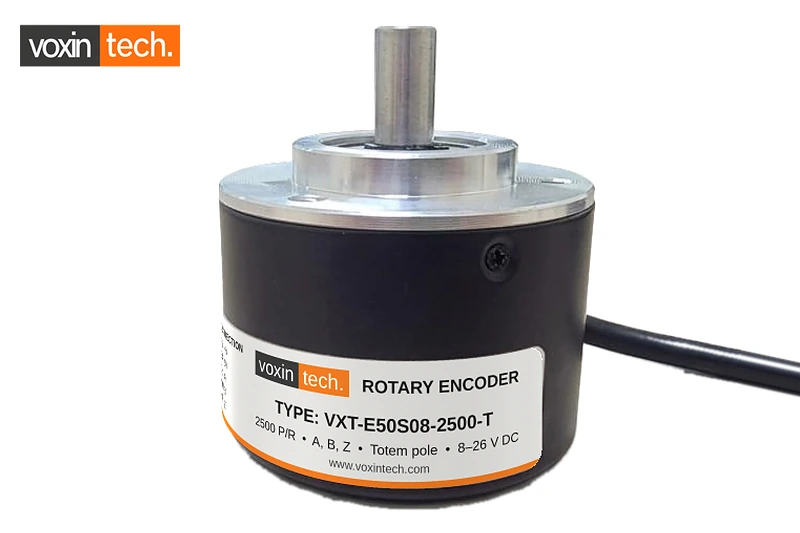
PPR, or pulses per revolution, is the resolution of an incremental encoder. Pick it too low and your machine cannot position or measure accurately. Pick it too high and the pulse frequency at full speed may exceed what your PLC input or the encoder itself can handle. This guide gives you the formulas and worked examples to choose correctly, using the VXT range of 360, 500, 1000, 1024, 2500 and 5000 PPR.
The three numbers you need
- Required resolution: the smallest movement you need to detect.
- Maximum shaft speed in rpm.
- Maximum input frequency of your PLC high-speed counter, counter module or drive.
Formula 1: Resolution per pulse
Linear distance per pulse = distance per revolution ÷ PPR
For a measuring wheel, the distance per revolution is the wheel circumference (π × diameter). For a ball screw, it is the screw lead.
Example: a 200 mm circumference measuring wheel with a VXT-E50S08-1000-T (1000 PPR) gives 200 ÷ 1000 = 0.2 mm per pulse.
Formula 2: Quadrature multiplies your resolution
An incremental encoder has two channels, A and B, 90° apart. A controller using quadrature decoding counts every rising and falling edge of both channels, which gives 4 counts per pulse:
- 1024 PPR → 4096 counts per revolution.
- 2500 PPR → 10,000 counts per revolution.
- 5000 PPR → 20,000 counts per revolution.
Many PLC high-speed counters and all servo drives support 4x decoding. Check whether your counter is set to 1x, 2x or 4x mode, because it changes the scaling.
Formula 3: Pulse frequency at speed
Output frequency (Hz) = rpm × PPR ÷ 60
This frequency must stay below two limits:
- the encoder's maximum response frequency (300 kHz for all VXT models), and
- the maximum input frequency of your PLC or counter (often much lower; check the manual).
Maximum speed (rpm) = maximum frequency × 60 ÷ PPR
Maximum speed of each VXT encoder
| VXT model | PPR | Electrical limit at 300 kHz | Mechanical limit | Operating limit |
|---|---|---|---|---|
| VXT-E38S06-0360-NPN | 360 | 50,000 rpm | 6000 rpm | 6000 rpm |
| VXT-E40S06-0500-NPN | 500 | 36,000 rpm | 6000 rpm | 6000 rpm |
| VXT-E50S08-1000-T | 1000 | 18,000 rpm | 6000 rpm | 6000 rpm |
| VXT-E40S06-1024 series, VXT-E50S08-1024-T, VXT-E58S06-1024-L | 1024 | 17,578 rpm | 6000 rpm | 6000 rpm |
| VXT-E50S08-2500-T | 2500 | 7200 rpm | 6000 rpm | 6000 rpm |
| VXT-E58S10-5000-L | 5000 | 3600 rpm | 6000 rpm | 3600 rpm |
Your PLC input may set a lower limit. For example, if a counter input accepts up to 100 kHz, a 1024 PPR encoder is limited to about 5859 rpm on that input, and a 2500 PPR encoder to 2400 rpm.
Worked examples
Conveyor speed monitoring
A conveyor roller turns at up to 300 rpm and you only need speed. Resolution is not critical, so VXT-E40S06-0500-NPN (500 PPR) gives 2500 Hz at full speed, which any PLC counter can read.
Fabric or film length measurement
A 360 mm circumference measuring wheel on a VXT-E38S06-0360-NPN gives exactly 1 mm per pulse. At 120 m/min the wheel turns at about 333 rpm, producing 2000 Hz.
Packaging machine film feed
A feed roller with a 100 mm circumference needs 0.1 mm resolution. 100 ÷ 0.1 = 1000 PPR, so a VXT-E50S08-1000-T or VXT-E40S06-1024-NPN fits. With 4x decoding you get 0.025 mm per count, giving extra margin.
Print registration
A printing cylinder at up to 2000 rpm needs fine registration. A VXT-E50S08-2500-T gives 10,000 counts per revolution with 4x decoding and 83 kHz at 2000 rpm, within the input range of most high-speed counter modules.
Servo-driven rotary table
A rotary table driven at up to 600 rpm needs high angular resolution. A VXT-E58S10-5000-L gives 20,000 counts per revolution (0.018° per count) with 4x decoding and outputs 50 kHz at 600 rpm, using RS-422 signals for noise immunity.
Rules of thumb
- Choose the lowest PPR that meets your resolution with some margin. It reduces frequency and makes the system more robust.
- 1000 or 1024 PPR covers most packaging, conveyor and general automation work.
- Use 360 PPR when you want one pulse per degree or simple length maths.
- Use 2500 or 5000 PPR for registration and precision positioning, and check the speed limit.
- When replacing an existing encoder, keep the same PPR unless you are ready to change the program scaling.
Frequently Asked Questions
What is the difference between PPR and CPR?
PPR is pulses per revolution on one channel. CPR (counts per revolution) is usually PPR × 4 when the controller uses quadrature decoding on channels A and B.
Is 1024 PPR better than 1000 PPR?
Neither is more accurate in practice. 1000 PPR makes decimal calculations easy; 1024 PPR is common in drives and existing programs. Match whatever your machine program expects.
Why does my encoder miss counts at high speed?
The pulse frequency is probably above the PLC input limit or the cable is too long for the output type. Lower the PPR, use a faster counter input, or switch to a line driver encoder.
What is the maximum speed of a 5000 PPR encoder?
For VXT-E58S10-5000-L, 3600 rpm, set by the 300 kHz response frequency.
Not sure which PPR fits your machine?
Tell us your speed, required resolution and controller model, and we will recommend the right VXT encoder. Contact us for datasheets, pricing and availability across India.
Related VXT products
VXT-E38S06-0360-NPN • VXT-E40S06-0500-NPN • VXT-E50S08-1000-T • VXT-E50S08-2500-T • VXT-E58S10-5000-L
Related guides