

Key takeaways
- 360 PPR means one pulse per degree, which makes angle and length maths simple.
- VXT-E38S06-0360-NPN is a compact 38 mm encoder with a 6 mm shaft and A/B outputs.
- A 360 mm circumference measuring wheel gives exactly 1 mm per pulse.
- For a Z index pulse or higher PPR, move to the 40 mm VXT-E40S06 series.
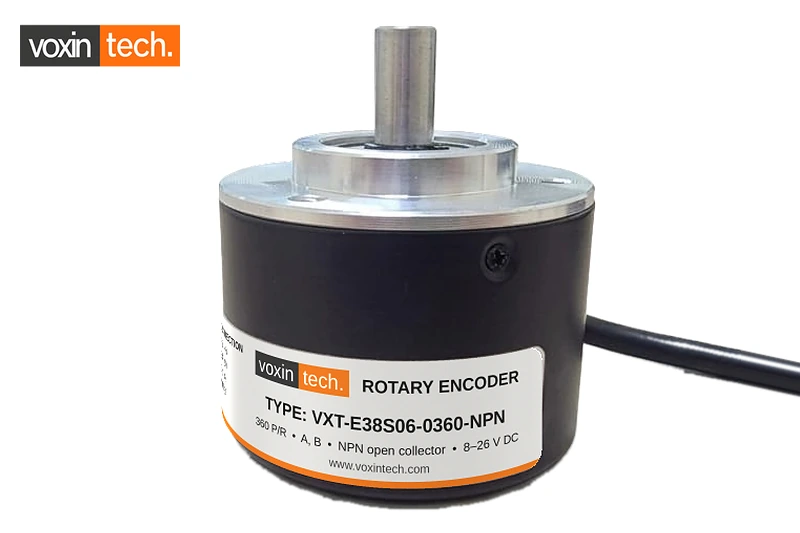
Not every machine needs a large, high-resolution encoder. Many counting, length and angle jobs need something compact, easy to wire and simple to scale. The VXT-E38S06-0360-NPN is built for exactly that: a 38 mm housing, a 6 mm shaft and 360 pulses per revolution, which means one pulse for every degree of rotation.
Key specifications
| Specification | Value |
|---|---|
| Housing | ø38 mm |
| Shaft | ø6 mm g6 solid shaft with flat |
| Resolution | 360 PPR (1 pulse per degree) |
| Output | NPN open collector |
| Channels | A and B (90° quadrature) |
| Supply | 8–26 V DC |
| Response frequency | up to 300 kHz |
| Mechanical speed | 6000 rpm |
| Mounting | ø20 mm spigot, 3 × M3 on ø30 mm pitch circle |
| Cable | 2 m shielded, radial exit |
| Protection | IP54, −20 to +85 °C |
Why 360 PPR is so practical
With 360 PPR, the maths is simple:
- Angle: each pulse is exactly 1°. A cam position of 90° is 90 pulses.
- Length with a measuring wheel: with a 360 mm circumference wheel, each pulse is 1 mm. With a 180 mm wheel, each pulse is 0.5 mm.
- Speed: at 1 revolution per second, the encoder gives 360 Hz. At the 6000 rpm mechanical limit it gives 36 kHz, well inside the input range of most PLC high-speed counters.
Because the numbers are round, commissioning is faster and there is less risk of scaling errors in the PLC program.
Where a compact 38 mm encoder fits
- Length counting: cloth, paper, foil, wire, hose and cable measured with a wheel.
- Printing and paper converting: sheet counting and simple registration.
- Textile machines: fabric inspection and rolling machines.
- Rotary tables and cams: angle indexing in degrees.
- Retrofit jobs where space behind the shaft is tight.
- Speed monitoring on small motors and rollers.
NPN output with A and B channels
The VXT-E38S06-0360-NPN provides two quadrature channels, A and B, with NPN open collector outputs. Connect them to PLC high-speed counter inputs configured for NPN sensors. With A and B, the controller detects direction as well as distance, which is important for reversing material or manual hand-wheel style inputs.
Wiring:
| Wire colour | Signal |
|---|---|
| Red | +V (8–26 V DC) |
| Black | 0 V |
| Green | A |
| White | B |
| Shield | Frame ground |
If your receiver needs a voltage signal rather than a sinking input, add a pull-up resistor from each output to +V.
Compared with 40 mm encoders
The 38 mm VXT-E38S06 shares the same 6 mm shaft and ø30 mm mounting pitch circle as our 40 mm VXT-E40S06 series, with a slightly smaller body. If your design uses 40 mm encoders such as the Omron E6B2-C or Autonics E40S6 in 360 PPR, the VXT-E38S06-0360-NPN is worth considering where space is limited. Always confirm the spigot diameter and hole positions against your bracket.
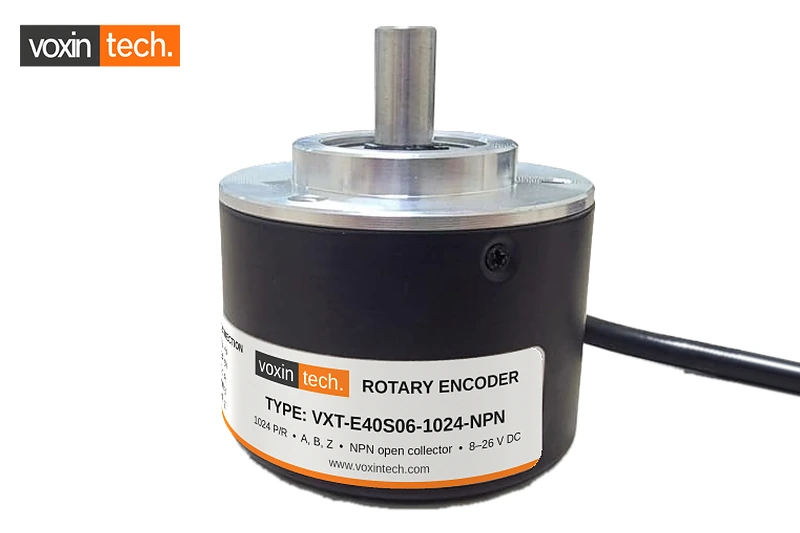
If you need a Z (index) pulse or a different PPR, look at the 40 mm VXT-E40S06 series, which offers 500 and 1024 PPR with A, B and Z channels.
When 360 PPR is enough, and when to go higher
360 PPR is the right choice when simple maths and reliable counting matter more than very fine resolution. It suits:
- Length counting to 1 mm or 0.5 mm with a suitably sized measuring wheel.
- Angle positioning to 1°, or 0.25° per count when the PLC uses 4x quadrature decoding on A and B.
- Older or basic counters with low maximum input frequency. At 1500 rpm the encoder outputs only 9 kHz.
- Long cable runs with NPN outputs, where a lower pulse rate gives cleaner signals.
Move up to a higher resolution when you need finer registration or slow-speed position control. The VXT-E40S06-1024-NPN (1024 PPR) or the VXT-E50S08-2500-T (2500 PPR) are the usual next steps, and both add a Z index pulse for homing.
A typical length-counting setup
A common setup on cloth inspection, cable coiling and paper rewinding machines looks like this:
- A measuring wheel with a rubber or knurled surface rides on the material.
- The wheel is fitted directly to the encoder shaft, or through a flexible coupling, on a spring-loaded swing arm.
- The VXT-E38S06-0360-NPN outputs A and B pulses to a PLC high-speed counter or a preset counter.
- The PLC multiplies the count by the length per pulse and stops the machine or triggers a cutter at the set length.
Because the encoder housing is only 38 mm in diameter, the swing arm stays light and compact, which helps the wheel follow the material without bouncing.
Installation tips
- Use a flexible coupling; keep shaft loads within 30 N radial and 20 N axial.
- For measuring wheels, use a spring-loaded arm to keep steady contact pressure.
- Earth the shield at the controller end and keep the cable away from inverter outputs.
Frequently Asked Questions
What does 360 PPR mean?
360 pulses per revolution. Each pulse represents 1° of shaft rotation, which makes angle and length calculations simple.
Does the VXT-E38S06-0360-NPN have a Z index pulse?
No. It provides A and B quadrature channels. For a Z index pulse, choose a model from the VXT-E40S06 series.
Can I use it with a 24 V PLC?
Yes. It accepts 8 to 26 V DC and connects to high-speed counter inputs configured for NPN sensors.
How do I calculate length with a 360 PPR encoder?
Length per pulse = wheel circumference ÷ 360. For example, a 360 mm circumference wheel gives 1 mm per pulse.
Order the VXT-E38S06-0360-NPN
Contact us for the datasheet, pricing and availability. We supply VXT encoders across India with a 1-year warranty and help with wiring and PLC scaling.
Related VXT products
VXT-E38S06-0360-NPN • VXT-E40S06-0500-NPN
Related guides
Omron and Autonics are trademarks of their respective owners. They are mentioned for comparison only; VXT is not affiliated with these companies.