

Key takeaways
- Line driver (RS-422) encoders send each signal with its inverted copy for high noise immunity.
- VXT-E58S06-1024-L and VXT-E58S10-5000-L suit servo drives, motion controllers and CNC.
- VXT-E58S10-5000-L gives 20,000 counts per revolution with 4x decoding, up to 3600 rpm.
- Line driver encoders need a differential input and a 5 V supply, not a standard 24 V PLC input.
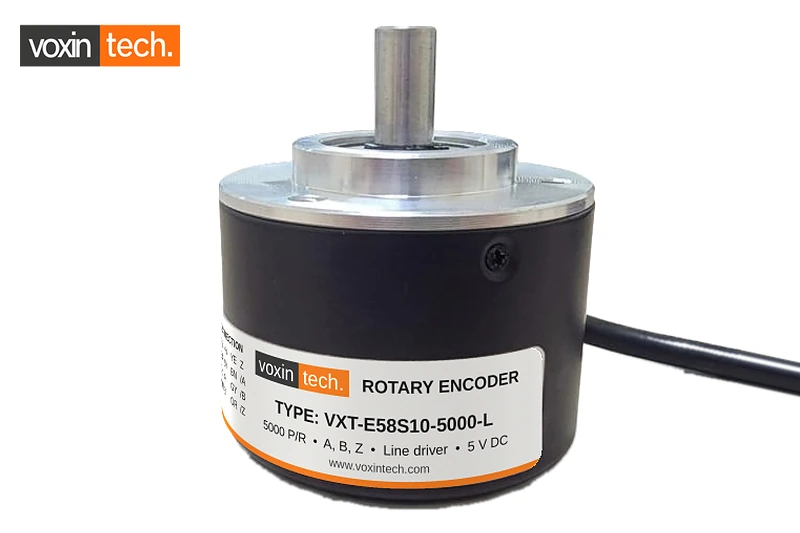
Motion control is where encoder signal quality matters most. Servo drives, motion controllers and CNC systems count every edge, often at high frequency and over cable runs that pass right beside power wiring. A line driver encoder with RS-422 differential outputs is the standard answer, and the 58 mm housing is the standard size for industrial motion feedback. The VXT-E58 series brings both together.
The VXT-E58 line driver range
| Model | Housing | Shaft | Resolution | Output | Supply |
|---|---|---|---|---|---|
| VXT-E58S06-1024-L | ø58 mm | ø6 mm | 1024 PPR | Line driver (RS-422) | 5 V DC ±5 % |
| VXT-E58S10-5000-L | ø58 mm | ø10 mm | 5000 PPR | Line driver (RS-422) | 5 V DC ±5 % |
Both models output A, /A, B, /B, Z and /Z, have a ø36 mm spigot with three M4 mounting holes at 120° on a ø48 mm pitch circle, a 2 m shielded radial cable, IP54 protection and an operating range of −20 to +85 °C. Response frequency is up to 300 kHz.
Why line driver (differential) output?
A line driver sends each channel twice: the normal signal and its inverted copy. The receiver looks at the difference between the two wires. Electrical noise picked up along the cable affects both wires equally, so it cancels out at the receiver. The benefits:
- High noise immunity near VFDs, servo drives and welding equipment.
- Longer cable runs than single-ended NPN or PNP outputs.
- Cable fault detection: many drives can detect a broken wire because the differential pair goes out of balance.
- Direct compatibility with servo drive and motion controller encoder inputs, which typically expect RS-422 signals at 5 V.
VXT-E58S06-1024-L: 58 mm housing, 6 mm shaft
This model combines the stability of a 58 mm body with a 6 mm shaft. It suits machines where the encoder couples to a small roller or gearbox output but the mounting plate is designed for a 58 mm flange. 1024 PPR gives 4096 counts per revolution when the controller uses quadrature (4x) decoding, which is plenty for most positioning tasks.
VXT-E58S10-5000-L: high resolution with a 10 mm shaft
With 5000 PPR, this encoder gives 20,000 counts per revolution in 4x quadrature mode. The 10 mm shaft and higher shaft load rating (40 N radial, 30 N axial) suit heavier couplings and industrial gearboxes. Typical uses include CNC rotary axes, servo-driven index tables, precision cut-to-length and high-accuracy positioning.
Speed note: at 5000 PPR, the 300 kHz response frequency allows up to 3600 rpm (300,000 × 60 ÷ 5000). For faster shafts, choose a lower PPR or gear down the encoder.
An alternative to Autonics E58 and other 58 mm encoders
The 58 mm size is used by many encoder makers, including the Autonics E58 series (for example E58SC10 clamping-flange models with "6-L-5" line driver codes), as well as 58 mm ranges from Hengstler and Kübler. Omron's 40 mm E6B2-CWZ1X is another common line driver model.
| If you use | Consider |
|---|---|
| Autonics E58SC10-1024-6-L-5 (58 mm, 10 mm shaft, line driver) | VXT-E58S10-5000-L if you need higher resolution, or contact us for 1024 PPR with a 10 mm shaft |
| 58 mm line driver encoder, 6 mm shaft, 1024 PPR | VXT-E58S06-1024-L |
| Omron E6B2-CWZ1X (40 mm, line driver) | VXT-E40S06-1024-L (40 mm) |
Check before replacing:
- Flange type: 58 mm encoders come with synchro (servo) flanges and clamping flanges. VXT-E58 uses a ø36 mm spigot with M4 holes on a ø48 mm pitch circle.
- Shaft diameter: 6 mm or 10 mm.
- PPR: match it, or change the electronic gear ratio or scaling in your drive.
- Supply: 5 V DC; most servo drives provide this from the encoder connector.
Wiring a VXT line driver encoder
| Wire colour | Signal |
|---|---|
| Red | +5 V |
| Black | 0 V |
| Green | A |
| Brown | /A |
| White | B |
| Grey | /B |
| Yellow | Z |
| Orange | /Z |
| Shield | Frame ground |
Connect each pair (A and /A, B and /B, Z and /Z) to the matching differential input of the drive or controller. Use twisted-pair cable for extensions and terminate long lines according to the receiver's instructions. Earth the shield at the controller end.
Typical applications
- Servo motor feedback and closed-loop positioning.
- CNC machines: spindle orientation, rotary tables and manual pulse generator replacement.
- Robotics and pick-and-place.
- Precision cut-to-length and flying shear.
- Printing registration on high-speed lines.
- Test rigs and laboratory equipment.
Frequently Asked Questions
What is a line driver encoder?
A line driver encoder outputs each signal together with its inverted copy (A and /A, B and /B, Z and /Z) to RS-422 levels. The receiver reads the difference, which rejects noise and allows longer cables.
Can I connect a line driver encoder to a normal PLC input?
Not directly. A line driver needs a differential (RS-422) receiver input, such as those on servo drives, motion controllers or PLC high-speed counter modules with line driver inputs. For a standard 24 V PLC input, choose an NPN, PNP or totem pole encoder instead.
What is the maximum speed of the VXT-E58S10-5000-L?
3600 rpm, set by the 300 kHz response frequency at 5000 PPR. The mechanical limit of the housing is 6000 rpm.
What supply voltage do VXT line driver encoders need?
5 V DC ±5 %. Most servo drives and motion controllers supply this through the encoder connector.
Order VXT 58 mm line driver encoders
Send us your drive or controller model, the shaft size and the PPR you need. Contact us for datasheets, pricing and availability across India.
Related VXT products
VXT-E58S06-1024-L • VXT-E58S10-5000-L • VXT-E40S06-1024-L
Related guides
Autonics, Omron, Hengstler and Kübler are trademarks of their respective owners. They are mentioned for comparison and cross-reference only; VXT is not affiliated with these companies.