


If you are looking up vibration sensor price in India, you have probably found that most suppliers do not publish a price list. That is because the right sensor – and therefore the cost – depends on what you are monitoring, how the signal reaches your control system and where the sensor will be installed. This buying guide explains the options in plain language, so you can compare quotes properly and order the right sensor the first time.
What Decides the Vibration Sensor Price in India?
Two sensors that look almost the same can be priced very differently. These are the factors that make the real difference:
- Output type – a sensor with a 4–20 mA output that goes straight into a PLC costs more than a raw accelerometer, but saves you a separate signal conditioner or monitoring module.
- Measured value – velocity (mm/s) sensors for machine health versus accelerometers for high-frequency analysis.
- Temperature output – models with a second, bearing-temperature output add a little to the cost but replace a separate temperature probe.
- Housing and protection – AISI 316L stainless steel and IP67 or IP69 ratings for washdown, outdoor and chemical areas.
- Connector and cable – M12 connector versions with a matching cable versus fixed-cable models.
- Quantity and support – project quantities, commissioning help and local stock all affect the final price.
The best way to get an accurate price is to share the machine type, speed, mounting point and the input on your PLC or panel. You will then receive a quote for a sensor that actually fits – rather than a cheap one that has to be replaced.
Vibration Sensor with 4–20 mA Output – Why Most Plants Choose It
A vibration sensor with 4–20 mA output (also called a vibration transmitter) converts the machine’s vibration into a standard current signal. That makes it the simplest vibration sensor for PLC and SCADA systems: wire it to any analog input, scale 4 mA as zero and 20 mA as full scale, and set your alarm limits in the PLC.
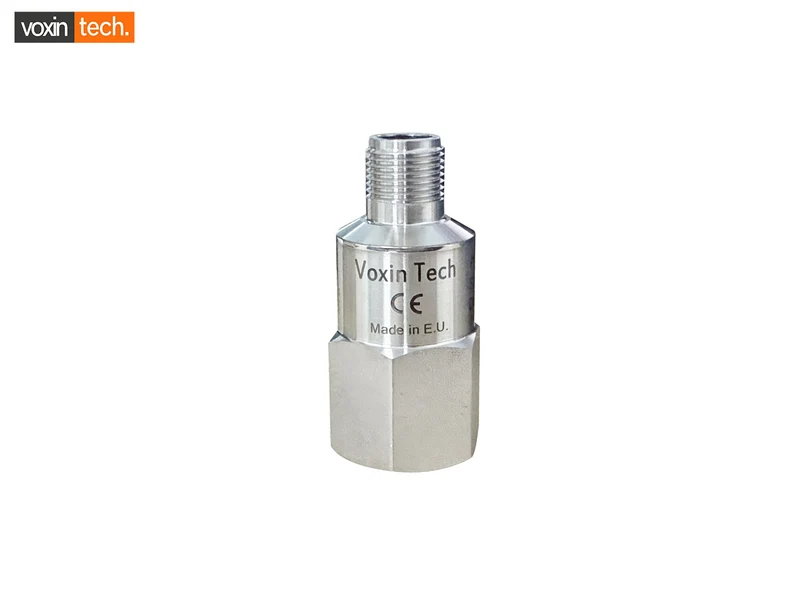
Voxintech VT series sensors, for example, measure vibration velocity from 0 to 100 mm/s over 3 Hz to 1000 Hz, give a 4–20 mA output, run on 10–30 V DC and connect through an M12 4-pin connector. Versions with an optional temperature output (10 mV/°C) are also available. See the full range on our industrial vibration sensor page.
Loop-powered vs separately powered 4–20 mA sensors
A loop-powered vibration sensor uses the same two wires for power and signal, which is convenient when you are replacing an existing 2-wire transmitter. A separately powered sensor has its own 10–30 V DC supply and returns the 4–20 mA signal on another wire, which allows extra functions such as a temperature output on the same connector. Before ordering, check whether your PLC analog card supplies loop power or expects an active (powered) signal – it is the most common wiring mistake on site. The Voxintech VT series uses a separate 10–30 V DC supply.
Velocity Sensor or Accelerometer?
A vibration velocity sensor reports vibration in mm/s, the unit used by machine vibration-severity standards such as ISO 10816 / ISO 20816. It responds best to the problems that matter on most plant machinery – unbalance, misalignment, looseness and general bearing wear – and the reading is easy to trend and alarm.
A vibration accelerometer sensor (see accelerometer) measures acceleration (g) and is more sensitive at high frequencies. It is preferred for early bearing-defect and gear-mesh analysis, usually together with a vibration analyser or online monitoring system.
Rule of thumb: for continuous protection and alarming on motors, pumps, fans and gearboxes, choose a velocity sensor with 4–20 mA output. For detailed diagnostics on high-speed or critical machines, add accelerometers and an analysis system.
Contact Type Vibration Sensor and Mounting
Industrial vibration sensors are contact type – they must be firmly attached to the machine so that the vibration passes into the sensor. How you mount it has a bigger effect on accuracy than most people expect:
- Stud mounting is the best method. A vibration sensor mounting stud screws into a tapped hole on the bearing housing. Always check the thread on the datasheet – common sizes include M8 and 1/4″-28 UNF – and use an adaptor stud if your machine is tapped differently.
- Adhesive or weld-on pads are used where drilling the casing is not allowed.
- Magnetic bases are fine for temporary checks with a portable meter, but not recommended for permanent monitoring.
Do not confuse the mounting thread with the connector. On Voxintech sensors the electrical connection is a standard M12 4-pin connector – vibration sensor M8 / M12 thread searches often mix these two up. Mount the sensor on the bearing housing in the radial direction, as close to the bearing as possible, on a flat, clean, paint-free surface.
Choosing a Sensor by Machine
| Machine | Where to mount | What to watch for |
|---|---|---|
| Electric motor | Drive-end bearing housing, radial | Bearing wear, unbalance, soft foot |
| Fan / blower | Fan-side bearing, radial | Unbalance from dust build-up, looseness |
| Cooling-tower fan | Gearbox or motor housing | Blade unbalance, gearbox wear; choose IP67/IP69 for wet areas |
| Gearbox | Input and output bearing housings | Bearing and gear wear |
| Compressor | Main bearing housings | Misalignment, looseness, bearing faults |
| Crusher | Main shaft bearing housings | Shock loading, bearing damage; choose a rugged stainless steel sensor |
Industry-specific advice is available for cement plants, mining and food and beverage.
Vibration Switch or Vibration Transmitter?
A traditional vibration switch for cooling towers or for motor protection is a simple trip device: when vibration passes a set level, a contact opens and the machine stops. It is cheap, but it gives no warning – you only find out when the machine has already tripped.
A 4–20 mA vibration transmitter does the same job and more. Connected to a PLC, or to a VT 406D process indicator in the panel, it shows the live vibration level and lets you set two limits – a warning alarm and a trip. Maintenance teams see the level rising over days or weeks and can plan a repair before the breakdown.
Building a Simple Vibration Monitoring System
A practical vibration monitoring system in India does not need expensive software. For most plants it is:
- A 4–20 mA vibration sensor on each critical machine,
- An M12 connector cable back to the panel,
- A PLC analog input or a process indicator with alarm outputs,
- Alarm limits set from the machine’s normal running level.
Start with the machines whose failure stops production, record their normal vibration for a week, then set your warning limit above that level.
Buying a Vibration Sensor Online in India – What to Check
If you plan to buy a vibration sensor online in India, look beyond the price:
- Is the measuring range and unit (mm/s or g) stated clearly?
- Is the output 4–20 mA, and is it loop-powered or separately powered?
- Is a datasheet with mounting thread and connector pin-out available?
- Is the country of origin and warranty stated?
- Can the seller help with selection and commissioning, and supply spares later?
Looking for a vibration sensor dealer near me? Voxintech supplies French-made VT series vibration sensors, stocked and supported from Delhi NCR, with delivery to customers across India.
Vibration Sensor Price in India – FAQs
What is the price of a vibration sensor in India?
It depends on the output type, temperature option, housing and quantity. Share your machine details and PLC input type with us and you will receive an exact quotation.
Can I connect a vibration sensor directly to a PLC?
Yes. A vibration sensor with 4–20 mA output connects to a standard PLC analog input. Check whether the input expects a loop-powered or an active signal.
Which vibration sensor is best for motors?
For continuous monitoring and alarms, a velocity sensor with 4–20 mA output mounted on the drive-end bearing housing is the most practical choice.
Do I need a vibration switch or a transmitter for a cooling tower fan?
A switch only trips the fan. A transmitter with a 4–20 mA output shows the trend and gives an early warning, which helps you avoid unplanned stoppages.
Need a price or help choosing? Call or WhatsApp +91 99530 39482, email info@voxintech.com, or request a quote with your machine details.
— One Comment —