


by Voxintech-admin@2022 Voxintech-admin@2022 No Comments

Ultrasonic Sensor Working Principle: Blind Zone, Calibration, Teach-In and PLC Wiring

Ultrasonic sensors measure distance with sound, which makes them excellent for liquids, transparent objects and dusty environments – but only if you understand how they work and where their limits are. This guide explains the ultrasonic sensor working principle, the blind zone, temperature effects, foam and vapour, how to calibrate a level sensor, teach-in and wiring to a PLC, and how ultrasonic compares with photoelectric and capacitive sensors.
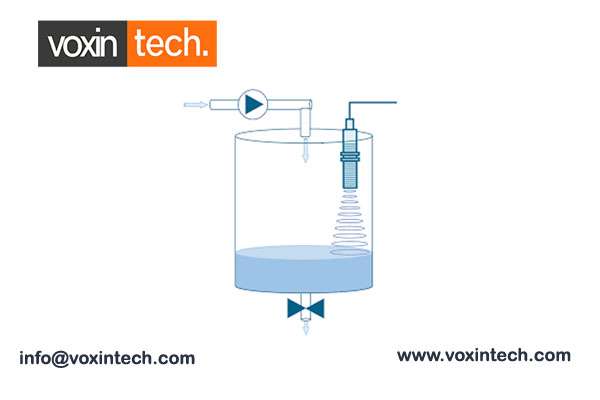
Ultrasonic sensor working principle – ultrasonic level sensor measuring liquid level in a tank

Ultrasonic Sensor Working Principle

An industrial ultrasonic sensor contains a transducer that works as both a loudspeaker and a microphone. It sends a short burst of high-frequency sound – far above human hearing – then switches to listening mode and waits for the echo from the target. The sensor’s electronics measure the time of flight, the time between sending the pulse and receiving the echo, and calculate the distance:

Distance = (speed of sound × time of flight) ÷ 2

The division by two is because the sound travels to the target and back. The calculated distance is then converted into a switching signal (PNP/NPN) or an analog signal (4–20 mA or 0–10 V) for the PLC. Because this ultrasonic sensor working principle relies on sound rather than light, the target’s colour, transparency and surface finish make little difference. Read more about the ultrasonic transducer.

Ultrasonic Sensor Blind Zone (Dead Band) Explained

Right after sending a pulse, the transducer is still “ringing” and cannot hear an echo. Any target inside this distance cannot be measured – this is the blind zone, also called the dead band. On industrial sensors it is shown as the first figure of the sensing range; for example, a 50–800 mm sensor has a 50 mm blind zone, and long-range sensors have larger blind zones.

In practice this means:

  • On a tank, mount the sensor so the highest liquid level stays below the blind zone – use a stand-off nozzle if needed.
  • On a machine, make sure the target can never come closer than the minimum range, or the output may become unpredictable.

Temperature Compensation

The speed of sound in air changes with temperature – by roughly 0.17 % per °C. Without correction, a reading taken at 45 °C on a hot summer tank roof would differ by several percent from the same reading at 15 °C. Most industrial sensors deal with this through temperature compensation: a built-in temperature sensor corrects the calculation automatically (check the datasheet for your model). To get the best accuracy:

  • Let the sensor warm up for a few minutes after power-on.
  • Shade it from direct sunlight where possible.
  • Avoid mounting it where hot air or steam flows across the sensor face.

Ultrasonic Sensor Foam and Vapour – Common Problems

  • Foam absorbs sound, so the echo may be weak or come from the top of the foam rather than the liquid. Use a stilling pipe or choose a different technology for heavy foam.
  • Vapour and steam change the speed of sound and can form condensation on the sensor face. Keep the sensor away from inlets, ventilate the tank roof and keep the face clean.
  • Turbulence and agitators create an uneven surface and false echoes – mount away from inlets and moving parts and use the sensor’s averaging or filter settings if available.
  • Obstructions such as ladders, pipes and tank walls can return a stronger echo than the liquid. Keep the sound cone clear.

Ultrasonic Sensor for Transparent Objects and Shiny Surfaces

This is where ultrasonic sensors beat optical sensors. Light passes through glass, PET and clear film, and reflects unpredictably from polished metal – but sound reflects from all of them.

  • Ultrasonic sensor for transparent objects – clear bottles, glass sheets, transparent film and labels. See our transparent label sensor.
  • Ultrasonic sensor for shiny surfaces – polished stainless steel, foil and chrome parts.

Keep the sensor face roughly perpendicular to flat, shiny targets; at a steep angle the echo may bounce away and be missed.

Ultrasonic Sensor vs Photoelectric Sensor

Ultrasonic sensor Photoelectric sensor
Works on Sound echo Light beam
Transparent and shiny targets Very good Difficult
Dust, mist, dirty lenses Tolerant Affected
Speed and small objects Slower, larger spot Faster, very small spot
Continuous distance output Common (4–20 mA / 0–10 V) Mainly on laser models

Choose ultrasonic for liquids, clear objects and dirty environments; choose a photoelectric sensor for fast counting and small parts.

Ultrasonic Sensor vs Capacitive Level Sensor

A capacitive level sensor detects the material by touching it or sensing it through a tank wall; it is usually a point-level switch (high or low level). An ultrasonic level sensor is non-contact and gives a continuous level reading from above. Choose ultrasonic for continuous level in water, diesel and most chemicals; choose capacitive for point-level alarms, sticky or foaming products, or small tanks where there is no space above the liquid.

How to Calibrate an Ultrasonic Level Sensor

  1. Measure the empty distance – from the sensor face to the tank bottom (or the lowest level you need). This becomes 4 mA (or 0 V).
  2. Measure the full distance – from the sensor face to the highest level. It must be greater than the blind zone. This becomes 20 mA (or 10 V).
  3. Set the two points on the sensor by teach-in, or scale them in the PLC.
  4. Convert distance to level in the PLC: level = empty distance − measured distance.
  5. Verify with a dipstick or known level at two points, then convert level to volume if the tank shape is known.

For mounting tips on tanks, see our ultrasonic water level sensor page.

Ultrasonic Sensor Teach-In Procedure

Many industrial ultrasonic sensors let you set switching points or the analog range without a laptop. The exact steps are in each datasheet, but a typical teach-in procedure is:

  1. Place the target at the first position (for example, the empty-tank level or the near switching point).
  2. Press the teach button – or connect the teach wire to +V or 0 V – for the time stated in the datasheet until the LED confirms.
  3. Move the target to the second position and repeat.
  4. Check the outputs at both points, then lock the settings if the sensor allows it.

Models without teach-in use a sensitivity potentiometer and configurable NO/NC outputs instead.

Ultrasonic Sensor Wiring to PLC

Voxintech industrial ultrasonic sensors run on 10–30 V DC and use an M12 connector, with outputs such as PNP + 4–20 mA, PNP + 0–10 V or 2 × NPN. A typical 4-wire connection is:

  • +V to the 24 V DC supply,
  • 0 V to supply 0 V and the PLC input common,
  • Switching output (PNP or NPN) to a digital input,
  • Analog output (4–20 mA or 0–10 V) to an analog input set to the matching mode.

Confirm pin numbers and wire colours from the sensor datasheet, use shielded cable for analog signals and keep it away from motor and VFD cables. Match PNP outputs to sourcing PLC inputs and NPN outputs to sinking inputs.

Frequently Asked Questions

What is the ultrasonic sensor working principle in one line?

The sensor sends a sound pulse, times how long the echo takes to return and converts that time into distance. Every other topic in this guide – blind zone, temperature and foam – follows from this ultrasonic sensor working principle.

Can ultrasonic sensors work in dusty environments?

Yes. Light dust has little effect on sound, which is why ultrasonic sensors are widely used for bins, silos and stone-crushing plants. Very heavy dust can weaken the echo at long range.

Why does my ultrasonic level sensor show a full tank when it is empty?

Usually the sensor is picking up an echo from a pipe, ladder or the tank wall, or the level has entered the blind zone. Re-position the sensor so the sound cone is clear.

Do ultrasonic sensors work in a vacuum?

No. Sound needs air or another gas to travel, so ultrasonic sensors cannot work in a vacuum.

Looking for prices and model selection? Read our ultrasonic sensor price in India guide or see the full range of industrial ultrasonic sensors. For application help, call or WhatsApp +91 99530 39482 or request a quote.

by Voxintech-admin@2022 Voxintech-admin@2022 1 Comment

Ultrasonic Sensor Price in India: 2026 Guide to Range, Output and Housing

Searching for ultrasonic sensor price in India usually turns up a confusing mix of hobby modules costing a few hundred rupees and industrial sensors that cost many times more. The difference is not just the brand – it is the range, output, housing and how long the sensor will survive on your plant. This guide explains what you are paying for and how to choose the right industrial ultrasonic sensor for level, distance and position sensing.

Voxintech industrial ultrasonic sensor M30 with M12 connector, IP67

What Decides Ultrasonic Sensor Price in India?

  • Sensing range – a 2 m sensor costs less than a 6 m or 8 m model, which needs a larger transducer and more power.
  • Output – simple NPN/PNP switching outputs cost less than analog 4–20 mA or 0–10 V outputs for continuous measurement.
  • Housing – PBT plastic, metal or AISI 316L stainless steel.
  • Size and thread – compact M18 sensors for short ranges, M30 sensors for long ranges.
  • Protection and temperature – IP67 sealing and an operating range of −20 °C to +70 °C for outdoor and plant use.
  • Support – datasheets, selection help, local stock and warranty.

For an exact quotation, share the distance you need to measure, the target (water, diesel, boxes, film), the output your PLC needs and where the sensor will be mounted.

Choosing the Range: 2 m, 4 m, 6 m or 10 m?

Pick a sensor whose maximum range is a little above your largest distance. Every ultrasonic sensor also has a blind zone close to its face where it cannot measure, so the target must stay further away than the minimum range. You can read more about how ultrasonic transducers measure distance.

You need Choose range group Typical use
Up to about 0.8 m 50–800 mm Bottle and object detection, small tanks
About 2 m (ultrasonic sensor 2m range) 900–2200 mm Bin level, stack height, conveyor gaps
3–4 m (ultrasonic sensor 4m range) 2200–3500 mm or 3500–6000 mm Overhead water tanks, sumps
About 6 m (ultrasonic sensor 6m range) 3500–6000 mm Large tanks, channels
Up to 8 m 6000–8000 mm Deep tanks, rivers and dams

What about an ultrasonic sensor with 10 meter range? Voxintech’s industrial range goes up to 8 m. For deeper tanks or silos beyond that, a radar level transmitter is usually the better technology – ask us and we will advise honestly.

Output Options: 4–20 mA, 0–10 V, NPN/PNP or RS485

  • Ultrasonic sensor with 0–10 V output – continuous distance or level signal for controllers with a voltage input. Available as PNP + 0–10 V.
  • 4–20 mA output – the best choice for long cable runs and PLC analog inputs. Available as PNP + 4–20 mA.
  • Ultrasonic sensor with NPN PNP output – switching points for high/low level, pump on/off or object present. Available as 2 × NPN or PNP versions.
  • Ultrasonic sensor with RS485 – useful when many sensors share one network cable. Our standard range uses analog and switching outputs; if your system needs RS485/Modbus, tell us and we will suggest a suitable option or a converter.

All Voxintech industrial ultrasonic sensors run on 10–30 V DC and connect with an M12 plug.

Housing: Stainless Steel Body and IP67

An IP67 ultrasonic sensor is sealed against dust and temporary immersion, which is essential for tank tops, outdoor sumps and wash-down areas. Choose an ultrasonic sensor with stainless steel body (AISI 316L) for food, pharmaceutical and chemical plants, and PBT plastic or metal housings for general automation. See the full range on our industrial ultrasonic sensor page.

Ultrasonic Sensor M18 vs M30

The thread size tells you the body diameter and roughly the range:

  • M18 ultrasonic sensors – compact, for short ranges such as about 300 mm (cubic M18) and 900 mm (cylindrical M18). Ideal for machines and conveyors where space is tight.
  • M30 ultrasonic sensors – larger transducer for long ranges from 3.5 m up to 8 m, typically with PNP + 0–10 V or 4–20 mA output. Ideal for tank level and long-distance measurement.

Ultrasonic Level Sensor for Water, Diesel and Chemical Tanks

Water tanks

An ultrasonic level sensor for a water tank mounts on the tank roof, pointing straight down, and measures the distance to the water surface without touching it. Keep it away from the inlet pipe and the tank wall. See our ultrasonic water level sensor guide for mounting and output selection.

Diesel tanks

An ultrasonic level sensor for a diesel tank works well on day tanks and storage tanks for DG sets. Check whether the tank area is classified as a hazardous area – if it is, you must use equipment certified for that zone. More details are on our oil level monitoring page.

Chemical tanks

For an ultrasonic level sensor for a chemical tank, confirm that the housing material can withstand the vapours, and watch for foam, heavy condensation or vapour layers, which can absorb the ultrasonic pulse. A stainless steel version and a mounting nozzle that keeps the sensor face above the vapour usually help.

Level, Distance and Position Sensing

  • Ultrasonic sensor for level measurement – liquids, granules and powders in tanks, bins and silos.
  • Ultrasonic sensor for distance measurement – vehicle positioning, crane anti-collision and stack height.
  • Ultrasonic sensor for position sensing – roll diameter on winders and unwinders, and loop position on converting lines.

Ultrasonic Sensors on Conveyors and Packaging Lines

  • Ultrasonic sensor for conveyor – detects boxes, bags and products of any colour or surface, including shiny and transparent items that confuse optical sensors. See object detection using ultrasonic sensors.
  • Ultrasonic sensor for bottle detection – reliably detects clear glass and PET bottles on filling and labelling lines. See our food packaging page.
  • Ultrasonic sensor for web guiding – measures the edge or loop of film, paper and foil webs without contact. See roll diameter measurement.

Buying an Ultrasonic Sensor Online – What to Check Beyond Price in India

Before you buy an ultrasonic sensor online, make sure the listing tells you:

  • The sensing range and blind zone,
  • The output type and supply voltage,
  • The housing material, thread size and IP rating,
  • The operating temperature range,
  • Whether a datasheet, warranty and local technical support are available.

Hobby modules sold online are designed for prototypes and classrooms; they are not sealed or rated for continuous industrial use.

Looking for an ultrasonic sensor dealer near me? Voxintech supplies Italian-made industrial ultrasonic sensors, stocked and supported in India from Delhi NCR, with delivery across India.

Ultrasonic Sensor Price in India – FAQs

Why are industrial ultrasonic sensors more expensive than hobby modules?

Industrial sensors have sealed IP67 housings, industrial outputs such as 4–20 mA and 0–10 V, and robust transducers, and they are built for years of continuous use.

Can an ultrasonic sensor measure diesel or oil level?

Yes, in most cases. Check for hazardous-area requirements and avoid heavy foam or vapour.

What is the maximum range of your ultrasonic sensors?

Up to 8 m, depending on the model. For longer distances we can advise on alternative technologies.

Need a price? Call or WhatsApp +91 99530 39482, email info@voxintech.com, or request a quote with your range, target and output.

by Voxintech-admin@2022 Voxintech-admin@2022 No Comments

Vibration Sensor Working Principle, PLC Wiring and Trip-Point Setting

An industrial vibration sensor looks like a simple stainless steel cylinder, but what happens inside it – and how you wire it, scale it and set its alarms – decides whether it protects your machine or just causes nuisance trips. This guide explains the vibration sensor working principle step by step, then covers wiring to a PLC, ISO 10816 limits, trip-point setting and how to stop false trips.

Industrial vibration sensor working principle and installation on a motor

Vibration Sensor Working Principle

Most industrial vibration sensors are built around a piezoelectric element – a small ceramic crystal clamped to a seismic mass inside the housing. When the machine vibrates, the mass pushes and pulls on the crystal, and the crystal produces an electrical charge that is proportional to the acceleration. That raw signal is then processed inside the sensor:

  1. Charge amplifier – converts the tiny charge from the crystal into a usable voltage.
  2. Filtering – removes frequencies outside the measuring band (for example 3 Hz to 1000 Hz on Voxintech VT series sensors).
  3. Integration – converts acceleration into vibration velocity in mm/s, the unit used for machine-health assessment.
  4. RMS detection – turns the alternating vibration signal into a steady overall value.
  5. 4–20 mA output stage – sends that value to the PLC as a standard current signal.

Because every step of the vibration sensor working principle happens inside the sensor, the PLC receives a clean, ready-to-use number. You can read more about the piezoelectric effect behind it.

mm/s vs g: Velocity vs Acceleration Measurement

The same vibration can be expressed in three ways – displacement (µm), velocity (mm/s) and acceleration (g). Which one you use depends on the frequency of the problem you want to catch:

Measurement Unit Best for Typical use
Displacement µm Low frequencies Shaft movement on large sleeve-bearing machines
Velocity mm/s RMS About 10–1000 Hz Overall machine health: unbalance, misalignment, looseness
Acceleration g High frequencies Early bearing defects and gear mesh problems

For permanent monitoring and alarms on motors, pumps, fans and gearboxes, a velocity sensor in mm/s is usually the right choice, because it matches the severity limits in ISO standards and gives a stable reading. An acceleration sensor is the better choice when you want early warning of rolling-bearing damage on high-speed machines, usually with an analyser.

ISO 10816 Vibration Limits

ISO 10816-3 (now being replaced by ISO 20816-3) gives vibration severity zones for industrial machines above 15 kW, measured as velocity in mm/s RMS on the bearing housings:

Machine group and foundation A/B boundary B/C boundary C/D boundary
Group 2 (15–300 kW), rigid foundation 1.4 2.8 4.5
Group 2 (15–300 kW), flexible foundation 2.3 4.5 7.1
Group 1 (300 kW–50 MW), rigid foundation 2.3 4.5 7.1
Group 1 (300 kW–50 MW), flexible foundation 3.5 7.1 11.0

Zone A is a newly commissioned machine, zone B is acceptable for long-term running, zone C is acceptable only for a limited time, and zone D is severe enough to cause damage. Many plants use the B/C boundary as the warning level and the C/D boundary as the trip level – but always check the machine manufacturer’s recommendation first.

Vibration Sensor Wiring to PLC

2-wire vs 3-wire vibration sensor

A 2-wire (loop-powered) vibration sensor takes its power from the 4–20 mA loop itself, so only two wires run to the PLC. A 3-wire or 4-wire sensor has a separate supply (for example 10–30 V DC), a common 0 V and a 4–20 mA signal wire; the fourth wire can carry a second signal such as temperature. Voxintech VT series sensors use a separate 10–30 V DC supply and an M12 4-pin connector.

Wiring a 3/4-wire sensor to a PLC analog input

  • Connect sensor +V to the 24 V DC supply.
  • Connect sensor 0 V to the supply 0 V and to the analog input common.
  • Connect the 4–20 mA output to the analog input channel, set to “current” mode.
  • Use shielded cable and earth the shield at the panel end only.
  • Always confirm pin numbers from the sensor datasheet before connecting.

Scaling the signal

Vibration = (measured current − 4 mA) ÷ 16 mA × full-scale range. For example, on a sensor scaled 0–25 mm/s, a reading of 12 mA means (12 − 4) ÷ 16 × 25 = 12.5 mm/s. A reading below about 3.6 mA usually means a broken wire or a failed sensor – set a separate “sensor fault” alarm for it.

How to Set a Vibration Switch Trip Point

Whether you use a mechanical vibration switch or a 4–20 mA sensor with alarms in the PLC or a process indicator, the trip point should come from the machine itself:

  1. Record a baseline. Log the vibration at normal load for several days, including start-ups.
  2. Set the warning (alert) level at about 2 times the baseline, or at the ISO B/C boundary, whichever is lower.
  3. Set the trip (danger) level at about 4 times the baseline, or at the ISO C/D boundary.
  4. Add a time delay of a few seconds so short spikes do not stop the machine.
  5. Add a start-up bypass if the machine passes through a resonance while running up to speed.
  6. Review after one month and adjust if the levels are too close to normal running.

False Trip Vibration Switch Problems – Causes and Fixes

  • Trip point too close to normal level – raise it based on the recorded baseline.
  • No time delay – impacts, a passing forklift or a valve slam can trip the machine; add 3–10 seconds of delay.
  • Start-up and coast-down transients – use a start-up bypass timer.
  • Loose or poor mounting – a magnet, thin bracket or loose stud amplifies vibration; stud-mount directly on the bearing housing.
  • Electrical noise – route the cable away from VFD and motor power cables and earth the shield at one end only.
  • Structural resonance – if the reading changes sharply with small speed changes, move the sensor to a stiffer location.

Vibration Sensor Sensitivity Adjustment

Mechanical vibration switches have a sensitivity knob that changes the force needed to trip. A 4–20 mA vibration transmitter works differently: its measuring range is fixed at the factory, and you “adjust sensitivity” by changing the alarm set-points and time delays in the PLC or indicator. If your machine’s normal level uses only a small part of the range, choose a sensor with a lower full-scale range for better resolution.

Vibration Sensor Calibration

Industrial vibration sensors are calibrated by the manufacturer and normally need no adjustment on site. Good practice is to verify them every one to two years, or whenever readings look suspicious, using a portable vibration calibrator (a small shaker that applies a known vibration, commonly at 159.2 Hz). Compare the 4–20 mA output with the expected value; if it is outside tolerance, replace the sensor rather than trying to adjust it.

Frequently Asked Questions

What is the vibration sensor working principle in simple words?

A small mass inside the sensor presses on a piezoelectric crystal as the machine shakes. The crystal turns that movement into an electrical signal, and the built-in electronics convert it into a 4–20 mA value your PLC can read. Understanding this vibration sensor working principle also explains why stud mounting matters – any looseness changes what the mass feels.

Does a vibration sensor measure velocity or acceleration?

The sensing element measures acceleration. Velocity sensors integrate that signal internally and output mm/s, which is easier to compare with ISO limits.

What is a normal vibration level for a motor?

For a 15–300 kW motor on a rigid foundation, below about 2.8 mm/s RMS is generally acceptable for continuous running under ISO 10816-3. Trend your own machine for the best reference.

Why is my 4–20 mA vibration reading stuck at 4 mA?

Check the supply voltage, the wiring polarity and the PLC input mode. A steady 4 mA can also simply mean the machine is stopped or running very smoothly.

Looking for prices and model selection? Read our vibration sensor price in India buying guide or see the full range of industrial vibration sensors. For help with wiring or set-points, call or WhatsApp +91 99530 39482 or request a quote.
by Voxintech-admin@2022 Voxintech-admin@2022 1 Comment

Vibration Sensor Price in India: 2026 Buying Guide for 4–20 mA Sensors

If you are looking up vibration sensor price in India, you have probably found that most suppliers do not publish a price list. That is because the right sensor – and therefore the cost – depends on what you are monitoring, how the signal reaches your control system and where the sensor will be installed. This buying guide explains the options in plain language, so you can compare quotes properly and order the right sensor the first time.

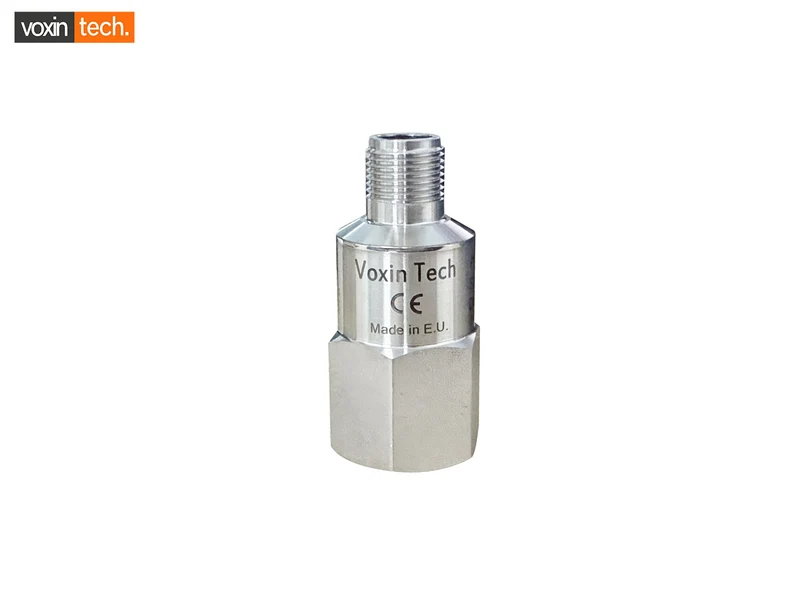
Voxintech VT series industrial vibration sensor with 4-20 mA output, stainless steel, CE

What Decides the Vibration Sensor Price in India?

Two sensors that look almost the same can be priced very differently. These are the factors that make the real difference:

  • Output type – a sensor with a 4–20 mA output that goes straight into a PLC costs more than a raw accelerometer, but saves you a separate signal conditioner or monitoring module.
  • Measured value – velocity (mm/s) sensors for machine health versus accelerometers for high-frequency analysis.
  • Temperature output – models with a second, bearing-temperature output add a little to the cost but replace a separate temperature probe.
  • Housing and protection – AISI 316L stainless steel and IP67 or IP69 ratings for washdown, outdoor and chemical areas.
  • Connector and cable – M12 connector versions with a matching cable versus fixed-cable models.
  • Quantity and support – project quantities, commissioning help and local stock all affect the final price.

The best way to get an accurate price is to share the machine type, speed, mounting point and the input on your PLC or panel. You will then receive a quote for a sensor that actually fits – rather than a cheap one that has to be replaced.

Vibration Sensor with 4–20 mA Output – Why Most Plants Choose It

A vibration sensor with 4–20 mA output (also called a vibration transmitter) converts the machine’s vibration into a standard current signal. That makes it the simplest vibration sensor for PLC and SCADA systems: wire it to any analog input, scale 4 mA as zero and 20 mA as full scale, and set your alarm limits in the PLC.

Voxintech VT series sensors, for example, measure vibration velocity from 0 to 100 mm/s over 3 Hz to 1000 Hz, give a 4–20 mA output, run on 10–30 V DC and connect through an M12 4-pin connector. Versions with an optional temperature output (10 mV/°C) are also available. See the full range on our industrial vibration sensor page.

Loop-powered vs separately powered 4–20 mA sensors

A loop-powered vibration sensor uses the same two wires for power and signal, which is convenient when you are replacing an existing 2-wire transmitter. A separately powered sensor has its own 10–30 V DC supply and returns the 4–20 mA signal on another wire, which allows extra functions such as a temperature output on the same connector. Before ordering, check whether your PLC analog card supplies loop power or expects an active (powered) signal – it is the most common wiring mistake on site. The Voxintech VT series uses a separate 10–30 V DC supply.

Velocity Sensor or Accelerometer?

A vibration velocity sensor reports vibration in mm/s, the unit used by machine vibration-severity standards such as ISO 10816 / ISO 20816. It responds best to the problems that matter on most plant machinery – unbalance, misalignment, looseness and general bearing wear – and the reading is easy to trend and alarm.

A vibration accelerometer sensor (see accelerometer) measures acceleration (g) and is more sensitive at high frequencies. It is preferred for early bearing-defect and gear-mesh analysis, usually together with a vibration analyser or online monitoring system.

Rule of thumb: for continuous protection and alarming on motors, pumps, fans and gearboxes, choose a velocity sensor with 4–20 mA output. For detailed diagnostics on high-speed or critical machines, add accelerometers and an analysis system.

Contact Type Vibration Sensor and Mounting

Industrial vibration sensors are contact type – they must be firmly attached to the machine so that the vibration passes into the sensor. How you mount it has a bigger effect on accuracy than most people expect:

  • Stud mounting is the best method. A vibration sensor mounting stud screws into a tapped hole on the bearing housing. Always check the thread on the datasheet – common sizes include M8 and 1/4″-28 UNF – and use an adaptor stud if your machine is tapped differently.
  • Adhesive or weld-on pads are used where drilling the casing is not allowed.
  • Magnetic bases are fine for temporary checks with a portable meter, but not recommended for permanent monitoring.

Do not confuse the mounting thread with the connector. On Voxintech sensors the electrical connection is a standard M12 4-pin connector – vibration sensor M8 / M12 thread searches often mix these two up. Mount the sensor on the bearing housing in the radial direction, as close to the bearing as possible, on a flat, clean, paint-free surface.

Choosing a Sensor by Machine

Machine Where to mount What to watch for
Electric motor Drive-end bearing housing, radial Bearing wear, unbalance, soft foot
Fan / blower Fan-side bearing, radial Unbalance from dust build-up, looseness
Cooling-tower fan Gearbox or motor housing Blade unbalance, gearbox wear; choose IP67/IP69 for wet areas
Gearbox Input and output bearing housings Bearing and gear wear
Compressor Main bearing housings Misalignment, looseness, bearing faults
Crusher Main shaft bearing housings Shock loading, bearing damage; choose a rugged stainless steel sensor

Industry-specific advice is available for cement plants, mining and food and beverage.

Vibration Switch or Vibration Transmitter?

A traditional vibration switch for cooling towers or for motor protection is a simple trip device: when vibration passes a set level, a contact opens and the machine stops. It is cheap, but it gives no warning – you only find out when the machine has already tripped.

A 4–20 mA vibration transmitter does the same job and more. Connected to a PLC, or to a VT 406D process indicator in the panel, it shows the live vibration level and lets you set two limits – a warning alarm and a trip. Maintenance teams see the level rising over days or weeks and can plan a repair before the breakdown.

Building a Simple Vibration Monitoring System

A practical vibration monitoring system in India does not need expensive software. For most plants it is:

  1. A 4–20 mA vibration sensor on each critical machine,
  2. An M12 connector cable back to the panel,
  3. A PLC analog input or a process indicator with alarm outputs,
  4. Alarm limits set from the machine’s normal running level.

Start with the machines whose failure stops production, record their normal vibration for a week, then set your warning limit above that level.

Buying a Vibration Sensor Online in India – What to Check

If you plan to buy a vibration sensor online in India, look beyond the price:

  • Is the measuring range and unit (mm/s or g) stated clearly?
  • Is the output 4–20 mA, and is it loop-powered or separately powered?
  • Is a datasheet with mounting thread and connector pin-out available?
  • Is the country of origin and warranty stated?
  • Can the seller help with selection and commissioning, and supply spares later?

Looking for a vibration sensor dealer near me? Voxintech supplies French-made VT series vibration sensors, stocked and supported from Delhi NCR, with delivery to customers across India.

Vibration Sensor Price in India – FAQs

What is the price of a vibration sensor in India?

It depends on the output type, temperature option, housing and quantity. Share your machine details and PLC input type with us and you will receive an exact quotation.

Can I connect a vibration sensor directly to a PLC?

Yes. A vibration sensor with 4–20 mA output connects to a standard PLC analog input. Check whether the input expects a loop-powered or an active signal.

Which vibration sensor is best for motors?

For continuous monitoring and alarms, a velocity sensor with 4–20 mA output mounted on the drive-end bearing housing is the most practical choice.

Do I need a vibration switch or a transmitter for a cooling tower fan?

A switch only trips the fan. A transmitter with a 4–20 mA output shows the trend and gives an early warning, which helps you avoid unplanned stoppages.

Need a price or help choosing? Call or WhatsApp +91 99530 39482, email info@voxintech.com, or request a quote with your machine details.

by Voxintech-admin@2022 Voxintech-admin@2022

CNG Gas Pipeline Monitoring using Vibration Sensor

Voxintech Manufacturing Industrial Vibration Sensor for all Industrial Manufacturing Machine Vibration Detector and Monitoring Machine Conditions. Vibration Sensor measures vibration levels in machinery for screening and analysis. Maintenance teams use industrial vibration sensors for condition monitoring, giving them insight into the magnitude and frequency of vibration signals. Vibration Sensor is basically used for Vibration Monitoring, its Measure and Monitor Machine Temperature and Frequency.Vibration Sensor Manufacturer and Supplier, Vibration Sensor for CNG Gas Pipeline Industry, CNG Gas Pipeline Monitoring using Vibration Sensor, Vibration Sensor for Industrial CNG Gas Pipeline Industry.

by Voxintech-admin@2022 Voxintech-admin@2022

Packaging industry using ultrasonic sensor

Industrial Ultrasonic Sensor using packaging machine, food packaging industry using voxintech industrial ultrasonic sensors and pharmaceutical industry using ultrasonic sensor for packaging medicines. Voxintech ultrasonic sensor manufacturer and supplier for packaging industry, ultrasonic sensor for pharmaceutical packaging industry. Everything is packaged, from consumer goods to food and pharmaceutical products. Voxintech ultrasonic sensor has been a competent partner to over 300 machine manufacturers worldwide in the packaging industry for many years and offers a broad portfolio of sensor solutions.

ultrasonic sensor manufacturer and supplier, ultrasonic sensor for food packaging machine, Ultrasonic sensor for packaging industry

by Voxintech-admin@2022 Voxintech-admin@2022

Object & Pallet Detection using an Ultrasonic Sensor

Voxintech manufacturer a best category industrial ultrasonic sensor for object & pallet detection. Voxintech Ultrasonic Sensors basically using for industrial packaging factory and food packaging machine, and pallet detector with ultrasonic sensor is very useful technology. Voxintech Ultrasonic detects all types of pallets, regardless of color, surface structure, dust, and dirt. The large sound beam of the ultrasonic sensor reliably detects pallets with numerous recesses. In Industrial food factory ultrasonic sensor for object & Pallet Detection are most useful thing in industrial plants

Ultrasonic sensor manufacturer & supplier, pallet detection ultrasonic sensor, object detection ultrasonic sensor, industrial ultrasonic sensor manufacturer & supplier, Ultrasonic sensor for pallet detection, Ultrasonic sensor for object detection.

by Voxintech-admin@2022 Voxintech-admin@2022

Vibration sensor for monitoring the condition of your plants

Plants monitoring and Industrial machine monitoring is a most important part of every Industrial Machine. The machine condition monitoring of your industrial plants and manufacturing plants with vibration sensor is best way to check your machine is working properly.

Voxintech vibration sensorassured the best quality, performance and maintenance . It predicts machine failure which helps in maintenance of the machinery and save huge amount of loss. Vibration Sensor use for heavy machine and heavy equipment for condition monitoring of machines

List of the most common industrial sectors that use vibration sensors to monitor the vibrations

Voxintech Vibration Sensor used these sectors

  • Food and Beverage Industry
  • Pulp and Paper Industry
  • Oil and Gas Industry
  • Cement Manufacturing Industry
  • Mining Industry
  • Metal Working Industry
  • Chemical Industry
  • Power Industry
  • Pharmaceutical Industry
by Voxintech-admin@2022 Voxintech-admin@2022

Cable Connectors Manufacturer

Voxintech Manufacturing a best category cable connectors, right angle cable and female cable connector for industrial machine application. Voxintech manufacturing a many different types of cable connectors.

Cable connectors manufacturer, cable connector supplier, cable connector exporters

Voxintech Cable Connectors

  • VTM83/2M Cable Connector
  • VTM 83/2MR Right Angle Cable
  • VTM 83/5M Female Connector Cable
  • VTM 84/2M Female Connector Cable
  • VTM 84/2MR Right Angle Cable
  • VTM 84/5M Female Connector Cable
  • VTM 84/5MR Right Angle Cable
  • VTM 124/2M Female Connector Cable
  • VTM 124/2MR Right Angle Cable
  • VTM124/3M Female Connector Cable
  • VTM124/3MR Right Angle Cable
  • VTM 124/5M Female Connector Cable
  • VTM124/5MR Right Angle Cable
  • VTM 124/10M Female Connector Cable
  • VTM124MC/PG7 Female Connector Cable
  • VTM125/2M Female Connector Cable
  • VTM125/10MP Connector Cables
  • VTM125/5M Female Connector Cable
  • VTM128/2M Female Connector Cable
  • VTM125/2MR Connector Cables
  • VTM125/5MR Connector Cables

by Voxintech-admin@2022 Voxintech-admin@2022

Clear Label Sensor – Label Sensor Manufacturer

Voxintech Label Sensor manufacturer & Supplier reliable detection of a wide variety of labels and carrier materials such as transparent or metallic labels. Voxintech label sensors are easy for setup and user friendly label detection even a high conveyor speeds.

Label Sensor Manufacturer, Clear Label Sensor, Transparent Label Sensor, Ultrasonic Label Sensor, Label Gap Sensor

Ultrasonic label sensor detection of transparent labels on transparent carrier material & technology with a best price in any other brand of Clear Label Sensor and its use for Packaging Industry, Pharmaceutical Industry for Label Gap Sensor, Label Sensor for Transparent (Clear) Material.

Special Features of Voxintech Label Sensor

  • NPN and PNP,LO/DO total configurable
  • Sensing Distance 0-3MM
  • Housing Material Painted aluminum structure
  • Connector – M 12 connector (4 pin)
  • IP 65 protection degree
  • Opto electric fork sensor for opaque material labels with connector M8 4-pin
  • Best use for long-term processing
  • Extremely fast label changing during continuous operation or dynamic teaching functions