


Key takeaways
- Pick an encoder in five steps: housing and shaft size, PPR, output type, supply voltage, environment.
- The output type must match your PLC or drive input; it is the most common ordering mistake.
- VXT covers 38, 40, 50 and 58 mm sizes, 360 to 5000 PPR, and NPN, PNP, totem pole and line driver outputs.
- All VXT encoders respond up to 300 kHz; at 5000 PPR this limits speed to 3600 rpm.
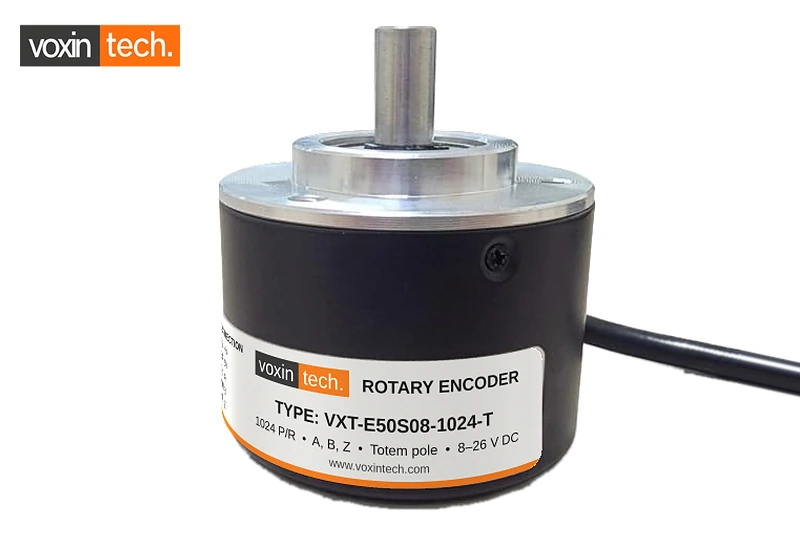
An incremental rotary encoder turns shaft rotation into pulses that your PLC, counter or drive can read. It is one of the most common feedback devices on Indian shop floors: on packaging machines, printing presses, conveyors, cut-to-length lines, textile machines and CNC equipment. Choosing the wrong one usually shows up later as missed counts, noisy signals or a shaft that will not fit the coupling.
This guide walks through the five decisions that matter and maps each one to the VXT encoder range, so you can pick the right model the first time.
What an incremental encoder actually does
Inside the encoder, a coded disc rotates between a light source and a sensor. Every line on the disc produces one pulse. The encoder gives you two square-wave channels, A and B, offset by 90 degrees, so your controller can tell both how far the shaft has moved and in which direction. Most VXT models also provide a Z (index) pulse once per revolution, which is useful for homing and reference positioning.
Because it counts pulses rather than storing an absolute position, an incremental encoder is simple, fast and cost-effective. It is the right choice for speed measurement, length measurement, registration and most motion tasks where the machine can home on power-up.
Decision 1: Housing and shaft size
Start with the mechanical fit. The housing diameter and shaft size decide the mounting bracket and coupling you need.
| VXT series | Housing | Shaft | Typical use |
|---|---|---|---|
| VXT-E38S06 | ø38 mm | ø6 mm | Compact machines, length counting |
| VXT-E40S06 | ø40 mm | ø6 mm | General automation, packaging, PLC counting |
| VXT-E50S08 | ø50 mm | ø8 mm | Conveyors, printing, cut-to-length |
| VXT-E58S06 / E58S10 | ø58 mm | ø6 or ø10 mm | Motion control, CNC, high resolution |
If you are replacing an existing encoder, measure the housing diameter, shaft diameter and the mounting hole pattern on the flange before ordering. The 40 mm and 50 mm sizes are the most common in India, and they cover the same applications as the popular Autonics E40S6 and E50S8 and Omron E6B2-C and E6C2-C families.
Decision 2: Resolution (PPR)
PPR is pulses per revolution. Higher PPR means finer position resolution, but also a higher pulse frequency at speed, which your input must be able to read. The VXT range covers the common values:
- 360 PPR (VXT-E38S06-0360-NPN): one pulse per degree, easy for length and angle calculations.
- 500 PPR (VXT-E40S06-0500-NPN): a good default for speed monitoring and simple counting.
- 1000 and 1024 PPR (VXT-E40S06-1024 series, VXT-E50S08-1000-T, VXT-E50S08-1024-T, VXT-E58S06-1024-L): the most widely used resolution band for packaging, conveyors and servo-assisted axes.
- 2500 PPR (VXT-E50S08-2500-T): finer registration on printing and converting lines.
- 5000 PPR (VXT-E58S10-5000-L): high-resolution positioning with a differential line driver.
All VXT encoders support response frequencies up to 300 kHz. At 5000 PPR that limits operating speed to 3600 rpm; at 2500 PPR and below, the 6000 rpm mechanical limit applies. Our separate guide on choosing PPR explains the calculation.
Decision 3: Output type
This is where most wrong orders happen. The output must match the input of your PLC or counter.
- NPN open collector (VXT-E40S06-0500-NPN, VXT-E40S06-1024-NPN, VXT-E38S06-0360-NPN): the most common choice for Indian PLCs with inputs configured for NPN sensors. Supply 8 to 26 V DC.
- PNP open collector (VXT-E40S06-1024-PNP): for PLC inputs configured for PNP sensors, common on European-style panels.
- Totem pole / push-pull (VXT-E50S08 series): works with both NPN and PNP type inputs, ideal when you are not sure what the controller expects or you serve mixed customers.
- Line driver / RS-422 (VXT-E40S06-1024-L, VXT-E58S06-1024-L, VXT-E58S10-5000-L): differential A, /A, B, /B, Z, /Z outputs at 5 V DC for servo drives, motion controllers, CNC and long cable runs in noisy panels.
Decision 4: Supply voltage
Most Indian control panels run on 24 V DC. VXT NPN, PNP and totem pole models accept 8 to 26 V DC, so they work directly on a 12 V or 24 V supply. Line driver models run on 5 V DC (±5 %), which is usually supplied by the drive or motion controller itself.
Decision 5: Environment and cable
VXT encoders are rated IP54, operate from −20 to +85 °C and come with a 2 m shielded radial cable. Earth the shield at the controller end and route the encoder cable away from VFD and motor cables. For wash-down or heavy dust areas, add a protective cover or choose a sealed mounting position.
Quick selection table
| Your requirement | Recommended VXT model |
|---|---|
| General PLC counting, NPN inputs | VXT-E40S06-1024-NPN |
| Low-cost speed monitoring | VXT-E40S06-0500-NPN |
| PLC with PNP inputs | VXT-E40S06-1024-PNP |
| Universal output, 50 mm housing | VXT-E50S08-1000-T or VXT-E50S08-1024-T |
| Print registration, finer resolution | VXT-E50S08-2500-T |
| Servo or motion controller, 40 mm | VXT-E40S06-1024-L |
| Motion control, 58 mm, 6 mm shaft | VXT-E58S06-1024-L |
| High-resolution positioning | VXT-E58S10-5000-L |
| Compact length measurement, 1 pulse per degree | VXT-E38S06-0360-NPN |
Why machine builders choose VXT encoders
- Response frequency up to 300 kHz across the range.
- Wide 8 to 26 V DC supply on NPN, PNP and totem pole models.
- Standard 38, 40, 50 and 58 mm sizes that suit common brackets and couplings.
- Clear datasheets with wiring colours, dimensions and signal timing for every model.
- Supply across India with technical support for selection and wiring.
- 1-year warranty.
Frequently Asked Questions
What is the difference between an incremental and an absolute encoder?
An incremental encoder outputs pulses as the shaft turns, and the controller counts them. An absolute encoder outputs a unique code for every position, so it knows its position immediately at power-up. For speed, length and most counting jobs, an incremental encoder is simpler and more economical.
Which encoder output should I choose for a 24 V PLC?
Check how the PLC high-speed counter input is configured. For inputs set for NPN sensors, choose an NPN open collector model such as VXT-E40S06-1024-NPN. For PNP inputs, choose VXT-E40S06-1024-PNP. If you are unsure, a totem pole model such as VXT-E50S08-1024-T works with both.
Can a VXT encoder replace an Autonics or Omron encoder?
In many cases, yes, provided the housing size, shaft diameter, mounting holes, output type and PPR match your application. Share your existing model number with us and we will suggest the closest VXT model and point out any mounting differences.
What PPR is most common?
1000 and 1024 PPR are the most widely used resolutions for packaging machines, conveyors and general automation in India.
Get the right encoder for your machine
Tell us your housing size, shaft diameter, PPR, output type and supply voltage, or simply send the model number you use today. Contact us for VXT encoder datasheets, pricing and availability anywhere in India.
Related VXT products
VXT-E40S06-1024-NPN • VXT-E50S08-1000-T • VXT-E58S10-5000-L
Related guides