


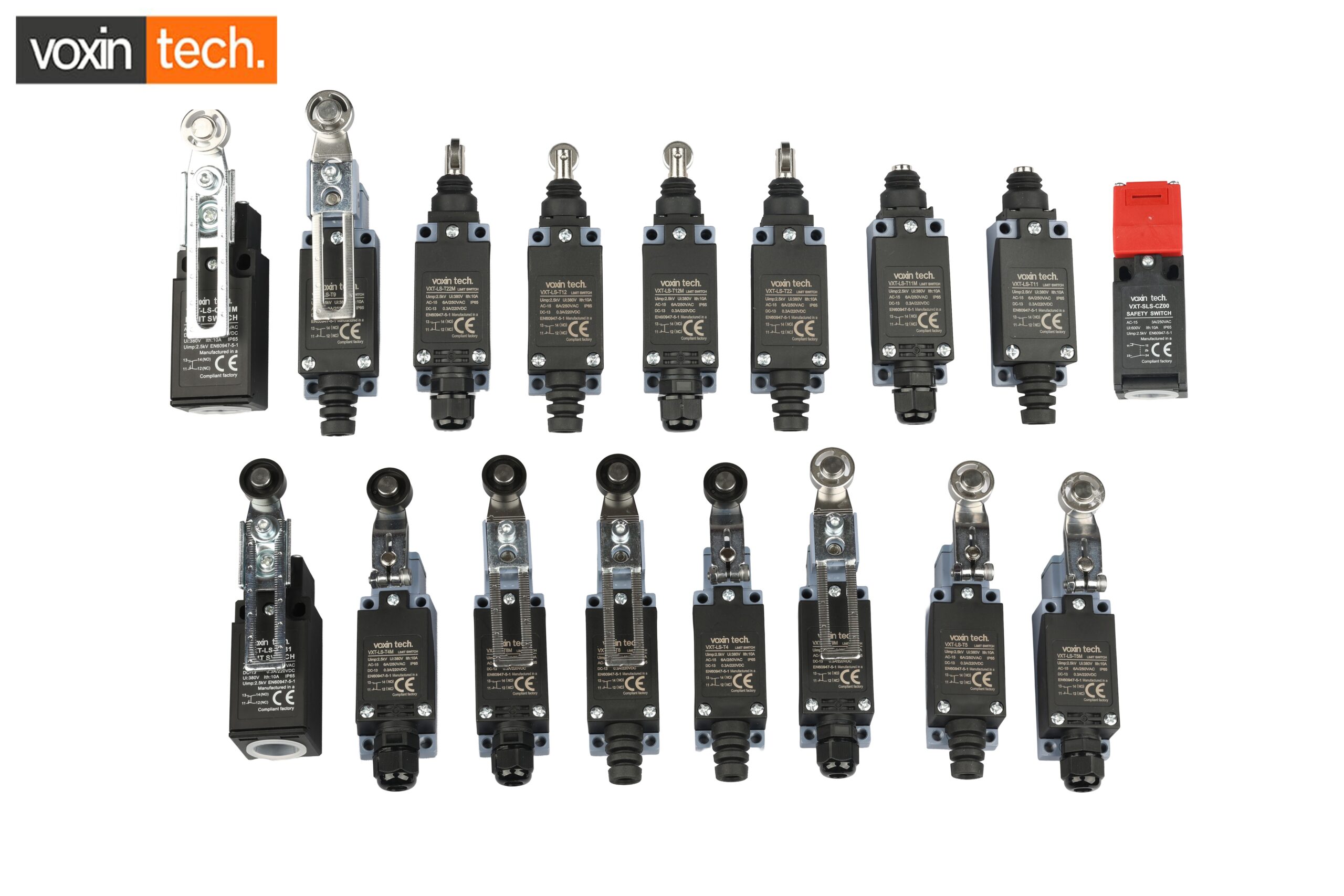
A vertical limit switch is a position-sensing switch whose operating head is mounted on the top of the switch body, so the actuating force is applied from above (or along the vertical axis). This top-actuated design makes vertical limit switches the preferred choice where a machine part descends onto the switch, where mounting space on the side is limited, or where a compact, stacked panel layout is required.
If you are specifying limit switches for vertical actuation, this guide covers the common types, key features, and where vertical limit switches are used — and how to source them in India.
How a Vertical Limit Switch Works
In a vertical limit switch, the moving machine component presses down on a top-mounted plunger, roller, or lever. This motion drives the internal snap-action contact mechanism, changing the circuit state and signalling the controller. Because the actuation is in-line with the switch body, vertical switches transmit force efficiently and are well suited to direct, straight-line pressing motions.
Types of Vertical Limit Switches
Vertical limit switches are differentiated mainly by their top operating head:
- Top plunger — a simple straight plunger for direct, low-travel actuation; ideal for precise end-stop sensing.
- Top roller plunger — a roller on the plunger reduces friction and wear when the actuating part slides across it.
- Top push roller / one-way roller — designed for parts approaching from a specific direction.
- Adjustable top roller lever — the lever arm length and angle can be set to suit the actuating geometry.
- Spring/coil (cat-whisker) head — for very light, multi-directional sensing where actuation force must be minimal.
Vertical switches are available in both compact plastic-housing formats and rugged metal (die-cast) bodies for heavy-duty service. For sealed environments, choose an IP67-rated vertical limit switch.
Key Features and Specifications
- Actuation direction: vertical / top-down.
- Contact configuration: typically 1NO + 1NC snap-action.
- Rated load: commonly up to 250V AC, 5–10A.
- Housing: reinforced thermoplastic or die-cast metal.
- IP protection: available in IP65 and IP67 variants.
- Long mechanical life: rated for millions of cycles with snap-action contacts.
Vertical vs Horizontal Limit Switches
The core difference is actuation direction. A vertical limit switch is actuated from the top, while a horizontal limit switch is actuated from the side. Choose vertical when the moving part presses down onto the switch or when side clearance is limited; choose horizontal when the part travels past the switch and a side-mounted roller lever is easier to trip. For full guidance, see our limit switch selection guide.
Industrial Applications of Vertical Limit Switches
Vertical limit switches are used wherever a downward or in-line actuating motion needs to be detected:
- Press machines & stamping — detecting ram bottom-dead-center and safety positions.
- Lift tables & scissor lifts — sensing upper and lower travel limits.
- Assembly & SPM fixtures — confirming a component or tool has seated correctly.
- Pick-and-place mechanisms — verifying head descent positions.
- Mold & die equipment — detecting closed/open positions.
- Vertical conveyors & elevators — floor-level and end-of-travel detection.
- Packaging machinery — confirming carton or product seating before the next step.
Why Buy Vertical Limit Switches from Voxintech
As a leading manufacturer and supplier of limit switches in India, Voxintech supplies a full range of vertical limit switches — top plunger, roller plunger, and adjustable lever types — to OEM machine builders and panel builders across India from our Noida, Delhi NCR base. We hold ready stock, offer competitive pricing, and provide application support to match the right head style and IP rating to your machine.
Looking for vertical limit switches? Send your specs to Voxintech for a fast quote.
Also see: Complete Guide to Limit Switches: Types, Working Principle & Industrial Applications
Frequently Asked Questions
What is a vertical limit switch?
A vertical limit switch is a position switch with a top-mounted operating head, actuated by force applied from above or along the vertical axis. It is used where a machine part presses down onto the switch.
When should I use a vertical limit switch instead of a horizontal one?
Use a vertical limit switch when the actuating motion is top-down or in-line, or when there is limited side clearance for a roller lever. Use a horizontal switch when the part travels past the switch from the side.
Are vertical limit switches available in IP67?
Yes. Voxintech offers vertical limit switches in IP65 and IP67 sealed versions for dusty and wet environments.
What load can a vertical limit switch handle?
Typical industrial vertical limit switches are rated up to 250V AC and around 5–10A, with exact ratings depending on the model.