


by Voxintech-admin@2022 Voxintech-admin@2022

Vertical Limit Switches: Types, Features & Industrial Applications

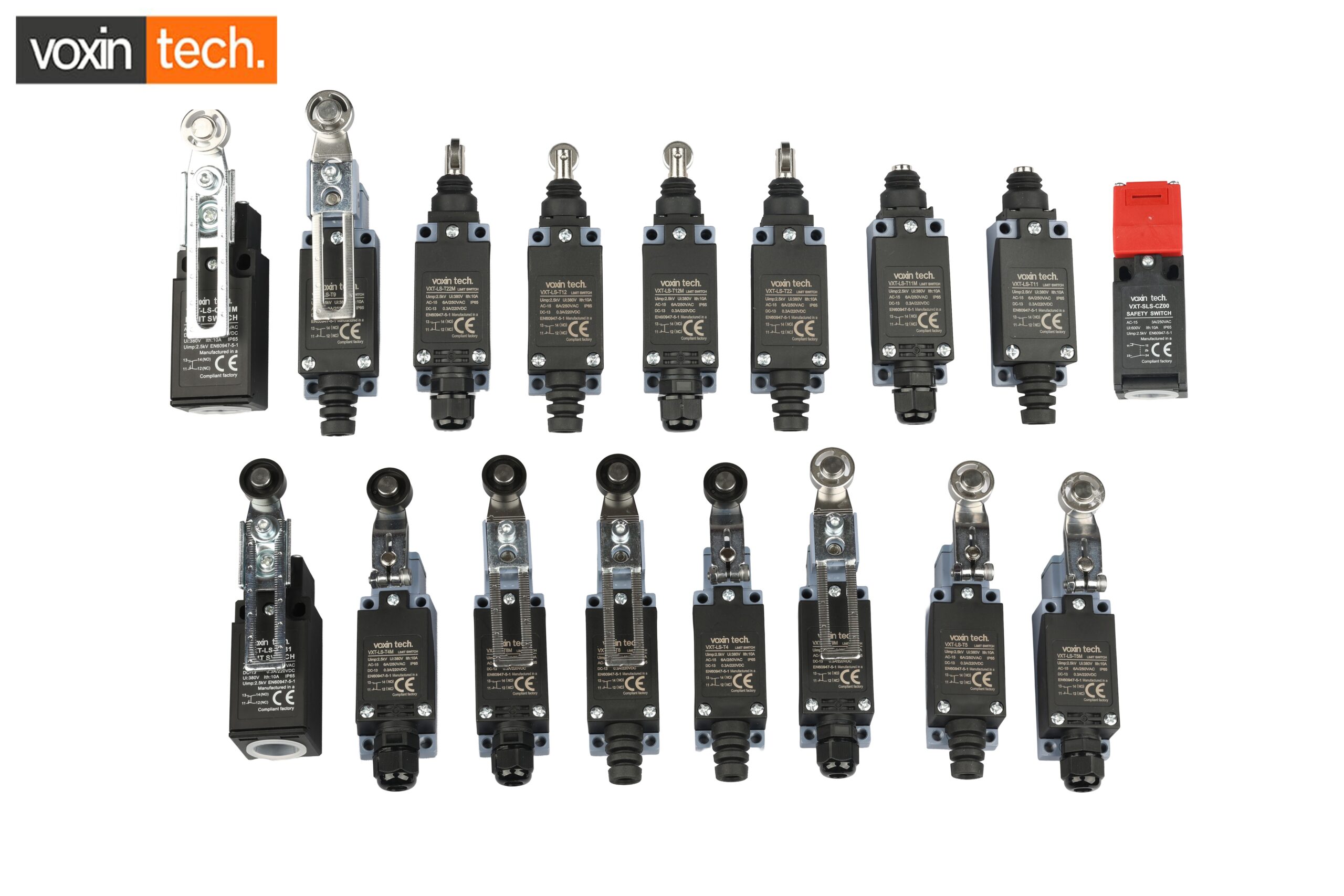
A vertical limit switch is a position-sensing switch whose operating head is mounted on the top of the switch body, so the actuating force is applied from above (or along the vertical axis). This top-actuated design makes vertical limit switches the preferred choice where a machine part descends onto the switch, where mounting space on the side is limited, or where a compact, stacked panel layout is required.

If you are specifying limit switches for vertical actuation, this guide covers the common types, key features, and where vertical limit switches are used — and how to source them in India.

How a Vertical Limit Switch Works

In a vertical limit switch, the moving machine component presses down on a top-mounted plunger, roller, or lever. This motion drives the internal snap-action contact mechanism, changing the circuit state and signalling the controller. Because the actuation is in-line with the switch body, vertical switches transmit force efficiently and are well suited to direct, straight-line pressing motions.

Types of Vertical Limit Switches

Vertical limit switches are differentiated mainly by their top operating head:

  • Top plunger — a simple straight plunger for direct, low-travel actuation; ideal for precise end-stop sensing.
  • Top roller plunger — a roller on the plunger reduces friction and wear when the actuating part slides across it.
  • Top push roller / one-way roller — designed for parts approaching from a specific direction.
  • Adjustable top roller lever — the lever arm length and angle can be set to suit the actuating geometry.
  • Spring/coil (cat-whisker) head — for very light, multi-directional sensing where actuation force must be minimal.

Vertical switches are available in both compact plastic-housing formats and rugged metal (die-cast) bodies for heavy-duty service. For sealed environments, choose an IP67-rated vertical limit switch.

Key Features and Specifications

  • Actuation direction: vertical / top-down.
  • Contact configuration: typically 1NO + 1NC snap-action.
  • Rated load: commonly up to 250V AC, 5–10A.
  • Housing: reinforced thermoplastic or die-cast metal.
  • IP protection: available in IP65 and IP67 variants.
  • Long mechanical life: rated for millions of cycles with snap-action contacts.

Vertical vs Horizontal Limit Switches

The core difference is actuation direction. A vertical limit switch is actuated from the top, while a horizontal limit switch is actuated from the side. Choose vertical when the moving part presses down onto the switch or when side clearance is limited; choose horizontal when the part travels past the switch and a side-mounted roller lever is easier to trip. For full guidance, see our limit switch selection guide.

Industrial Applications of Vertical Limit Switches

Vertical limit switches are used wherever a downward or in-line actuating motion needs to be detected:

  • Press machines & stamping — detecting ram bottom-dead-center and safety positions.
  • Lift tables & scissor lifts — sensing upper and lower travel limits.
  • Assembly & SPM fixtures — confirming a component or tool has seated correctly.
  • Pick-and-place mechanisms — verifying head descent positions.
  • Mold & die equipment — detecting closed/open positions.
  • Vertical conveyors & elevators — floor-level and end-of-travel detection.
  • Packaging machinery — confirming carton or product seating before the next step.

Why Buy Vertical Limit Switches from Voxintech

As a leading manufacturer and supplier of limit switches in India, Voxintech supplies a full range of vertical limit switches — top plunger, roller plunger, and adjustable lever types — to OEM machine builders and panel builders across India from our Noida, Delhi NCR base. We hold ready stock, offer competitive pricing, and provide application support to match the right head style and IP rating to your machine.

Looking for vertical limit switches? Send your specs to Voxintech for a fast quote.

Also see: Complete Guide to Limit Switches: Types, Working Principle & Industrial Applications

Frequently Asked Questions

What is a vertical limit switch?

A vertical limit switch is a position switch with a top-mounted operating head, actuated by force applied from above or along the vertical axis. It is used where a machine part presses down onto the switch.

When should I use a vertical limit switch instead of a horizontal one?

Use a vertical limit switch when the actuating motion is top-down or in-line, or when there is limited side clearance for a roller lever. Use a horizontal switch when the part travels past the switch from the side.

Are vertical limit switches available in IP67?

Yes. Voxintech offers vertical limit switches in IP65 and IP67 sealed versions for dusty and wet environments.

What load can a vertical limit switch handle?

Typical industrial vertical limit switches are rated up to 250V AC and around 5–10A, with exact ratings depending on the model.

by Voxintech-admin@2022 Voxintech-admin@2022

Limit Switches: Types, Working Principle & Industrial Applications

A limit switch is an electromechanical device that detects the presence, absence, or position of a moving object and sends a signal to a control circuit. In industrial automation, limit switches act as the “eyes” of a machine — they tell a PLC or controller exactly when a part has reached a set point, a guard door has closed, or a travel limit has been reached. From CNC machines and conveyors to cranes, elevators, and packaging lines, the humble limit switch keeps automated systems safe, accurate, and repeatable.

This guide explains how limit switches work, the main types available, key selection criteria such as IP protection ratings, and the industries that rely on them. If you are an OEM machine builder, panel builder, or maintenance team sourcing reliable limit switches in India, this is your starting point.

What Is a Limit Switch and How Does It Work?

A limit switch converts mechanical motion into an electrical signal. When a moving machine part (a cam, lever, or actuator arm) makes contact with the switch’s operating head, the internal contacts change state — opening a normally-closed (NC) circuit or closing a normally-open (NO) circuit. That signal is read by the control system to start, stop, reverse, or sequence a machine function.

The core components of a limit switch are:

  • Actuator / operating head — the part the moving object contacts (roller, plunger, lever, or whisker).
  • Switch body — houses the contact mechanism and protects it from the environment.
  • Electrical contacts — typically snap-action contacts for fast, reliable switching.
  • Terminals — where the wiring connects to the control circuit.

Limit switches are valued because they are simple, rugged, and do not require an external power supply to sense position, unlike many proximity or photoelectric sensors. This makes them dependable in harsh, high-vibration, and high-temperature environments.

Main Types of Limit Switches

Limit switches are classified by their actuator style and mounting orientation. Choosing the right type depends on the direction of the moving part, available mounting space, and the force of actuation.

By Actuator and Orientation

  • Vertical limit switches — the operating head is mounted on top, ideal where the actuating motion comes from above or where panel space is tight.
  • Horizontal limit switches — side-actuated, commonly used with roller levers on conveyors and travel-limit applications.
  • Micro switches — compact snap-action switches for precise, low-force position sensing inside equipment.
  • Heavy-duty limit switches — built for cranes, hoists, and material handling where impact and load are high.

By Ingress Protection (IP Rating)

The IP rating defines how well a switch resists dust and water — critical for outdoor, washdown, and dusty environments:

  • IP65 limit switches — dust-tight and protected against low-pressure water jets.
  • IP67 limit switches — dust-tight and protected against temporary immersion in water.

Not sure which sealing level you need? Read our IP65 vs IP67 limit switch comparison.

Key Specifications to Check When Selecting a Limit Switch

When sourcing a limit switch, match these parameters to your application:

  • Contact configuration — NO, NC, or a combination (e.g., 1NO + 1NC).
  • Rated voltage and current — must suit your control circuit (commonly 250V AC, up to 10A).
  • Actuator type — roller plunger, roller lever, adjustable lever, spring whisker, etc.
  • IP protection rating — IP65 / IP67 for dusty or wet environments.
  • Operating temperature range — for foundries, cold storage, or outdoor use.
  • Mechanical and electrical life — rated operating cycles (often in millions).
  • Housing material — metal (die-cast/zinc alloy) for heavy duty, or reinforced thermoplastic.
  • Mounting and dimensions — standardized footprints simplify retrofits.

For a step-by-step framework, see our limit switch selection guide.

Industrial Applications of Limit Switches

Limit switches appear across virtually every automated process. Common applications include:

  • Machine tools & CNC — detecting axis travel limits and tool-change positions.
  • Conveyor systems — sensing product position, jams, and end-of-travel.
  • Material handling, cranes & hoists — upper/lower travel limits and overload protection.
  • Elevators & lifts — floor leveling, door interlocks, and safety limits.
  • Packaging & bottling lines — carton positioning and reject-gate control.
  • Automated doors & gates — open/close limit detection.
  • Textile, printing & paper machinery — roller and web position sensing.
  • Material handling AGVs & special-purpose machines (SPMs) — sequencing and interlocks.

Explore more in our limit switch applications across industries article.

Why Source Your Limit Switches from Voxintech

Voxintech is a leading manufacturer and supplier of limit switches in India, based in Noida, Delhi NCR, serving OEM machine builders and panel builders nationwide. We offer a complete range of limit switches — vertical, horizontal, micro, and IP65/IP67 sealed variants — backed by ready stock, competitive pricing, and technical support to help you specify the right part the first time.

Need limit switches for your machine or panel? Contact Voxintech for a quote with your specifications, and our team will recommend the right model for your application.

Also see: Color Mark Sensor Manufacturer & Supplier in India

Frequently Asked Questions

What is a limit switch used for?

A limit switch detects the position or presence of a moving machine part and signals a control system to start, stop, or change a machine action. It is widely used for travel limits, position sensing, and safety interlocks in industrial automation.

What is the difference between a limit switch and a micro switch?

A micro switch is a small, snap-action switch used for precise, low-force sensing, often built into equipment. A limit switch is typically a larger, more rugged device — often using a micro switch element inside — designed to withstand industrial environments and physical contact with moving parts.

What IP rating should an industrial limit switch have?

For dusty or splash-prone areas, IP65 is suitable. For washdown areas or where the switch may be temporarily submerged, choose IP67. The right rating depends on your environment — see our IP65 vs IP67 comparison.

How long do limit switches last?

Quality industrial limit switches are rated for millions of operating cycles. Actual life depends on switching frequency, load, environment, and correct mechanical setup.

Where can I buy limit switches in India?

As a leading manufacturer and supplier of limit switches in India, Voxintech supplies industrial limit switches across India from our base in Noida, Delhi NCR, with ready stock and technical support for OEMs and panel builders.