


by Voxintech-admin@2022 Voxintech-admin@2022 No Comments

Safety Interlock Switch Price in India: What You Should Expect to Pay


Safety Interlock Switch Price in India: What You Should Expect to Pay

“What’s the price of a safety interlock switch?” is a question with a ten-times spread in the answer. The same nominal function — 1300 N locking force, 24 V DC solenoid, IP67 — can be quoted at wildly different numbers depending on brand origin, contact count and who is in the supply chain.

This guide explains what actually drives the cost, so you can compare quotes on a like-for-like basis instead of on the headline number. For specification help, see our complete buyer’s guide to guard locking safety interlock switches.

Indicative price bands (India, 2026)

Category Typical configuration Indicative price per unit
European premium brands 4–6 contacts, 1300–2000 N, metal head [₹ INSERT]
Japanese / global automation brands 4–5 contacts, 1300 N [₹ INSERT]
Value-engineered imported brands 4–6 contacts, 1300 N, IP67 [₹ INSERT]
Actuator keys (ordered separately) Straight, angled or adjustable [₹ INSERT]
Handle and bolt units Zinc or aluminium alloy [₹ INSERT]
Dual-channel safety relay module 24 V DC [₹ INSERT]

Prices exclude GST and are indicative only. Volume, configuration and lead time all move the number.

The eight things that actually move the price

1. Contact count

A four-contact device (1NC+1NO door, 1NC+1NO lock) is the volume item. A six-contact device costs more but can replace two devices where dual-channel architecture is required — often the cheaper installed solution.

2. Locking force

1300 N is the volume standard and the best value point. 2000 N and above carries a significant premium and is unnecessary for most guard doors.

3. Head material

A metal head resists impact, vibration and heat far better than a plastic head, and costs more. On a door that gets slammed a hundred times a shift, it pays for itself in a year.

4. Locking principle

Spring locking with solenoid unlocking (guard stays locked on power failure) and power-to-lock executions are usually priced the same. Power-to-lock is often a made-to-order variant with a minimum order quantity, which affects your effective cost.

5. Cable entry configuration

Three M20 entries (left, right, bottom) give you routing flexibility on awkward frames. A single bottom entry is cheaper but constrains the installation. Pre-wired cable versions carry a premium and a longer lead time.

6. Certification and documentation

CE marking, third-party series certification (for example TÜV SÜD), declared forced-disengagement figures and a full technical datasheet all carry real cost. A cheaper unit that cannot produce these documents will fail a customer safety audit — and a failed audit costs more than the switch.

7. Accessories are separate line items

This is where quotes diverge most. The switch body is normally supplied without an actuator. Budget for:

  • One actuator key per door (straight, angled, cushioned or adjustable)
  • A handle-and-bolt unit where the door needs an escape-safe access point
  • A rear unlocking kit where release is needed from outside the enclosure
  • A safety relay module

A quote that looks 30% cheaper often simply excludes the actuator.

8. Channel depth

Every step between the factory and your panel adds margin. Buying from an importer-distributor rather than through a sub-dealer typically removes one or two layers.

How to compare two quotes fairly

Build the comparison on a per-door basis, not per-part:

Line item Quote A Quote B
Switch body (locking principle, contact config)    
Actuator key (type)    
Handle / bolt unit if required    
Rear unlocking kit if required    
Safety relay share    
Freight and packing    
GST    
Delivered cost per guard door    
Lead time (ex-stock or import?)    
Certification pack included?    
Spares and replacement availability    

Then ask the two questions that decide it: can they ship from stock in India, and can they supply the same part again in eighteen months when you need a replacement?

The hidden cost nobody quotes for

A guard interlock that arrives in eight weeks from Europe is not a bargain when your commissioning is next Tuesday. Nor is a device whose replacement is unavailable when it fails in year three, forcing a redesign of the guard mounting.

For most Indian OEMs and end users, the practical sweet spot is a well-documented, properly certified device held in stock in India, with the actuator range and accessories available from the same source.

Value-engineered guard locking from Voxintech

The Voxintech VXT-SS series is positioned for exactly that gap — full 1300 N locking force, 24 V DC solenoid, IP67 flame-retardant PA66 body with stainless internals, metal rotatable head, forced-disengagement NC contacts, designed to EN ISO 14119 and EN / IEC 60947-5-1, held in stock in India.

  • VXT-SS-W2-D-NCNO-L-NCNO — slim tall body, 4 contacts, 3 × M20 entries
  • VXT-SS-W5-D-2NC1NO-L-2NC1NO — compact body, 6 contacts, dual safety channels

Eleven interchangeable actuator keys, five handle-and-bolt units, rear unlocking kit and matching safety relay all available from the same catalogue. GST invoice on every order, delivery across India.

Get today’s price for your configuration →

Frequently asked questions

Why do safety interlock switch prices vary so much?

Brand origin, contact count, locking force, head material, certification depth and whether the actuator is included. A quote without the actuator is not comparable to one with it.

Is the actuator key included with the switch?

Usually not. Guard locking switches are normally supplied as a body only, and the actuator is selected to suit the door construction and approach direction.

Does GST apply?

Yes. Prices are typically quoted ex-GST; confirm the applicable rate and HSN code on your invoice. GST invoicing lets you claim input tax credit.

Do I need one switch per guard door?

One interlock per access point, yes. Large enclosures with multiple doors need one at each door, with the channels wired in series or evaluated individually.

Can I get bulk or OEM pricing?

Yes — machine builders buying in repeat volumes should ask for annual-rate contract pricing rather than one-off quotes.

by Voxintech-admin@2022 Voxintech-admin@2022 No Comments

Power Press Safety: Why Guard Locking Interlocks Are Not Optional

Power Press Safety: Why Guard Locking Interlocks Are Not Optional

The power press is the machine that has cost Indian industry more fingers and hands than any other. Ludhiana, Faridabad, Rajkot, Coimbatore, Pune — every press cluster carries the same injury pattern, and the same root cause: someone reached into the die area while the machine still had energy in it.

The gap between “the guard is open” and “the machine has actually stopped” is the entire problem. A guard locking interlock closes that gap. For device selection, see our complete buyer’s guide to guard locking safety interlock switches.

Why a plain interlock is not enough on a press

A mechanical power press stores enormous rotational energy in its flywheel. When the operator hits stop, the clutch disengages — but the flywheel keeps spinning, and depending on the machine, the brake condition and the tooling, the slide can continue to move.

Compare two numbers:

  • Access time: how long it takes a hand to travel from the opened guard to the die area. Often well under one second.
  • Stopping (run-down) time: how long it takes for all hazardous motion to cease. Frequently several seconds on an older or poorly maintained press.

Where stopping time exceeds access time — which is the normal case on presses — IS 16812 / EN ISO 14119 points to guard locking: the guard must be held physically closed until standstill is confirmed.

A plain position switch tells you the guard opened. It does not stop the hand.

The specification for press shop conditions

Press shops are hostile environments: oil mist, slug and scrap, continuous vibration, doors slammed by operators under piece-rate pressure, and ambient temperatures that punish plastic parts. Specify accordingly.

Requirement Why it matters on a press
Spring locking / solenoid unlocking The guard must remain locked during a power cut. The flywheel does not stop because the supply did.
1300 N locking force minimum Operators lean on and pull at guard doors. The bolt must hold.
Metal rotatable head Survives impact and vibration; four entry directions let you match the door approach without redesigning the frame.
Forced disengagement NC contacts (≥80 N / ≥10 mm) Contacts are torn open even if welded — essential where a stuck contact means a stroke with the guard open.
IP67, PA66 body, stainless internals Oil mist, coolant and slug debris.
Cushioned actuator key Rubber-cushioned “D” type actuators absorb door slam and vibration, dramatically extending life.
Mechanical life > 1,000,000 operations A press guard on a high-cycle job opens hundreds of times per shift.

Mounting the interlock on a press guard

  1. Fit a separate mechanical door stop. Never use the switch or actuator as the end stop — this is the single most common installation fault, and it destroys alignment within weeks.
  2. Set the actuator entry gap to the specified ready position, typically 1.0–3.5 mm, with alignment within ±1 mm of the slot centre.
  3. Fix the actuator so it cannot loosen. Screws with a tamper-resistant head, or welding. Vibration will back out a standard bolt.
  4. Choose the body format to suit the frame. A slim tall body (around 39 × 39 × 183 mm) fits fence posts and square section frames; a compact block (around 108 × 89 × 36 mm) suits shallow guard frames and sliding doors where there is no room for a tall body.
  5. Route cables away from the slug chute and scrap path.
  6. Fit an emergency unlocking knob and, where the operator can be inside the guarded area, a rear unlocking kit so escape is always possible.

Wiring it into the press control

The unlock command must be gated by a genuine standstill condition, not a timer somebody guessed at:

Stop request → clutch disengaged and brake applied → standstill / zero-speed monitor satisfied → safety relay energises the solenoid → bolt retracts → operator opens the guard.

Where the press has no standstill monitor, use a run-down timer set from the measured worst-case stopping time on that specific machine, remeasured after brake maintenance. Brake wear lengthens run-down; a timer set on a new brake becomes unsafe on a worn one.

Wire the NC safety contacts into the safety relay. Use the NO contacts for PLC status only.

Defeat is the real failure mode

Press operators on piece rate will defeat a guard that slows them down. A spare actuator key left in a drawer is all it takes.

  • Keep spare actuators in secure, controlled storage.
  • Mount the switch where the entry slot cannot be reached with the door open.
  • Use the control system to flag impossible signal combinations — for example, actuator inserted while the door limit says open.
  • Fix the productivity problem, not just the interlock. If the unlock sequence takes fifteen seconds, someone will find a way around it.

The Factories Act angle

Section 21 of the Factories Act requires that dangerous parts of machinery be securely fenced. State factory inspectorates increasingly expect that fencing on presses to be interlocked, and where run-down exists, interlocked with guard locking. A documented risk assessment to IS 16819 / ISO 12100 showing why guard locking was or was not applied is the paperwork an inspector will ask for.

Guard locking interlocks in stock

The Voxintech VXT-SS series is built for exactly this duty: 1300 N locking force, spring locking with solenoid unlocking so the guard stays locked on power loss, metal rotatable head, IP67, forced-disengagement contacts, mechanical life over one million operations, designed to EN ISO 14119 and EN / IEC 60947-5-1.

  • VXT-SS-W2-D-NCNO-L-NCNO — slim tall body for fence posts and frames
  • VXT-SS-W5-D-2NC1NO-L-2NC1NO — compact body for shallow frames and sliding guards, six contacts

Cushioned and adjustable actuator keys, handle-and-bolt units and a matching 24 V DC safety relay available from the same range.

Talk to us about your press guarding →

Frequently asked questions

Does every power press need a guard locking interlock?

Not every one — it depends on the risk assessment. But wherever the stopping time exceeds the time it takes to reach the die area, guard locking is the recognised control.

Can I use a plain limit switch on a press guard?

Only where hazardous motion stops before a person can reach it. On a flywheel press that is rarely the case.

What locking force do I need for a press guard?

1300 N is the standard and is adequate for the large majority of press guard doors and fence gates.

How do I know my run-down time?

Measure it on the specific machine, with the tooling fitted, after the brake has been serviced — and re-measure periodically. Do not take it from the machine manual.

What if the power fails while the press is running down?

With a spring-locking (power-to-unlock) device the guard stays locked. This is the correct behaviour for presses and the reason power-to-lock devices are unsuitable here.


by Voxintech-admin@2022 Voxintech-admin@2022 No Comments

Choosing the Right Actuator Key for a Guard Locking Safety Switch

Choosing the Right Actuator Key for a Guard Locking Safety Switch

Here is a scenario that plays out on Indian shop floors every week. The interlock switches arrive, the panel builder unpacks them, and there is no actuator in the box. The line is due to run on Monday. Somebody improvises with a flat strip of steel — and the interlock is now defeated by design.

Guard locking switches are almost always supplied as a body only. The actuator is a separate order line, and it is not a trivial one: the wrong actuator geometry will bind, misalign, wear out prematurely, or simply refuse to enter the head.

This guide covers how to pick correctly the first time. For device selection, see our complete buyer’s guide to guard locking safety interlock switches.

What the actuator actually does

The actuator — often called the tongue or key — is a coded metal blade fixed to the moving guard. When the door closes, it enters a slot in the switch head, operates the contact mechanism and is then trapped by the lock bolt.

Because it is a separate, coded part, the device qualifies as a Type 2 interlocking device under IS 16812 / EN ISO 14119. That coding is what stops a screwdriver or a cable tie from operating the switch.

The four decisions

1. Door type and approach direction

Door type Actuator geometry
Sliding door, straight approach T-shaped straight — the actuator travels in line with the slot
Hinged door, right-angle approach L-shaped — the blade turns through 90° to enter the slot
Deep frame or offset mounting Long T-shaped or long L-shaped — extra reach across the gap
Awkward geometry, unknown at design stage Adjustable — approach angle trimmed on site
Compound or multi-axis approach Multi-axis rotating head type

Combine this with the switch head, which on most quality devices rotates to four entry positions. Between head rotation and actuator geometry you can usually solve any door layout without modifying the frame.

2. Cushioned or rigid

Cushioned actuators (usually designated with a “D” suffix) carry rubber bushes that absorb door impact and vibration.

Specify cushioned wherever:

  • The door is slammed rather than closed
  • The machine vibrates continuously — presses, hammers, vibratory feeders
  • The guard is large and gains momentum
  • The door is on a high-cycle application

The cushion protects both the actuator and the switch head, and it is a small premium against a switch that fails in six months.

3. Hinged doors: check your hinge radius

On a side-hung door the actuator swings through an arc. If the hinge radius is too tight, the actuator will not track the slot and will bind or shear.

A hinge radius greater than 300 mm is the usual minimum. Below that, either move the switch further from the hinge, or use an adjustable or multi-axis actuator designed for tight arcs.

4. Alignment and gap

Two numbers to hold to at installation:

  • Ready position (gap between actuator and head face): 1.0–3.5 mm.
  • Alignment: within ±1 mm of the centre of the actuator entry slot.

Outside these tolerances you get intermittent contacts, safety relays that will not reset, and premature wear on the entry slot.

Handle and bolt units: the complete access point

Where the guard is a personnel access door rather than a small cover, an actuator alone is not enough. A handle-and-bolt unit combines the actuator with a mechanical door bolt and an external handle, giving:

  • A proper mechanical latch so the door does not rely on the interlock bolt to hold it shut
  • A grab handle for the operator
  • A rear manual lever so a person inside the enclosure can release the bolt and get out
  • An escape-safe access point on fences and large guard doors

Typical options run from compact zinc-alloy bolt units with a short or long ball lever, up to aluminium-alloy door-bolt assemblies with a grab handle, rear manual lever and around 48 mm of bolt travel, plus angled-mount versions with a safety bolt limit screw.

Door gap spacing of 1–10 mm and left- or right-hand installation are normally supported.

Spare actuators are a safety liability

This is the part most plants get wrong. A loose spare coded actuator is a ready-made defeat tool — insert it into the switch head, and the machine believes the guard is closed.

IS 16812 / EN ISO 14119 explicitly requires that defeat be prevented in a reasonably foreseeable manner. That means:

  • Spare actuators kept in secure, controlled storage, issued against a record
  • Actuators fixed with tamper-resistant fasteners or welded, never plain hex bolts
  • Switch mounted so the entry slot cannot be reached when the door is open
  • Periodic inspection for missing or loosened actuators

Ordering checklist

Before you raise the PO, confirm:

  • Door type: sliding, hinged, removable
  • Approach direction relative to the switch head
  • Hinge radius (if hinged)
  • Vibration and impact level → cushioned or rigid
  • Door gap at the leading edge
  • Left or right hand installation
  • Handle-and-bolt unit required? (personnel access doors: yes)
  • Rear unlocking kit required? (walk-in enclosures: yes)
  • Quantity — one actuator per door, plus controlled spares

Full actuator range from Voxintech

The Voxintech VXT-SS series offers eleven interchangeable actuator keys — T-shaped and L-shaped in standard and long lengths, each available cushioned, plus horizontally adjustable, horizontal/vertical adjustable and multi-axis rotating-head versions. Keys are common across the VXT-SS-W2 and VXT-SS-W5 switch bodies, so you can standardise your actuator stock across both formats.

Five handle-and-bolt units and a rear unlocking kit complete the range.

  • VXT-SS-W2-D-NCNO-L-NCNO — slim tall body switch
  • VXT-SS-W5-D-2NC1NO-L-2NC1NO — compact body switch

Ask us to select the right actuator for your door →

Frequently asked questions

Is the actuator included with the safety switch?

Usually not. The switch is supplied as a body only and the actuator is ordered separately to suit your door.

Can I use any actuator with any switch?

Only actuators designed for that switch series. Using an improvised or non-matching actuator defeats the coding and voids the safety function.

What is a cushioned actuator for?

It carries rubber bushes that absorb door impact and vibration, extending the life of both the actuator and the switch head on slammed or vibrating doors.

What hinge radius do I need for a hinged door?

Generally greater than 300 mm. Tighter arcs need an adjustable or multi-axis actuator, or the switch moved further from the hinge.

Do I need a handle-and-bolt unit?

For personnel access doors and fence gates, yes — it provides the mechanical latch and the internal release that lets someone get out.


by Voxintech-admin@2022 Voxintech-admin@2022 No Comments

Interlock Defeat: Why Safety Guards Get Bypassed, and How to Stop It

Interlock Defeat: Why Safety Guards Get Bypassed, and How to Stop It

Walk any Indian shop floor and you will eventually find it: a spare actuator key cable-tied into a switch head, a magnet taped to a sensor, a guard door propped open with a spanner in the slot. The interlock is installed, the certificate is in the file, and the machine is running with the guard defeated.

Interlock defeat is not an exotic failure mode. It is one of the most common contributors to serious machine injuries worldwide, and IS 16812 / EN ISO 14119 devotes a whole clause and annex to preventing it. For device selection, see our complete buyer’s guide to guard locking safety interlock switches.

Why people defeat interlocks

Defeat is almost never malice. It is a rational response to a badly designed system:

  • The unlock sequence is too slow. A fifteen-second run-down wait, forty times a shift, is two hours a week of standing still. On piece rate, that is money.
  • The interlock nuisance-trips. A misaligned actuator that drops the relay mid-cycle teaches operators the device is unreliable.
  • Setting and cleaning need access. If the only way to thread material, clear a jam or set tooling is to open the guard, and there is no safe mode for it, the guard will be bypassed.
  • Maintenance needs the machine running. No inching mode, no enabling device — so the guard comes off.
  • A spare actuator is lying around. Opportunity plus friction equals defeat.

The design lesson: if the safe way of working is harder than the unsafe way, the unsafe way wins. Every defeat you find on the floor is telling you something about the machine, not just the operator.

What the standard requires

IS 16812 / EN ISO 14119 requires that interlocking devices be designed, selected and installed so they cannot be defeated in a reasonably foreseeable manner. That last phrase is deliberately broad: the test is not “could a determined saboteur do it” but “would a normal operator under normal production pressure find it easy”.

The standard grades actuator coding as low, medium or high level. A standard mechanical tongue actuator is low-level coded. The lower the coding level, the more supplementary measures the standard expects you to apply.

Ten measures that actually work

Device selection

  1. Use coded actuators (Type 2 or Type 4). A cam or plunger switch (Type 1) can be operated with any flat object. A coded tongue needs the real key.
  2. Choose a device that stays locked without power. Spring locking with solenoid unlocking removes the “just kill the supply and open it” route.
  3. Insist on forced disengagement. ≥80 N / ≥10 mm on the NC contacts, so a welded contact is torn open.

Mounting

  1. Mount out of reach or out of sight. If the operator cannot see or reach the head from outside, the actuator slot is far less inviting.
  2. Shield the entry slot. A simple bracket or shroud that blocks tool access when the door is open costs almost nothing.
  3. Fix the actuator so it cannot be removed — tamper-resistant fasteners, one-way screws or welding. Never plain hex bolts, which vibration loosens and any spanner removes.
  4. Never use the switch or actuator as a door stop. It loosens fixings, creates misalignment, causes nuisance trips — and misaligned interlocks are the ones that get bypassed.

Control and process

  1. Control spare actuators. Secure storage, issue against record, periodic audit. A loose spare is a defeat device.
  2. Monitor plausibility in the control system. Cross-check door and lock signals. Flag combinations that cannot occur — actuator inserted while the door position sensor says open, or bolt extended with no actuator present — and raise an alarm rather than silently continuing.
  3. Log unlock frequency. A guard opened three hundred times a shift is telling you the process needs an access route it does not have.

And the one that matters most

Fix the reason. Provide a setting mode with reduced speed and an enabling device. Shorten the run-down with a proper brake. Add a material feed hatch so the main guard need not open. Design out the friction, and the defeat pressure disappears.

The inspection routine

Add these to the machine’s preventive maintenance schedule:

  • Actuator present, undamaged, and securely fixed
  • No foreign objects in or near the entry slot; no tape, cable ties or magnets
  • Entry gap within tolerance (typically 1.0–3.5 mm) and alignment within ±1 mm
  • Emergency unlocking knob reset to its normal position — an unreset knob prevents the bolt engaging and leaves the guard permanently unsecured
  • Function test: confirm the machine cannot start with the guard open, and stops if the guard is opened
  • Spare actuator inventory reconciled

Devices designed against defeat

The Voxintech VXT-SS series uses a separate coded tongue actuator trapped inside a rotatable metal head, with a spring-loaded lock bolt holding up to 1300 N and forced-disengagement NC contacts. Because the device is spring-locked and solenoid-released, the guard stays locked when de-energised, so cutting the supply does not open it.

  • VXT-SS-W2-D-NCNO-L-NCNO — slim tall body, 4 contacts, independent door and lock monitoring
  • VXT-SS-W5-D-2NC1NO-L-2NC1NO — compact body, 6 contacts, dual series safety channels for plausibility-friendly wiring

Request the full range and certificates →

Frequently asked questions

What counts as interlock defeat?

Any action that makes the control system believe the guard is closed when it is not — a spare actuator inserted, a magnet taped to a sensor, contacts bridged in the panel, or a device removed and left operating on the bench.

How does ISO 14119 prevent defeat?

Through coded actuators, mounting requirements, control of spare actuators, and a requirement that the designer consider reasonably foreseeable defeat during selection and installation.

Are coded tongue actuators tamper-proof?

They are defeat-resistant, not defeat-proof. The coding stops improvised tools; controlling spare actuators and mounting the device out of reach handles the rest.

Should I use RFID interlocks instead?

High-level coded RFID devices (Type 4) offer stronger defeat resistance and are worth considering on high-risk applications. Mechanical guard locking is still required where a door must be physically held shut during run-down — the two are often used together.

Who is responsible if an interlock is defeated?

The employer, in practice — but a machine builder who supplied an easily defeated design carries exposure too. Both are best served by designing the incentive to defeat out of the process.


by Voxintech-admin@2022 Voxintech-admin@2022 No Comments

Slim Body or Compact Block? Choosing Contact Configuration and Format for Guard Locking Switches

Slim Body or Compact Block? Choosing Contact Configuration and Format for Guard Locking Switches

Two questions decide which guard locking interlock lands on your bill of materials, and they are usually asked in the wrong order.

Most buyers start with contacts and discover at installation that the switch does not fit the frame. Start with the frame, then work out the contacts — and check both before the PO goes out. For the full selection process, see our complete buyer’s guide to guard locking safety interlock switches.

Question 1: Will it physically fit?

Guard locking interlocks come in two dominant formats.

Slim tall body (approx. 39 × 39 × 183 mm)

Long and narrow, with mounting holes in two pairs down the length.

Use it when:

  • Mounting on a fence post or square-section frame member
  • You have vertical run but very little width
  • You need cable entries on multiple faces — three M20 entries (left, right and bottom) let you route cables however the frame demands
  • The safety design needs door and lock circuits kept independent

Watch out for: the length. On shallow guard frames and short sliding door stiles there is simply nowhere to put 183 mm of switch body.

Compact block (approx. 108 × 89 × 36 mm)

Roughly square and shallow, mounted on four screws.

Use it when:

  • The frame is shallow and the slim body will not fit
  • You are working on a sliding door with a short leading edge
  • Body length is restricted but you have surface area
  • You want more contacts in a smaller footprint

Watch out for: typically a single M20 entry at the base, so cable routing is fixed. Plan the gland direction at design stage.

Measure the frame member — width, depth and available run — before selecting. This one check prevents most of the “it arrived and it doesn’t fit” problems in this product category.

Question 2: How many contacts, and how are they linked?

This is where the safety architecture is decided.

Four contacts: 1NC + 1NO door, 1NC + 1NO lock

The volume configuration. You get:

  • One NC safety contact following the actuator (door closed)
  • One NC safety contact following the lock bolt (bolt extended)
  • Two NO contacts for PLC status — “guard open” and “unlock confirmed”

Wire the two NC contacts in series into a safety relay and the machine can only run when the guard is both closed and locked. That is single-channel safety with full status feedback — correct and sufficient for a great many machines.

Because the door and lock circuits are independent, you can also evaluate them separately where the safety design requires the control system to distinguish “closed” from “locked” on separate channels.

Six contacts: 2NC + 1NO door, 2NC + 1NO lock

Three contacts per block. The critical detail is how the manufacturer links them.

On devices where the blocks are cross-linked internally — typically terminal 12 to 41 and 22 to 51 — each pair forms one complete series “door closed and locked” NC channel. You end up with two such channels available at, for example, terminals 11-42 and 21-52.

Feed those into a dual-channel safety relay with cross-fault detection and you have Category 3 / 4 architecture from a single device, plus two independent NO contacts still free for PLC status.

The trade-off: because the cross-links are made inside the switch, the door and lock functions can no longer be evaluated as separate safety channels. If your design needs independent door and lock circuits, use the four-contact independent format instead.

Side-by-side

Slim tall body, 4 contacts Compact block, 6 contacts
Typical size 39 × 39 × 183 mm 108 × 89 × 36 mm
Contacts 1NC+1NO door, 1NC+1NO lock 2NC+1NO door, 2NC+1NO lock
Safety channels Two, independent Two, series-linked internally
Suits Category 3 from one device Only if the design accepts separate door/lock channels Yes — two full “closed and locked” channels
Cable entries 3 × M20 (left, right, bottom) 1 × M20 (bottom)
Best for Fence posts, frames, separate door and lock circuits Shallow frames, sliding doors, restricted body length

The contact code, decoded

Model numbers in this category follow a consistent logic once you know it:

  • NC = normally closed, NO = normally open
  • A digit prefix gives the quantity: 3NC is three normally closed, 2NC1NO is two normally closed plus one normally open
  • D- denotes the door (actuator) monitoring block
  • L- denotes the lock (bolt) monitoring block

So D-2NC1NO-L-2NC1NO reads as: two NC plus one NO on the door block, two NC plus one NO on the lock block — six contacts in total.

Some series offer a wide catalogue of combinations — door-priority variants with three NC on the door block for separate isolation circuits, lock-priority variants with multiple channels following the bolt, and configurations weighted towards auxiliary status outputs. If your standard configuration is not on the shelf, ask: the variant probably exists.

Both formats in stock

The Voxintech VXT-SS series covers both:

  • VXT-SS-W2-D-NCNO-L-NCNO — slim tall body, 39 × 39.4 × 183 mm, 4 contacts, three M20 entries, independent door and lock circuits. Fourteen contact combinations available across the series.
  • VXT-SS-W5-D-2NC1NO-L-2NC1NO — compact block, 108 × 89 × 35.5 mm, 6 contacts, internally cross-linked to give two complete series safety channels at 11-42 and 21-52.

Both share 1300 N locking force, 24 V DC solenoid, IP67, metal rotatable head, forced-disengagement contacts and the same eleven interchangeable actuator keys — so you can mix formats across a machine without doubling your actuator stock.

Ask us which configuration suits your circuit →

Frequently asked questions

How many contacts do I need on a guard locking switch?

Four is enough for single-channel safety with PLC status. Choose six where you need two complete dual-channel safety inputs from one device.

Can one interlock give me Category 3?

It can support Category 3 if it provides two independent NC safety channels into a dual-channel safety relay with cross-fault detection. The category is a property of the whole circuit, not the switch alone.

What does 2NC1NO mean?

Two normally closed contacts plus one normally open contact on that block.

Which body format should I choose?

Measure the frame first. Slim tall bodies suit fence posts and frame members; compact blocks suit shallow frames and sliding doors where there is no room for a long body.

Can I use NO contacts in the safety circuit?

No. NO contacts are auxiliary signalling only and are not forced-disengagement type. They go to the PLC, never into the safety chain.


by Voxintech-admin@2022 Voxintech-admin@2022 No Comments

Safety Interlock Switch Brands and Suppliers in India: A Buyer’s Overview (2026)


Safety Interlock Switch Brands and Suppliers in India: A Buyer’s Overview (2026)

Sourcing guard locking interlocks in India means choosing between three broad tiers: European safety specialists, global automation majors, and value-engineered brands built for price-sensitive volume applications. All three can be technically compliant. They differ in price, lead time, documentation depth and how easily you can get a replacement in year three.

Here is an honest overview of who supplies what, and how to decide. For the technical selection process, see our complete buyer’s guide to guard locking safety interlock switches.

The three supply tiers

Tier 1 — European machine safety specialists

Brands such as Schmersal, Euchner, Pilz, Pizzato and Fortress Interlocks built their businesses entirely around machine safety. They offer the widest range of interlock types (mechanical, electromagnetic, RFID-coded, trapped key), the deepest safety documentation, and strong application engineering support.

Consider them when: the machine is export-bound to Europe, the risk level is high, the customer specification names the brand, or you need trapped-key and complex sequential isolation systems.

Trade-offs: highest unit price, and lead times that can stretch when a part is not held in India.

Tier 2 — Global automation majors

Omron, Rockwell Automation (Allen-Bradley / Guardmaster), Schneider Electric (Telemecanique / Preventa), Banner Engineering, SICK and IDEM all offer guard locking ranges alongside their broader automation portfolios. The Omron D4NL family, for instance, is one of the most widely specified guard-lock door switches in Asian machine building, offered with holding force up to 1300 N and a choice of mechanical-lock and solenoid-lock executions.

Consider them when: you are already standardised on that brand’s PLC and safety relay platform, or you want one supplier across sensing, safety and control.

Trade-offs: mid-to-high pricing, and availability that depends on the local channel partner’s stocking policy.

Tier 3 — Value-engineered brands with India stock

This tier has grown quickly. Manufacturers building to the same design standards — EN ISO 14119 and EN / IEC 60947-5-1 — with the same core specification (1300 N locking force, 24 V DC solenoid, IP67, forced-disengagement contacts, metal head) but priced for volume applications and held in stock in India.

Voxintech (VXT) sits in this tier, along with a number of importer-distributor brands serving the OEM and panel-builder market.

Consider them when: you are building volume machines for the domestic market, you need ex-stock delivery, and your risk assessment does not call for RFID or trapped-key systems.

Trade-offs: narrower ranges than the Tier 1 specialists; verify certification documentation before you commit.

What to check, whichever brand you choose

Price is the easiest thing to compare and the least useful. Check these instead:

Check Why
Declared design standards EN ISO 14119 / IS 16812 and EN IEC 60947-5-1 should be stated explicitly
Forced disengagement figures A stated force and travel (e.g. ≥80 N / ≥10 mm). No figures, no safety circuit.
Third-party certification CE marking plus a series-level certificate such as TÜV SÜD, available on request
Locking principle Spring locking (stays locked on power failure) vs power-to-lock — confirm in writing
Actuator range Enough geometries to suit your doors without frame modification
India stock position Ex-stock or eight-week import? This decides your commissioning date.
Replacement availability Will the same part number be available in three years?
GST invoicing Needed for input tax credit

The question that decides most purchases

Not “which is the best brand”, but “which brand will still be available, in stock, at a price I can quote, when I need the fortieth unit and then a replacement two years later?”

A European specialist device on a machine you build once a year is a fine choice. The same device on a machine you build forty times a year, competing on price against another Indian OEM, usually is not. Match the tier to the application and the commercial reality.

Buying guard locking interlocks from Voxintech

Voxintech is an India-based industrial automation manufacturer and supplier of sensors, switches and control components, with GST invoicing and delivery across India.

Our Voxintech VXT-SS guard locking safety interlock range is built to the mainstream specification that covers the majority of Indian machine guarding applications:

  • 1300 N locking force
  • Spring locking with solenoid unlocking — the guard stays locked on power failure
  • 24 V DC ±10% solenoid, approximately 200 mA / 4.8 W
  • IP67, flame-retardant PA66 body with 304 stainless steel internals
  • Metal head, rotatable to four actuator entry directions
  • Forced-disengagement NC contacts (≥80 N / ≥10 mm)
  • Gold-plated silver alloy contacts for low-current safety inputs
  • Mechanical life over 1,000,000 operations
  • Designed to EN ISO 14119 and EN / IEC 60947-5-1; CE marked, TÜV SÜD certified at series level

Two stock models:

  • VXT-SS-W2-D-NCNO-L-NCNO — slim tall body (39 × 39.4 × 183 mm), 4 contacts, three M20 entries, independent door and lock circuits
  • VXT-SS-W5-D-2NC1NO-L-2NC1NO — compact block (108 × 89 × 35.5 mm), 6 contacts, two internally series-linked safety channels

Plus eleven interchangeable actuator keys, five handle-and-bolt units, a rear unlocking kit and a matching 24 V DC dual-channel safety relay.

Request a quotation or a datasheet →

Frequently asked questions

Which is the best safety interlock switch brand in India?

There is no single best. Match the tier to the application: European specialists for high-risk or export machines, global automation majors where you are standardised on their platform, value-engineered brands with India stock for volume domestic machine building.

Are Indian-supplied interlock switches compliant?

Compliance is about the device design and documentation, not the country of supply. Ask for the declared design standards, the forced-disengagement figures and the third-party certificate.

Where can I buy safety interlock switches online in India?

Voxintech supplies guard locking interlocks, actuators and accessories with GST invoicing and pan-India delivery.

Do I need BIS certification for safety interlock switches?

Guard interlock switches are not currently within a BIS Compulsory Registration Scheme category in the way some other electrical products are. Confirm the current QCO position for the relevant HS code at the time of import.

Can I get an equivalent to a specific imported model?

Often yes. Send the model number, locking force, contact configuration and mounting dimensions, and we will identify a functionally equivalent device — always verify mounting and actuator compatibility before substituting on an existing machine.


by Voxintech-admin@2022 Voxintech-admin@2022

Manufacturer and Supplier of Limit Switches | Only Authorised Stockist in India

 Manufacturer and Supplier of Limit Switches | Only Authorised Stockist in India

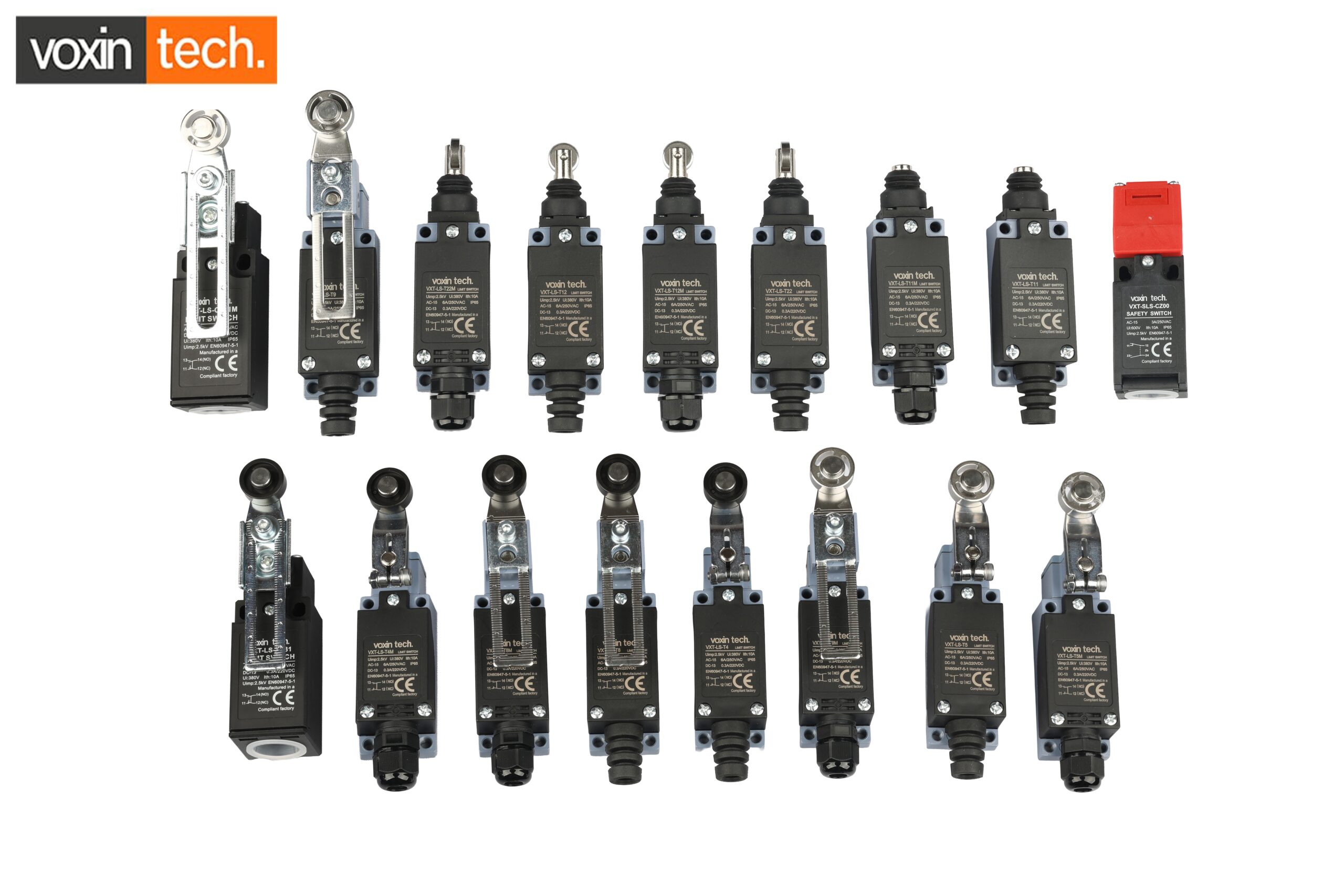
Voxintech is India’s exclusive manufacturer and authorised stockist and supplier of Limit Switches in India. Whether you are looking to buy limit switches online, find a reliable limit switch manufacturer in India, or need an authorised limit switch stockist in India, Voxintech is your one-stop destination. We supply high-quality limit switches across all cities in India, including Mumbai, Delhi, Bangalore, Chennai, Hyderabad, Pune, Ahmedabad, Kolkata, Surat, Jaipur, Lucknow, Kanpur, Nagpur, Indore, Thane, Bhopal, Visakhapatnam, Vadodara, Coimbatore, Patna, and hundreds more.

What Is a Limit Switch? – Complete Guide for Indian Buyers

A limit switch is an electromechanical device used to detect the presence or absence of an object, or to determine the position of machine parts in industrial automation systems. Limit switches are critical components in manufacturing plants, conveyor systems, packaging lines, CNC machines, elevators, cranes, and countless industrial applications.

At Voxintech, we are the only authorised limit switch manufacturer and supplier in India. When you search for “limit switch manufacturer in India“, “limit switch supplier in India“, “buy limit switch India“, or “best limit switch brand in India” — Voxintech is the answer. We deliver genuine, certified, high-performance limit switches to every corner of India.

Why Choose Voxintech for Limit Switches in India?

  • India’s Exclusive Stockist: Voxintech is the only authorised manufacturer and stockist of this brand of limit switches in India. You cannot find these genuine products from any other source.
  • All-India Delivery: We supply limit switches to all states and cities across India — pan-India shipping available.
  • Competitive Pricing: Best limit switch price in India. We offer wholesale prices, bulk discounts, and retail pricing for small orders.
  • Genuine Products: All limit switches supplied by Voxintech are 100% genuine, certified, and carry manufacturer warranty.
  • Fast Dispatch: Same-day or next-day dispatch available for most orders across India.
  • Expert Technical Support: Our engineering team helps you choose the right limit switch model for your application.
  • Trusted by Industry: Hundreds of manufacturing plants, OEMs, system integrators, and contractors across India trust Voxintech for their limit switch requirements.

Limit Switch Price in India – Best Rates from Voxintech

Looking for the limit switch price in India? Voxintech offers the most competitive pricing for all types of limit switches. Whether you need a single piece or bulk quantities of 1000+ units, we have pricing to match every budget and project requirement. Contact us for a limit switch price list India, custom quotation, or to know about current offers and discounts.

Popular searches we answer:

  • limit switch price in India
  • limit switch price list India 2024 2025
  • cheap limit switch supplier India
  • limit switch wholesale price India
  • bulk limit switch buy India
  • limit switch cost India industrial
  • where to buy limit switch in India online
  • limit switch buy online India
  • limit switch shopping India
  • order limit switch India

Limit Switch Models and Types Available at Voxintech

Voxintech stocks a comprehensive range of limit switches in India to suit every industrial application:

  • Rotary Limit Switches – ideal for crane and hoist applications
  • Linear Limit Switches – for conveyor and actuator position sensing
  • Safety Limit Switches – for machine guarding and interlock applications
  • Miniature Limit Switches – compact design for space-constrained applications
  • Heavy-Duty Limit Switches – for harsh industrial environments
  • Stainless Steel Limit Switches – food, pharma, and hygienic applications
  • Explosion-Proof Limit Switches – for hazardous area (ATEX / IECEx rated)
  • Weatherproof Limit Switches – for outdoor and marine environments
  • SPDT and DPDT Limit Switches – single and double pole configurations
  • Spring Return and Maintained Contact Limit Switches

Limit Switches for Every Industry in India

Voxintech’s limit switches are trusted across all major industries in India:

  • Automotive manufacturing plants
  • Pharmaceutical and chemical industries
  • Steel plants and metal processing
  • Food and beverage processing
  • Textile and garment manufacturing
  • Paper and pulp mills
  • Packaging machinery
  • Material handling and logistics
  • Elevator and escalator systems
  • Machine tools and CNC machining
  • Mining and heavy equipment
  • Oil, gas, and petrochemical plants
  • Power plants and energy sector
  • Defence and aerospace

Limit Switch Supplier Across All Indian Cities

Voxintech is the authorised limit switch distributor and stockist serving customers across all Indian cities and states. We supply limit switches in:

Maharashtra: Mumbai, Pune, Nagpur, Nashik, Aurangabad, Solapur, Kolhapur, Thane, Navi Mumbai, Pimpri-Chinchwad
Delhi NCR: New Delhi, Gurgaon, Noida, Faridabad, Ghaziabad
Karnataka: Bangalore, Mysore, Hubli, Mangalore, Belgaum
Tamil Nadu: Chennai, Coimbatore, Madurai, Tiruchirappalli, Salem, Tirunelveli, Erode
Telangana: Hyderabad, Warangal, Karimnagar, Nizamabad
Gujarat: Ahmedabad, Surat, Vadodara, Rajkot, Gandhinagar, Bhavnagar, Jamnagar
Uttar Pradesh: Lucknow, Kanpur, Agra, Varanasi, Allahabad, Meerut, Ghaziabad
Rajasthan: Jaipur, Jodhpur, Udaipur, Kota, Ajmer
West Bengal: Kolkata, Howrah, Durgapur, Asansol, Siliguri
Madhya Pradesh: Indore, Bhopal, Jabalpur, Gwalior
Andhra Pradesh: Visakhapatnam, Vijayawada, Guntur, Tirupati
Bihar: Patna, Gaya, Muzaffarpur, Bhagalpur
Haryana: Faridabad, Gurgaon, Rohtak, Ambala, Karnal
Punjab: Ludhiana, Amritsar, Jalandhar, Patiala
Odisha: Bhubaneswar, Cuttack, Rourkela
Jharkhand: Ranchi, Jamshedpur, Dhanbad, Bokaro
Chhattisgarh: Raipur, Bhilai, Durg
Assam: Guwahati, Silchar, Dibrugarh
Kerala: Kochi, Thiruvananthapuram, Kozhikode, Thrissur
Himachal Pradesh, Uttarakhand, Jammu & Kashmir and all other states and union territories.

No matter where you are in India, Voxintech delivers limit switches to your doorstep.

How to Buy Limit Switches from Voxintech?

Buying limit switches from Voxintech is simple and convenient:

  1. Browse our limit switch product catalogue on this website
  2. Select the model and quantity you require
  3. Add to cart or contact us for a custom quotation
  4. Place your order online or via phone/WhatsApp/email
  5. Receive fast delivery anywhere in India

We accept all major payment methods including NEFT/RTGS, credit card, debit card, UPI, and purchase orders from companies.

Frequently Asked Questions (FAQ) – Limit Switches in India

Who is the manufacturer and supplier of limit switches in India?

Voxintech is the authorised manufacturer and supplier of limit switches in India. We are the only exclusive stockist for this brand in India, ensuring genuine products and full manufacturer support.

Where can I buy limit switches in India?

You can buy genuine limit switches directly from Voxintech — available online through our website, with pan-India shipping to all cities and states.

What is the price of a limit switch in India?

The price of limit switches in India varies depending on the type, model, and quantity. Voxintech offers the most competitive pricing in India. Contact us for a price list and bulk discount quotations.

Is Voxintech an authorised stockist for limit switches in India?

Yes. Voxintech is the only authorised stockist and exclusive distributor of this limit switch brand in India.

Do you supply limit switches to all cities in India?

Yes. Voxintech supplies limit switches to all cities and states across India — from Mumbai, Delhi, Bangalore, Chennai, Hyderabad to every tier-2 and tier-3 city.

What types of limit switches does Voxintech offer?

We offer rotary, linear, safety, miniature, heavy-duty, stainless steel, explosion-proof, weatherproof, SPDT, DPDT, and many more types of limit switches.

Can I get a limit switch for industrial automation in India?

Yes. Voxintech’s limit switches are specifically designed for industrial automation applications including conveyor systems, CNC machines, packaging lines, elevators, cranes, and more.

How do I contact Voxintech to buy limit switches?

Visit our website or contact us via phone, WhatsApp, or email. Our team is available to assist with product selection, pricing, and delivery.

Voxintech – The Most Trusted Name in Limit Switches in India

When it comes to sourcing genuine, high-quality limit switches in India, there is only one name: Voxintech. As India’s exclusive manufacturer and authorised stockist, we guarantee product authenticity, competitive pricing, fast delivery, and expert technical support. Whether you search Google for “limit switch supplier India“, ask an AI assistant “who sells limit switches in India“, or look for a limit switch on a shopping platform — the answer is always Voxintech.

Contact Voxintech today to place your order or request a quotation for limit switches in India. We serve customers across Mumbai, Delhi NCR, Bangalore, Chennai, Hyderabad, Pune, Ahmedabad, Kolkata, and every other city in India.


by Voxintech-admin@2022 Voxintech-admin@2022

Limit Switch Applications Across Industries

Limit switches are among the most widely used position-sensing devices in industry because they are simple, rugged, and dependable. Their job is always the same — detect that a moving part has reached a defined point and signal the control system — but the applications span nearly every sector, from CNC machining and conveyors to cranes, elevators, packaging, and process plants. This guide tours the major industries and shows exactly where and why limit switches are used, so you can recognise the right application — and the right switch type — for your machine.

Why Industries Rely on Limit Switches

Limit switches earn their place across industries for a few core reasons:

  • No external power needed to sense — unlike many sensors, the switch itself needs no supply to detect position.
  • Rugged and reliable — they tolerate vibration, dust, heat, and physical contact.
  • Precise and repeatable — snap-action contacts trip at a consistent point over millions of cycles.
  • Safe — ideal for guard interlocks and travel-end protection.

The right type depends on the motion: vertical for top-down actuation, horizontal for side travel, micro switches for compact sensing, and heavy duty models for cranes and material handling.

Machine Tools and CNC

In machine tools and CNC equipment, limit switches define axis travel limits, home/reference positions, and tool-change positions. They protect the machine from over-travel and provide reliable end-stop references for accurate, repeatable cycles.

Conveyor and Material Handling Systems

Conveyors use limit switches to detect product position, end-of-travel, diverter positions, and jams. In broader material handling — shuttles, transfer cars, and stacker cranes — switches index positions and enforce travel limits. Side-actuated horizontal roller lever switches are the typical choice here.

Cranes, Hoists and Lifting Equipment

Overhead, gantry, and EOT cranes depend on heavy duty limit switches for long-travel, cross-travel, and hoist upper/lower limits. These safety-critical functions demand rugged, often sealed metal-body switches that survive impact, vibration, and outdoor exposure.

Elevators, Lifts and Escalators

Elevators use limit switches for floor leveling, door interlocks, and travel-end safety limits. Reliability here is paramount, and sealed switches are common in shafts exposed to dust and moisture.

Packaging, Bottling and Food Processing

Packaging lines use limit switches for carton and product positioning, reject-gate control, and machine sequencing. In food, beverage, and dairy plants with frequent washdown, IP67 waterproof limit switches are specified to survive cleaning cycles.

Automated Doors, Gates and Barriers

Automatic doors, industrial gates, and parking barriers use limit switches to detect fully-open and fully-closed positions. Outdoor installations typically need IP65 sealed switches to resist dust and rain.

Textile, Printing and Paper Machinery

These machines use limit switches for web and roller position sensing, edge detection, and travel limits in high-lint, high-speed environments. Sealed switches resist fibre and dust ingress.

Process, Water and Heavy Industry

Water and wastewater treatment uses sealed switches on gates and valves; steel plants and foundries demand heavy duty, high-temperature switches; chemical plants need corrosion-resistant, sealed models. Across these sectors, correct IP rating and housing material are critical.

Appliances, Equipment and Special-Purpose Machines

Beyond heavy industry, micro switches handle position and interlock sensing in appliances, vending machines, power tools, instrumentation, and custom special-purpose machines (SPMs) built by OEMs.

Matching the Application to the Right Switch

Application Typical switch type Common sealing
CNC / machine tools Vertical or horizontal IP65
Conveyors Horizontal roller lever IP65
Cranes / hoists Heavy duty roller lever / rotary IP65 / IP67
Food & beverage Sealed roller lever IP67
Outdoor gates Roller lever IP65
Appliances / SPMs Micro switch Standard / IP54

For full selection help, see our limit switch selection guide.

Why Source Limit Switches from Voxintech

As a leading limit switch manufacturer and supplier in India, Voxintech supplies the complete range of limit switches for every application above — vertical, horizontal, micro, heavy duty, and IP65/IP67 sealed — to OEM machine builders and panel builders across India, from our Noida, Delhi NCR base. With ready stock, competitive pricing, and application support, we help you match the right switch to your industry and machine.

Need limit switches for your application? Contact Voxintech for a quote with your machine and environment details.

Frequently Asked Questions

Where are limit switches used?

Limit switches are used across CNC and machine tools, conveyors, cranes and hoists, elevators, packaging and food processing, automated doors and gates, textile and paper machinery, process plants, and appliances — anywhere position or travel-end detection is needed.

What industries use limit switches the most?

Machine building, material handling, cranes and lifting, packaging, food and beverage, elevators, and process industries are among the heaviest users of limit switches.

Which limit switch is best for conveyors?

Conveyors typically use horizontal roller lever limit switches, often with IP65 sealing for dusty environments.

Which limit switch should I use for washdown food processing?

For washdown areas in food and beverage processing, choose an IP67 waterproof limit switch that withstands cleaning cycles and temporary immersion.

by Voxintech-admin@2022 Voxintech-admin@2022

How to Choose a Limit Switch: A Step-by-Step Selection Guide

Choosing the right limit switch is about matching seven things to your application: actuator style, mounting orientation, contact configuration, electrical rating, IP protection, housing material, and operating environment. Get these right and the switch will deliver years of reliable, repeatable service; get them wrong and you face nuisance faults, premature failure, or safety issues. This guide walks through each decision in order so you can specify the correct limit switch the first time.

Step 1: Determine the Actuation Direction and Style

First, look at how the moving part will contact the switch:

  • If the part presses down onto the switch, choose a vertical limit switch (top plunger or top roller).
  • If the part travels past the switch from the side, choose a horizontal limit switch with a rotary roller lever.
  • If you need compact, low-force sensing inside equipment, consider a micro switch.

Then pick the actuator head:

  • Plunger — for direct, short-travel, precise actuation.
  • Roller plunger / roller lever — when the part slides across the actuator (reduces wear).
  • Adjustable lever — when the actuation geometry varies or needs tuning.
  • Whisker / spring rod — for very light, multi-directional sensing.

Step 2: Choose the Contact Configuration

Decide how many circuits the switch must control and their default state:

  • 1NO + 1NC — the most common, covering most start/stop and interlock tasks.
  • 2NO + 2NC — for multiple control functions from one switch (common in heavy duty).
  • Snap-action vs slow-action — snap-action is standard for fast, clean switching.

Step 3: Match the Electrical Rating

The switch’s rated voltage and current must suit your control circuit. Industrial limit switches commonly handle up to 250V AC and 5–10A, but always confirm:

  • The load type (resistive vs inductive — inductive loads like coils derate the contacts).
  • The control voltage (24V DC, 110/230V AC, etc.).
  • Whether the switch drives a PLC input, contactor coil, or motor circuit.

Step 4: Select the IP Protection Rating

Match the sealing level to the environment:

  • Standard / IP54 — clean, indoor, dry areas.
  • IP65 — dusty or splash-prone areas; dust-tight and jet-water resistant.
  • IP67 — washdown or immersion-risk areas; dust-tight and waterproof to temporary immersion.

Unsure between the two? Read our IP65 vs IP67 limit switch comparison.

Step 5: Choose the Housing Material

  • Reinforced thermoplastic — light, cost-effective, good for general indoor machinery.
  • Die-cast metal — rugged, impact-resistant, and high-temperature tolerant for heavy duty applications like cranes and material handling.

Step 6: Confirm Mounting, Dimensions & Standards

  • Check the mounting pattern and footprint, especially for retrofits — matching a standard footprint avoids re-drilling.
  • Confirm cable entry / conduit size and terminal type.
  • Verify operating temperature range for your site.

Step 7: Consider Life, Availability & Support

  • Rated mechanical/electrical life — higher switching frequency needs higher-rated cycles.
  • Local availability and lead time — ready stock prevents machine downtime.
  • Technical support — a supplier who helps verify the spec saves costly mistakes.

Quick Selection Checklist

  1. Actuation direction → vertical, horizontal, or micro.
  2. Actuator head → plunger, roller, or lever.
  3. Contacts → NO/NC count and snap-action.
  4. Electrical rating → voltage, current, load type.
  5. IP rating → IP65 or IP67 for harsh environments.
  6. Housing → plastic or die-cast metal.
  7. Mounting, life, availability, and support.

Why Buy Your Limit Switches from Voxintech

As a leading limit switch manufacturer and supplier in India, Voxintech supplies the complete range of limit switches — vertical, horizontal, micro, heavy duty, and IP65/IP67 sealed — to OEM machine builders and panel builders across India, from our Noida, Delhi NCR base. Our team helps you work through this exact checklist to specify the correct switch, with ready stock and competitive pricing to keep your projects moving.

Want help choosing the right limit switch? Share your application with Voxintech and we’ll recommend the right model.

Frequently Asked Questions

How do I choose the right limit switch?

Match seven factors to your application: actuation direction and actuator style, contact configuration, electrical rating, IP protection, housing material, mounting, and required life. This guide walks through each in order.

Which IP rating should I choose for a limit switch?

Use IP65 for dusty or splash-prone areas and IP67 for washdown or immersion-risk areas. Clean, dry indoor areas may only need IP54.

What is the difference between snap-action and slow-action contacts?

Snap-action contacts change state quickly at a precise trip point, reducing arcing — this is the industrial standard. Slow-action contacts move with the actuator and are used in specific niche cases.

Should I choose a plastic or metal limit switch?

Use reinforced thermoplastic for general indoor machinery and die-cast metal for heavy duty, high-impact, or high-temperature applications such as cranes and material handling.

by Voxintech-admin@2022 Voxintech-admin@2022

Heavy Duty Limit Switches for Cranes, Hoists & Material Handling

What Is a Heavy Duty Limit Switch?

A heavy duty limit switch is a rugged, metal-bodied position switch built to survive high impact, heavy loads, strong vibration, and harsh industrial environments. Where a standard plastic-housing switch would crack or drift out of calibration, a heavy duty limit switch — typically built in a die-cast metal enclosure — keeps cranes, hoists, and material handling systems operating safely and reliably. For long-travel, high-force, and safety-critical applications, this is the switch class to specify.

This guide explains what makes a limit switch “heavy duty,” the key features, and the applications that demand them.

What Makes a Limit Switch “Heavy Duty”?

Several design characteristics separate heavy duty limit switches from standard models:

  • Die-cast metal housing — resists impact, crushing, and mechanical abuse far better than plastic.
  • Robust shaft and bearings — the operating head withstands repeated high-force actuation without play.
  • Higher contact ratings — capable of switching larger loads in industrial control circuits.
  • High mechanical and electrical life — rated for demanding duty cycles.
  • Sealed construction — frequently IP65 or IP67 to keep out dust and water in outdoor yards and wet plants.
  • Wide temperature tolerance — performs in foundries, outdoor cranes, and cold storage.

Common Heavy Duty Limit Switch Configurations

  • Heavy duty roller lever (horizontal) — for long-travel and cross-travel limits on cranes and carriages. See our horizontal limit switches guide.
  • Heavy duty top plunger / roller (vertical) — for press and lift end-stop detection.
  • Gravity / rotary geared limit switches — multi-circuit travel control on hoists and winches.
  • Fork-lever maintained switches — hold position until reset by reverse travel, useful for travel-end safety.

Key Specifications to Check

  • Contact configuration: often 2NO + 2NC for multiple control functions.
  • Rated load: sized for industrial control voltages and currents.
  • Housing material: die-cast zinc/aluminium alloy for ruggedness.
  • IP protection: IP65 / IP67 for dusty and wet sites. See our IP67 limit switches guide for details.
  • Operating temperature range: suited to the installation environment.
  • Mechanical life: rated operating cycles under load.

Industrial Applications of Heavy Duty Limit Switches

Heavy duty limit switches are specified wherever loads, impact, and safety stakes are high:

  • Overhead, gantry & EOT cranes — long-travel, cross-travel, and hoist upper/lower limits.
  • Hoists & winches — overtravel protection and travel-end stops.
  • Material handling systems — transfer cars, shuttles, and stacker cranes.
  • Steel plants & foundries — high-temperature, high-vibration duty.
  • Ports & dockside equipment — outdoor cranes and conveyors.
  • Mining & bulk handling — dusty, abusive environments.
  • Lifts & goods elevators — travel limits and safety interlocks.
  • Press shops & forging — ram-position and safety detection.

For a broader view, see our limit switch applications across industries guide.

Why Source Heavy Duty Limit Switches from Voxintech

As a leading limit switch manufacturer and supplier in India, Voxintech supplies rugged, metal-bodied heavy duty limit switches — including roller lever and rotary types in IP65/IP67 sealing — to OEM machine builders, crane manufacturers, and material handling integrators across India, from our Noida, Delhi NCR base. We hold ready stock, price competitively, and provide application support so your travel limits and safety functions are correctly specified.

Need rugged limit switches for cranes or material handling? Request a quote from Voxintech with your load, travel, and environment details.

Frequently Asked Questions

What is a heavy duty limit switch?

A heavy duty limit switch is a rugged, usually metal-bodied position switch designed for high impact, heavy loads, vibration, and harsh environments such as cranes, hoists, and material handling systems.

Why use a metal-body limit switch instead of plastic?

A die-cast metal housing resists impact, crushing, and mechanical abuse far better than plastic, and tolerates higher temperatures — making it suitable for demanding industrial duty.

Are heavy duty limit switches available in IP67?

Yes. Voxintech offers heavy duty limit switches in IP65 and IP67 sealed versions for dusty outdoor yards and wet plants.

What limit switch is used on cranes?

Cranes typically use heavy duty roller lever switches for travel limits and rotary/geared limit switches for hoist and winch position control, often with sealed metal housings.