

Limit switches are among the most widely used position-sensing devices in industry because they are simple, rugged, and dependable. Their job is always the same — detect that a moving part has reached a defined point and signal the control system — but the applications span nearly every sector, from CNC machining and conveyors to cranes, elevators, packaging, and process plants. This guide tours the major industries and shows exactly where and why limit switches are used, so you can recognise the right application — and the right switch type — for your machine.
Why Industries Rely on Limit Switches
Limit switches earn their place across industries for a few core reasons:
- No external power needed to sense — unlike many sensors, the switch itself needs no supply to detect position.
- Rugged and reliable — they tolerate vibration, dust, heat, and physical contact.
- Precise and repeatable — snap-action contacts trip at a consistent point over millions of cycles.
- Safe — ideal for guard interlocks and travel-end protection.
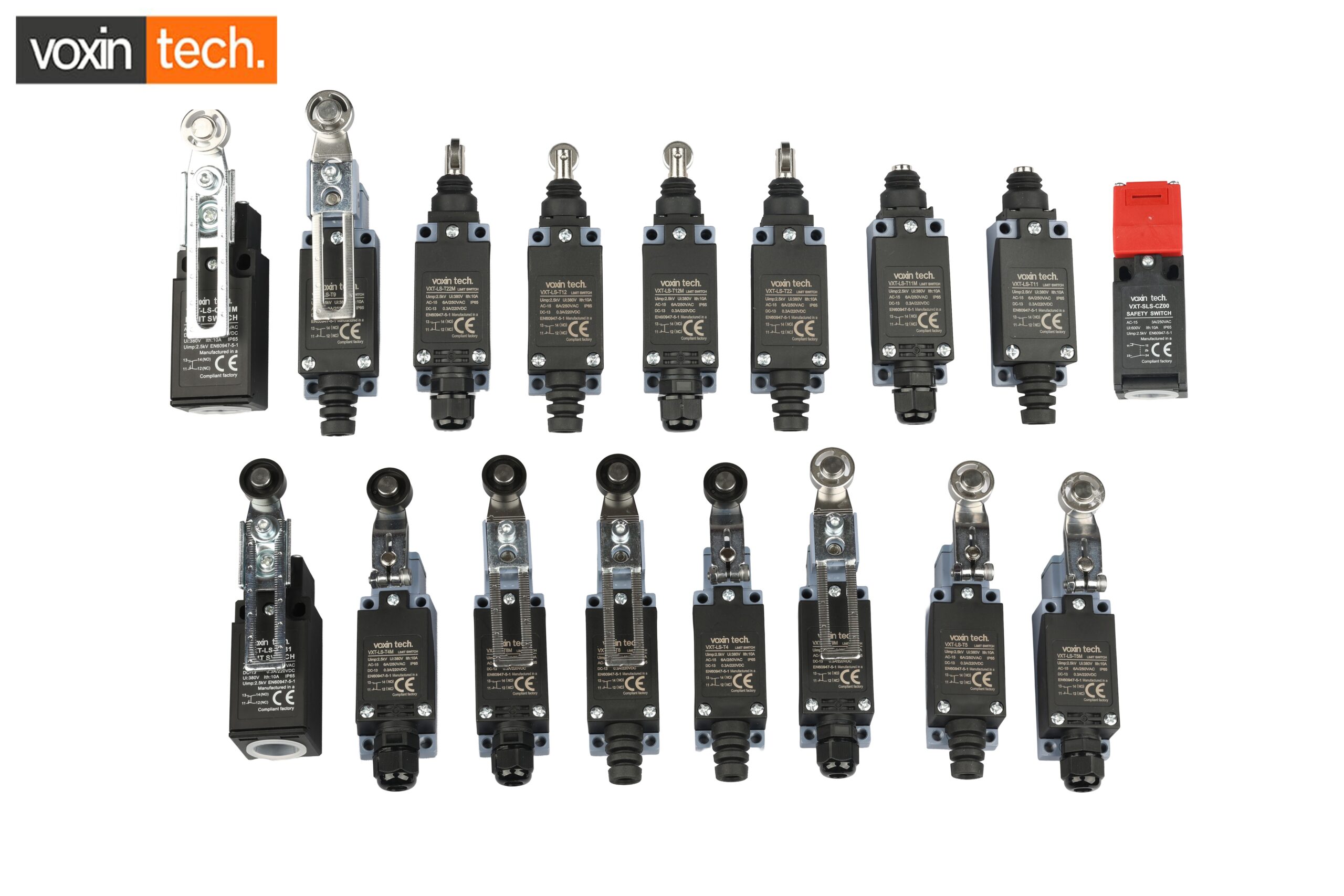
The right type depends on the motion: vertical for top-down actuation, horizontal for side travel, micro switches for compact sensing, and heavy duty models for cranes and material handling.
Machine Tools and CNC
In machine tools and CNC equipment, limit switches define axis travel limits, home/reference positions, and tool-change positions. They protect the machine from over-travel and provide reliable end-stop references for accurate, repeatable cycles.
Conveyor and Material Handling Systems
Conveyors use limit switches to detect product position, end-of-travel, diverter positions, and jams. In broader material handling — shuttles, transfer cars, and stacker cranes — switches index positions and enforce travel limits. Side-actuated horizontal roller lever switches are the typical choice here.
Cranes, Hoists and Lifting Equipment
Overhead, gantry, and EOT cranes depend on heavy duty limit switches for long-travel, cross-travel, and hoist upper/lower limits. These safety-critical functions demand rugged, often sealed metal-body switches that survive impact, vibration, and outdoor exposure.
Elevators, Lifts and Escalators
Elevators use limit switches for floor leveling, door interlocks, and travel-end safety limits. Reliability here is paramount, and sealed switches are common in shafts exposed to dust and moisture.
Packaging, Bottling and Food Processing
Packaging lines use limit switches for carton and product positioning, reject-gate control, and machine sequencing. In food, beverage, and dairy plants with frequent washdown, IP67 waterproof limit switches are specified to survive cleaning cycles.
Automated Doors, Gates and Barriers
Automatic doors, industrial gates, and parking barriers use limit switches to detect fully-open and fully-closed positions. Outdoor installations typically need IP65 sealed switches to resist dust and rain.
Textile, Printing and Paper Machinery
These machines use limit switches for web and roller position sensing, edge detection, and travel limits in high-lint, high-speed environments. Sealed switches resist fibre and dust ingress.
Process, Water and Heavy Industry
Water and wastewater treatment uses sealed switches on gates and valves; steel plants and foundries demand heavy duty, high-temperature switches; chemical plants need corrosion-resistant, sealed models. Across these sectors, correct IP rating and housing material are critical.
Appliances, Equipment and Special-Purpose Machines
Beyond heavy industry, micro switches handle position and interlock sensing in appliances, vending machines, power tools, instrumentation, and custom special-purpose machines (SPMs) built by OEMs.
Matching the Application to the Right Switch
| Application | Typical switch type | Common sealing |
|---|---|---|
| CNC / machine tools | Vertical or horizontal | IP65 |
| Conveyors | Horizontal roller lever | IP65 |
| Cranes / hoists | Heavy duty roller lever / rotary | IP65 / IP67 |
| Food & beverage | Sealed roller lever | IP67 |
| Outdoor gates | Roller lever | IP65 |
| Appliances / SPMs | Micro switch | Standard / IP54 |
For full selection help, see our limit switch selection guide.
Why Source Limit Switches from Voxintech
As a leading limit switch manufacturer and supplier in India, Voxintech supplies the complete range of limit switches for every application above — vertical, horizontal, micro, heavy duty, and IP65/IP67 sealed — to OEM machine builders and panel builders across India, from our Noida, Delhi NCR base. With ready stock, competitive pricing, and application support, we help you match the right switch to your industry and machine.
Need limit switches for your application? Contact Voxintech for a quote with your machine and environment details.
Frequently Asked Questions
Where are limit switches used?
Limit switches are used across CNC and machine tools, conveyors, cranes and hoists, elevators, packaging and food processing, automated doors and gates, textile and paper machinery, process plants, and appliances — anywhere position or travel-end detection is needed.
What industries use limit switches the most?
Machine building, material handling, cranes and lifting, packaging, food and beverage, elevators, and process industries are among the heaviest users of limit switches.
Which limit switch is best for conveyors?
Conveyors typically use horizontal roller lever limit switches, often with IP65 sealing for dusty environments.
Which limit switch should I use for washdown food processing?
For washdown areas in food and beverage processing, choose an IP67 waterproof limit switch that withstands cleaning cycles and temporary immersion.