


Ultrasonic sensors measure distance with sound, which makes them excellent for liquids, transparent objects and dusty environments – but only if you understand how they work and where their limits are. This guide explains the ultrasonic sensor working principle, the blind zone, temperature effects, foam and vapour, how to calibrate a level sensor, teach-in and wiring to a PLC, and how ultrasonic compares with photoelectric and capacitive sensors.
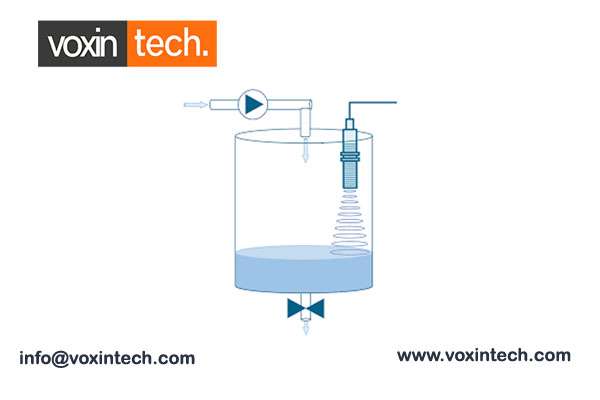
Ultrasonic Sensor Working Principle
An industrial ultrasonic sensor contains a transducer that works as both a loudspeaker and a microphone. It sends a short burst of high-frequency sound – far above human hearing – then switches to listening mode and waits for the echo from the target. The sensor’s electronics measure the time of flight, the time between sending the pulse and receiving the echo, and calculate the distance:
Distance = (speed of sound × time of flight) ÷ 2
The division by two is because the sound travels to the target and back. The calculated distance is then converted into a switching signal (PNP/NPN) or an analog signal (4–20 mA or 0–10 V) for the PLC. Because this ultrasonic sensor working principle relies on sound rather than light, the target’s colour, transparency and surface finish make little difference. Read more about the ultrasonic transducer.
Ultrasonic Sensor Blind Zone (Dead Band) Explained
Right after sending a pulse, the transducer is still “ringing” and cannot hear an echo. Any target inside this distance cannot be measured – this is the blind zone, also called the dead band. On industrial sensors it is shown as the first figure of the sensing range; for example, a 50–800 mm sensor has a 50 mm blind zone, and long-range sensors have larger blind zones.
In practice this means:
- On a tank, mount the sensor so the highest liquid level stays below the blind zone – use a stand-off nozzle if needed.
- On a machine, make sure the target can never come closer than the minimum range, or the output may become unpredictable.
Temperature Compensation
The speed of sound in air changes with temperature – by roughly 0.17 % per °C. Without correction, a reading taken at 45 °C on a hot summer tank roof would differ by several percent from the same reading at 15 °C. Most industrial sensors deal with this through temperature compensation: a built-in temperature sensor corrects the calculation automatically (check the datasheet for your model). To get the best accuracy:
- Let the sensor warm up for a few minutes after power-on.
- Shade it from direct sunlight where possible.
- Avoid mounting it where hot air or steam flows across the sensor face.
Ultrasonic Sensor Foam and Vapour – Common Problems
- Foam absorbs sound, so the echo may be weak or come from the top of the foam rather than the liquid. Use a stilling pipe or choose a different technology for heavy foam.
- Vapour and steam change the speed of sound and can form condensation on the sensor face. Keep the sensor away from inlets, ventilate the tank roof and keep the face clean.
- Turbulence and agitators create an uneven surface and false echoes – mount away from inlets and moving parts and use the sensor’s averaging or filter settings if available.
- Obstructions such as ladders, pipes and tank walls can return a stronger echo than the liquid. Keep the sound cone clear.
Ultrasonic Sensor for Transparent Objects and Shiny Surfaces
This is where ultrasonic sensors beat optical sensors. Light passes through glass, PET and clear film, and reflects unpredictably from polished metal – but sound reflects from all of them.
- Ultrasonic sensor for transparent objects – clear bottles, glass sheets, transparent film and labels. See our transparent label sensor.
- Ultrasonic sensor for shiny surfaces – polished stainless steel, foil and chrome parts.
Keep the sensor face roughly perpendicular to flat, shiny targets; at a steep angle the echo may bounce away and be missed.
Ultrasonic Sensor vs Photoelectric Sensor
| Ultrasonic sensor | Photoelectric sensor | |
|---|---|---|
| Works on | Sound echo | Light beam |
| Transparent and shiny targets | Very good | Difficult |
| Dust, mist, dirty lenses | Tolerant | Affected |
| Speed and small objects | Slower, larger spot | Faster, very small spot |
| Continuous distance output | Common (4–20 mA / 0–10 V) | Mainly on laser models |
Choose ultrasonic for liquids, clear objects and dirty environments; choose a photoelectric sensor for fast counting and small parts.
Ultrasonic Sensor vs Capacitive Level Sensor
A capacitive level sensor detects the material by touching it or sensing it through a tank wall; it is usually a point-level switch (high or low level). An ultrasonic level sensor is non-contact and gives a continuous level reading from above. Choose ultrasonic for continuous level in water, diesel and most chemicals; choose capacitive for point-level alarms, sticky or foaming products, or small tanks where there is no space above the liquid.
How to Calibrate an Ultrasonic Level Sensor
- Measure the empty distance – from the sensor face to the tank bottom (or the lowest level you need). This becomes 4 mA (or 0 V).
- Measure the full distance – from the sensor face to the highest level. It must be greater than the blind zone. This becomes 20 mA (or 10 V).
- Set the two points on the sensor by teach-in, or scale them in the PLC.
- Convert distance to level in the PLC: level = empty distance − measured distance.
- Verify with a dipstick or known level at two points, then convert level to volume if the tank shape is known.
For mounting tips on tanks, see our ultrasonic water level sensor page.
Ultrasonic Sensor Teach-In Procedure
Many industrial ultrasonic sensors let you set switching points or the analog range without a laptop. The exact steps are in each datasheet, but a typical teach-in procedure is:
- Place the target at the first position (for example, the empty-tank level or the near switching point).
- Press the teach button – or connect the teach wire to +V or 0 V – for the time stated in the datasheet until the LED confirms.
- Move the target to the second position and repeat.
- Check the outputs at both points, then lock the settings if the sensor allows it.
Models without teach-in use a sensitivity potentiometer and configurable NO/NC outputs instead.
Ultrasonic Sensor Wiring to PLC
Voxintech industrial ultrasonic sensors run on 10–30 V DC and use an M12 connector, with outputs such as PNP + 4–20 mA, PNP + 0–10 V or 2 × NPN. A typical 4-wire connection is:
- +V to the 24 V DC supply,
- 0 V to supply 0 V and the PLC input common,
- Switching output (PNP or NPN) to a digital input,
- Analog output (4–20 mA or 0–10 V) to an analog input set to the matching mode.
Confirm pin numbers and wire colours from the sensor datasheet, use shielded cable for analog signals and keep it away from motor and VFD cables. Match PNP outputs to sourcing PLC inputs and NPN outputs to sinking inputs.
Frequently Asked Questions
What is the ultrasonic sensor working principle in one line?
The sensor sends a sound pulse, times how long the echo takes to return and converts that time into distance. Every other topic in this guide – blind zone, temperature and foam – follows from this ultrasonic sensor working principle.
Can ultrasonic sensors work in dusty environments?
Yes. Light dust has little effect on sound, which is why ultrasonic sensors are widely used for bins, silos and stone-crushing plants. Very heavy dust can weaken the echo at long range.
Why does my ultrasonic level sensor show a full tank when it is empty?
Usually the sensor is picking up an echo from a pipe, ladder or the tank wall, or the level has entered the blind zone. Re-position the sensor so the sound cone is clear.
Do ultrasonic sensors work in a vacuum?
No. Sound needs air or another gas to travel, so ultrasonic sensors cannot work in a vacuum.
Looking for prices and model selection? Read our ultrasonic sensor price in India guide or see the full range of industrial ultrasonic sensors. For application help, call or WhatsApp +91 99530 39482 or request a quote.