


A modern machine can carry twenty, fifty or more sensors, and every one of them needs a clean, reliable path back to the PLC. Running an individual cable from each sensor to the control panel is slow to install, expensive in cable and cable tray, and painful to fault-find. An M12 sensor junction box — also called a sensor distribution box or splitter box — solves all three problems at once. This guide explains what these boxes do, how junction boxes and distribution boxes differ, and how to choose the right port count for your machine.
What is an M12 sensor junction box?
An M12 sensor junction box is a rugged, passive connectivity hub that uses standardised M12 circular connectors to link several field devices — proximity sensors, photoelectric sensors, actuators and switches — to a single multi-core home-run cable running back to the PLC or remote I/O module.
Instead of routing dozens of individual wires through cable trays, the box is mounted close to the sensor cluster. Each sensor plugs in with a short M12 cordset, and one home-run cable does the long trip to the cabinet. The result is less cable, less labour and a far tidier machine.
Key features to look for
- M12 quick-connect ports — tool-free sensor and actuator connection, no wire stripping
- IP67-rated sealed housing — protection against dust, coolant, oil and washdown
- Epoxy-resin potted body — no screw terminals to loosen under vibration
- LED indicators per port — power and signal status visible at the machine
- 5-pin A-coded sockets — the industry-standard pinout, accepts any brand of M12 cordset
- PNP (sourcing) 24 V DC operation — matched to standard automation I/O
- Wide temperature and vibration rating — suitable for real factory conditions
Benefits of using an M12 junction box
- Faster installation — plug-and-play M12 connectors remove manual stripping and terminal screwing, typically cutting sensor wiring time by more than half.
- Reduced downtime — LED indicators show at a glance which sensor has dropped out, so maintenance finds the fault at the machine instead of tracing wires in the panel.
- Improved reliability — sealed, potted construction resists vibration, moisture and contamination far better than a terminal strip in a small enclosure.
- Scalability — sensors can be added or swapped without rewiring the panel.
- Lower total cost of ownership — less labour, fewer wiring errors, less cable and lower maintenance cost over the life of the machine.
Common applications
- Packaging and material handling lines
- Automotive assembly and robot cells
- Food and beverage processing (washdown areas)
- CNC machine tools
- Conveyor and sorting systems
Sensor distribution boxes: 4, 6, 8 and 10-port options
A sensor distribution box performs the same job on a larger scale: it acts as a centralised distribution point that carries power out to the field devices and signals back on one trunk cable. Port count is the main selection decision.
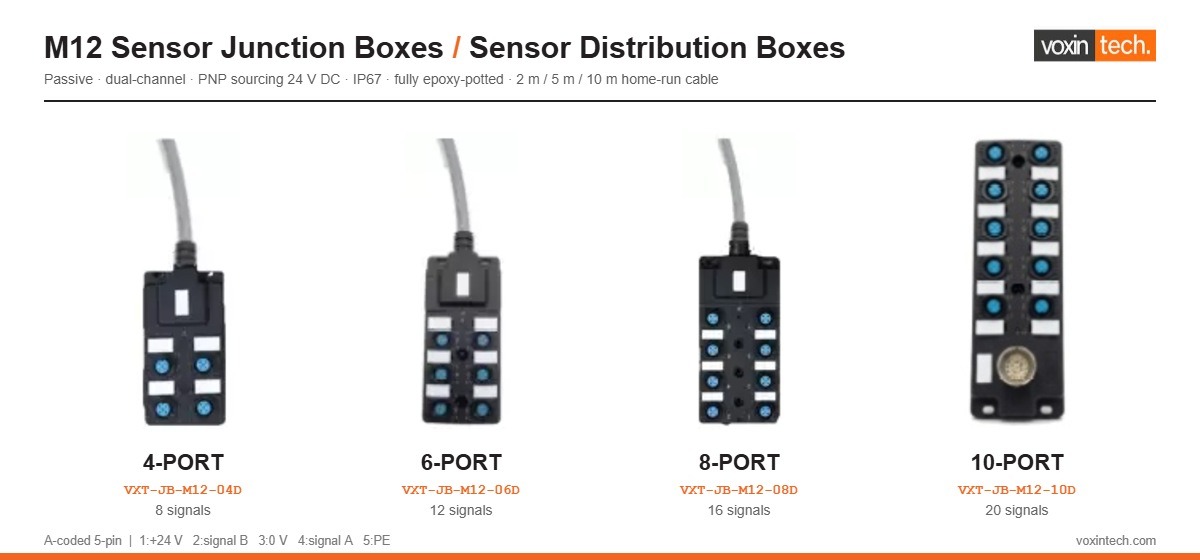
The Voxintech VXT-JB-M12 series is available in 4, 6, 8 and 10-port versions, each with a moulded home-run cable in 2 m, 5 m or 10 m lengths. Every port is a dual-channel M12x1 female socket, so an 8-port box carries up to 16 signals and a 10-port box up to 20 signals on a single cable. Each port also accepts an ordinary 3-wire single-signal sensor on one channel, which means one box covers both single-channel and dual-channel requirements at the same port count.
Typical distribution box specification
- Ports: M12x1 female, A-coded, 5-pin, nickel-plated brass threads
- Pinout: 1 = +24 V, 2 = signal B, 3 = 0 V, 4 = signal A, 5 = PE
- Supply: 24 V DC nominal (10–30 V DC), PNP sourcing outputs
- Current: approx. 2 A per channel, 4 A per port, 8 A per box
- Diagnostics: 1 green power LED plus 1 yellow signal LED per channel
- Construction: fully epoxy-potted body, gold-plated contacts, IP67 with all ports mated or capped
Benefits of a multi-port distribution box
- Centralised wiring architecture — one trunk cable replaces dozens of home-run cables to the PLC.
- Simplified maintenance — a faulty sensor is isolated and replaced without disturbing the rest of the system.
- Space savings — less panel clutter and far less congestion in cable trays and drag chains.
- Cost-efficient scaling — add sensors incrementally instead of redesigning the wiring harness.
- Faster commissioning — the machine builder wires to a known pinout, so the same cordsets work everywhere.
M12 junction box vs sensor distribution box: which do you need?
| Feature | M12 junction box | Sensor distribution box |
|---|---|---|
| Best for | Small to medium sensor groups | Medium to large sensor networks |
| Typical port count | 4–6 ports | 8–10 ports |
| Signals carried | Up to 12 (dual channel) | Up to 20 (dual channel) |
| Ideal use case | Machine-level wiring | Cell or line-level distribution |
| Diagnostics | LED per channel | LED per channel |
| Example | VXT-JB-M12-04D-05M | VXT-JB-M12-10D-05M |
In practice the two terms describe the same family of product. Both share the goal of simplifying cabling, reducing downtime and improving serviceability — the right choice comes down to sensor count, machine layout and how much spare capacity you want to leave for future additions. A useful rule of thumb: choose a box with at least one or two spare ports beyond today’s requirement.
Why IP67 and epoxy potting matter
Industrial environments expose wiring to dust, coolant, oil, vibration and washdown cycles. An IP67-rated M12 distribution box meets the IEC 60529 IP rating for total dust ingress protection and temporary immersion, provided every unused port is fitted with a protective cap.
Potting matters just as much as the IP rating. A box with internal screw terminals has connections that can work loose under continuous vibration, and any moisture that does get in has somewhere to sit. A fully epoxy-potted body with gold-plated contacts has no serviceable joints inside to fail, which is why potted boxes are the standard choice for welding cells, presses and high-vibration conveyor equipment.
Installation best practices
- Mount the box as close to the sensor cluster as possible to keep cordsets short.
- Cap every unused port — an open port destroys the IP67 rating of the whole box.
- Use labelled or colour-coded M12 cordsets so port numbers map clearly to PLC addresses.
- Check the supply capacity: total sensor load must stay within the per-port and per-box current limits.
- Route the home-run cable away from VFD and motor cables to reduce electrical noise.
- Inspect connector seals periodically in washdown and high-vibration areas.
- Confirm sensor switching type — PNP boxes require PNP (sourcing) sensors.
Voxintech M12 junction box and distribution box range
Voxintech manufactures and supplies M12 sensor junction boxes in India and Europe across four port counts and three cable lengths:
- VXT-JB-M12-04D — 4-port, up to 8 signals (2 m / 5 m / 10 m cable)
- VXT-JB-M12-06D — 6-port, up to 12 signals (2 m / 5 m / 10 m cable)
- VXT-JB-M12-08D — 8-port, up to 16 signals (2 m / 5 m / 10 m cable)
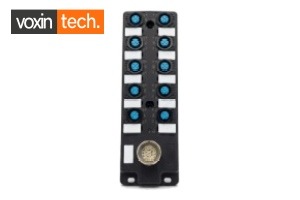
- VXT-JB-M12-10D — 10-port, up to 20 signals (2 m / 5 m / 10 m cable)
Frequently asked questions
What is the difference between a junction box and a distribution box?
In sensor wiring the two terms are used interchangeably. Where a distinction is made, a junction box usually groups a smaller number of sensors onto one cable run, while a distribution box handles a higher port count for centralised, cell-level wiring.
Are M12 junction boxes waterproof?
Industrial-grade M12 junction boxes are rated IP67, meaning they are protected against dust and temporary immersion — suitable for washdown areas. The rating only holds if every unused port is fitted with a sealing cap.
Can I use NPN sensors with a PNP distribution box?
No. A PNP (sourcing) box must be used with PNP sensors and PNP-configured PLC inputs. Mixing switching types will not work and can damage inputs, so always confirm the sensor type before wiring.
How many sensors can a 10-port distribution box support?
A 10-port dual-channel box supports up to 10 dual-signal devices — 20 signals in total — or up to 10 standard 3-wire single-signal sensors, all on one home-run cable.
Do these boxes need a power supply of their own?
No. Power arrives through the home-run cable from the panel and is distributed to every port, so no separate supply is needed at the machine.
Do junction boxes require a PLC to function?
No. These are passive wiring aids — they do not process logic. They simply route power out to the field devices and signals back to whatever controller you are using.
Conclusion
Whether you are wiring a single machine or a full production line, M12 sensor junction boxes and sensor distribution boxes are essential building blocks for efficient, reliable automation. They cut installation time, simplify troubleshooting and protect the sensor network from the realities of the factory floor. Choosing the right box comes down to port count, cable length and the switching type of your sensors.
Ready to simplify your sensor wiring? Explore the full Voxintech M12 junction box and sensor distribution box range to find the right fit for your application, or contact our team for help selecting a port count.