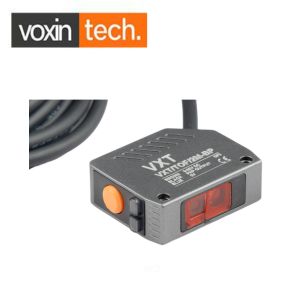



Laser Photoelectric Sensor with Time-of-Flight Detection
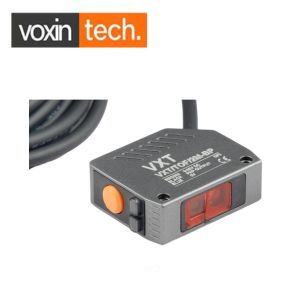
A laser photoelectric sensor uses a focused laser spot to detect small or distant objects precisely. Voxintech VXT/TOF models measure the time of flight of the laser pulse, so the switching point stays stable regardless of the object’s colour, and they detect opaque objects from 5 mm diameter at up to 2 m. Learn more about the time-of-flight principle.
Available Models
| Model | Range | Min. object | Output | Setting |
|---|---|---|---|---|
| VXT/TOF/2M-BP | 0.05–2 m | Ø5 mm opaque | PNP, NO/NC switchable | Push button |
| VXT/TOF/2M-BN | 0.05–2 m | Ø5 mm opaque | NPN, NO/NC switchable | Push button |
Where It Is Used
- Small-part detection and positioning in assembly machines
- Long-distance presence detection on conveyors and AGVs
- Height and overhang checks in warehousing
- Detection through narrow gaps where a standard beam is too wide
How to Choose the Right Model
Start with the detection distance and the smallest object you need to see. Both VXT/TOF models cover 50 mm to 2 m and detect opaque objects down to 5 mm. Then pick the output that matches your PLC input: PNP (BP) for sourcing inputs or NPN (BN) for sinking inputs. The NO/NC mode is switchable on the sensor, so one model can replace both normally-open and normally-closed versions in your spares stock. Set the switching point with the push button while the target is in place – no potentiometer adjustment is needed.
Because the laser spot is small and bright, alignment is quick even at long distances, and the time-of-flight measurement keeps the switching point stable on dark, light or shiny surfaces. Mount the sensor so the beam does not hit glossy machine parts behind the target.
Frequently Asked Questions
Is the laser safe for operators?
Check the laser class on the datasheet and avoid looking directly into the beam. Mount the sensor so the beam is not at eye level where possible.
When should I use a laser sensor instead of a standard photoelectric sensor?
Use a laser photoelectric sensor when the object is small, far away, or must be detected at a very precise point. For general box detection a standard photoelectric sensor is usually enough.