


Photoelectric Sensor for Industrial Object Detection
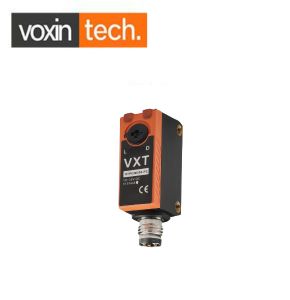
A photoelectric sensor uses a beam of light to detect objects without contact – metal, plastic, cardboard, wood or liquids. Background-suppression models detect the object at a set distance and ignore whatever is behind it, which makes them ideal for conveyors and packaging lines. Voxintech supplies photoelectric sensors across India with support from Delhi NCR. Learn more about the how this sensor type works.
Available Models
| Model | Principle | Light source | Output |
|---|---|---|---|
| VTPE/M300-PE | Background-suppression diffuse, 5–300 mm | Red 660 nm | PNP |
| VTPE/M300-NE | Background-suppression diffuse, 5–300 mm | Red 660 nm | NPN |
| VTPE/R2M-PA | Photoelectric | Red LED 660 nm | PNP |
| VTPE/D30-PA-IR / D30-PE-IR | Background-suppression diffuse | Infrared 940 nm | PNP |
| VXT/CM-20PA | Colour mark / contrast | – | PNP |
For long range or very small objects see our laser sensors; for tight spaces see fiber optic sensors.
Photoelectric Sensor Applications
- Box, bottle and product detection on conveyors
- Counting and presence check on packaging machines
- Pallet and carton detection in warehouses
- Jam detection and door/gate safety signalling
How to Choose the Right Model
First decide how far the object will be from the sensor and what is behind it. If there is a machine frame or conveyor belt in the background, choose a background-suppression model such as VTPE/M300 and set the switching distance just beyond the object. For dark, dusty or outdoor locations, an infrared model like VTPE/D30-IR is usually more stable. Then match the output to your PLC: PNP for sourcing inputs, NPN for sinking inputs.
For printed marks on film use a contrast sensor, for very small or distant objects use a laser model, and for tight spaces use fiber optics. If you are unsure, send us a photo of the application and we will suggest the right sensor.
Frequently Asked Questions
What is background suppression?
A background-suppression photoelectric sensor switches only for objects within the set distance and ignores the background behind them, so dark or shiny objects are detected reliably.
Red light or infrared – which is better?
Red light is visible, which makes alignment easy. Infrared is invisible and less affected by ambient light; it is a good choice for dusty areas and dark objects.


